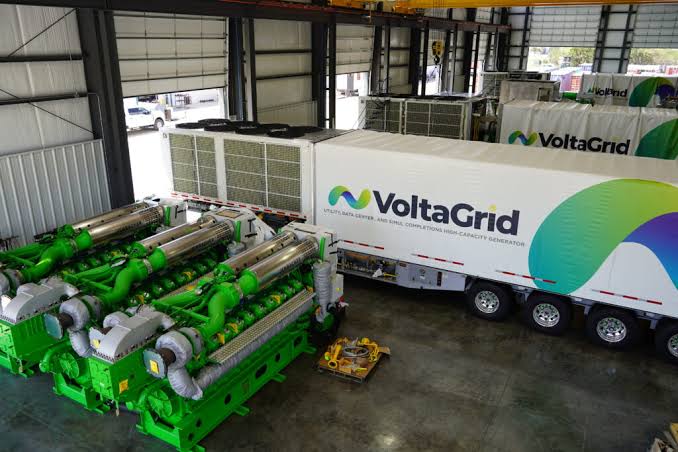
VoltaGrid LLC has secured air quality construction authorization for a 2,582 MW natural gas-fired power plant in Shackelford County, Texas, expanding its ABI-1 Electric Generating Unit to supply dedicated electricity to one of the largest artificial intelligence data center campuses in the United States.
Issued on November 19, 2026, by the Texas Commission on Environmental Quality (TCEQ), the permit scales ABI-1 up from an earlier authorization of 210 engines and 709 MW to 620 reciprocating engines across 10 independent power blocks. Unlike conventional utility generators that feed the regional transmission grid, ABI-1 will operate as a behind-the-meter microgrid delivering primary power directly to Vantage Data Centers’ planned $25 billion Frontier campus near Abilene.
Why 2.58 GW of Generation Supports a 1.4 GW Data Center
Vantage unveiled the Frontier campus in August 2025 as a 1.4 GW, 10-building development spanning 3.7 million square feet across 1,200 acres. The project is backed by DigitalBridge and Silver Lake and is projected to employ more than 5,000 workers across construction and operations.
Sizing the power plant at 2,582 MW—nearly double the data center’s 1.4 GW IT load—reflects the strict N+1 and N+2 redundancy requirements of off-grid AI compute clusters. Because ABI-1 operates independently of the Electric Reliability Council of Texas (ERCOT) transmission grid, VoltaGrid must maintain substantial reserve generation on-site to cover planned engine overhauls, ambient summer derating, and sudden mechanical trips.
Under the split ownership structure, VoltaGrid owns and operates the generating plant while Vantage owns and operates the data center campus. Construction authorization grants VoltaGrid 18 months to commence work—and forbids construction pauses exceeding 18 months—before the permit becomes void.
While hyperscale data center developers in Texas are turning to massive behind-the-meter natural gas plants to guarantee uninterrupted off-grid power, regional electric cooperatives across the Southwest are pursuing a contrasting strategy anchored in utility-scale solar and multi-hour battery storage. In neighboring New Mexico, Greenvolt Power recently broke ground on its $120 million Alamogordo hybrid project, pairing 100 MWac of solar generation with a 200 MWh battery system to supply firm renewable power to Tri-State Generation and Transmission Association.
620 Jenbacher Engines Arranged in 10 Power Blocks
Rather than relying on large combined-cycle gas turbines—which face multi-year global supply chain backlogs—VoltaGrid built ABI-1 around modular reciprocating internal combustion engines manufactured by Jenbacher:
- 250 Jenbacher J620 engines, each rated at approximately 3.22 MW
- 370 Jenbacher J624 engines, each rated at approximately 4.80 MW
Divided across 10 autonomous power blocks, the architecture isolates maintenance events so individual engine servicing never interrupts campus power. Standby units within each block are engineered to ramp up and synchronize with the microgrid within 60 to 90 seconds. Supporting balance-of-plant equipment includes 60 natural gas fuel heaters to prevent regulator freeze-ups and moisture condensation, 20 diesel-fired black-start emergency generators, 10 lubricating-oil storage tanks, and urea storage tanks for emissions abatement.
Emissions Footprint and Why Carbon Capture Was Rejected
Permit engineering reviews establish annual allowable greenhouse-gas emissions at 10,627,597 tons of carbon dioxide equivalent—including 10.62 million tons of direct carbon dioxide—making ABI-1 one of the largest single-site industrial emitters permitted in Texas. Criteria pollutant limits are capped at 569.6 tons of nitrogen oxides, 917.6 tons of carbon monoxide, and 523.1 tons of volatile organic compounds annually.
To control criteria pollutants, each engine block incorporates selective catalytic reduction (SCR) rated at 98% nitrogen oxide removal efficiency alongside oxidation catalysts achieving 95% reduction for carbon monoxide and volatile organic compounds.
During environmental review, regulators accepted VoltaGrid’s determination that post-combustion carbon capture and low-carbon fuel substitution are technically infeasible at the Shackelford County site. No carbon dioxide transport pipeline or sequestration infrastructure serves the immediate area, and neither carbon capture nor hydrogen co-firing has been commercially demonstrated at scale on four-stroke lean-burn reciprocating engines. Because ABI-1 qualifies as a major source under federal air rules, VoltaGrid must submit an initial Title V federal operating permit application before commercial operations begin and comply with continuous emissions monitoring and testing protocols.


Leave a Reply