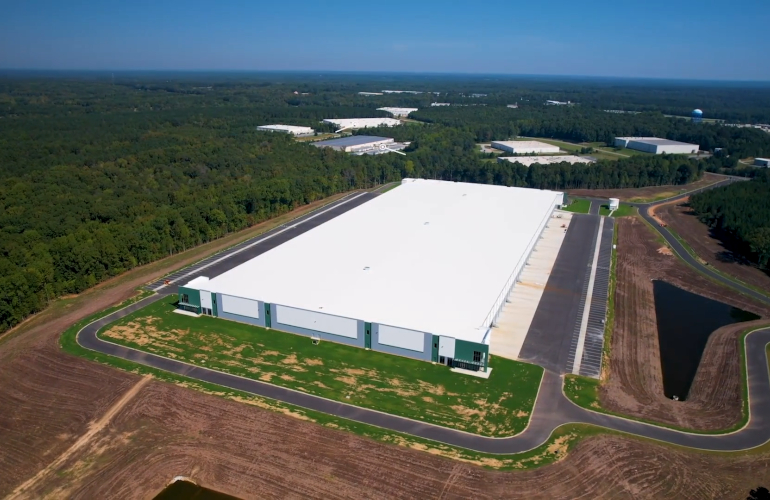
Suniva has completed an $835 million debt and equity raise to fund a 4.5 GW solar cell factory at 1200 Commerce Blvd in Laurens County, South Carolina. The company puts the project at roughly $600 million, expects it online in late 2027 and says it will create 564 jobs, lifting total US capacity to 5.5 GW.
The raise, announced on 8 September 2026, settles the financing question that had hung over the project since Suniva picked the site in April. It also lands three months later than the company had told investors to expect. In the exhibit filed with its June merger announcement, Suniva described the Laurens financing as targeted to close “later this month”, meaning June 2026. Suniva now describes the project as fully funded, and the shell of the building it will occupy as already complete.
Who put up the money
The package is layered rather than a single facility. Senior secured credit facilities came from funds managed by Goldman Sachs Alternatives and I Squared Capital, with a second lien facility from JBA Asset Management. Equity came from Electron Capital Partners, Orion Infrastructure Capital and Rubric Capital Management, alongside Lion Point Capital, the New York firm that has owned Suniva since it emerged from Chapter 11 in 2019 and remains its largest shareholder.
Orion Infrastructure Capital is the returning name. It committed $110 million in 2023 to restart and upgrade the Norcross plant, according to Suniva’s announcement of that restart in October 2023, so the Laurens equity extends a relationship rather than opening one. Roth Capital Partners acted as lead private placement agent, J.P. Morgan as sole structuring agent and Rodman & Renshaw as financial adviser, with Kilpatrick Townsend & Stockton as counsel to Suniva and Gibson, Dunn & Crutcher as counsel to Roth.
Connor Arras, managing director for climate credit at Goldman Sachs Alternatives, said the lenders took comfort from the fact that Suniva is already producing at commercial scale and holds long-term customer commitments covering its planned output. Suniva has not published the split between debt and equity, the tenor of the senior facilities or the identity of the offtakers, describing them only as leading US solar players contracted for the majority of planned future production.
The cost has risen 71% since April
The April and September numbers do not match, and the gap is the most substantive new fact in the announcement.
When the state confirmed the project on 14 April 2026, the South Carolina Department of Commerce put the investment at $350 million and said operations were expected online in 2027. Suniva’s own release the same day described a 4.5 GW plant with a projected opening in the second quarter of 2027. The September release puts the investment at approximately $600 million, completion in late 2027 and full ramp in 2028.
That is a 71% increase in stated capital cost and a slip of roughly two to three quarters, on an identical capacity target and an identical job number. Neither Suniva nor the state has explained the revision. Equipment pricing is the likeliest driver: Wood Mackenzie and SEIA reported in mid-2026 that balance-of-system equipment costs for commercial solar rose 60% year on year, with Section 232 metal tariffs pushing up prices for imported and domestic kit alike.
Even at the higher figure the project looks cheap per unit of capacity. At $600 million for 4.5 GW, Laurens works out at about $133 million per gigawatt of cell capacity. Canadian Solar’s 5 GW cell plant at Jeffersonville, Indiana was tracked at roughly $800 million by Industrial Info Resources in October 2025, or about $160 million per gigawatt, and that project is a ground-up build. The comparison is not like for like, which is the point.
A logistics shed becomes a cell fab
Suniva is not building a factory. It is fitting out an existing speculative distribution building, and that is why the capital number per gigawatt sits below its peers.
The address Suniva and the state have both given, 1200 Commerce Blvd, is the Hunter Industrial Building in Hunter Industrial Park. Laurens County Council documents reported in November 2025 by The Clinton Chronicle described the state’s listing for the property as a building of up to 621,486 square feet with 139 loading docks on 72.70 acres, then still available. Suniva’s September release gives the building as 621,468 square feet. NAI Earle Furman had been marketing it as a move-in-ready cross-dock facility.
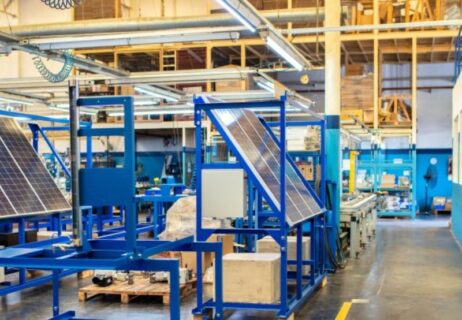
Converting a cross-dock warehouse into a cell line is a different exercise from converting one into a distribution centre. Cell manufacturing needs cleanroom conditions, high process water volumes, chemical handling and a heavy electrical load, none of which a dock-heavy logistics shed is built for. SUNation’s June filing listed contracted water and power for Laurens among its forward-looking statements, which suggests those connections were secured but not yet energised at signing. The 139 docks are largely surplus to a fab.
The precedent sits 40 miles down the road. ES Foundry’s Greenwood plant reached 3 GW of cell capacity in July 2026 inside a converted former Fujifilm building of more than 400,000 square feet, having taken an industrial box rather than a greenfield site. Laurens County had run the project under the codename Project Sunshine before the announcement, and council cleared inducement and fee-in-lieu-of-taxes agreements to bring it in. The state’s Coordinating Council for Economic Development approved job development credits, the value of which has not been published.
PERC technology and the policy exposure
Suniva’s technology choice is not incidental. SUNation’s June filing identified the combined company’s PERC technology and its scalability as a forward-looking matter, confirming Laurens will run PERC rather than TOPCon.
That is a deliberate hedge. It was reported in May 2026 that foreign-entity-of-concern rules create an intellectual property hurdle for domestic cell factories adopting mainstream TOPCon, keeping many US lines on older PERC production. PERC cells are less efficient, but the licensing path is clean, and clean licensing is what qualifies output for the Section 45X advanced manufacturing production credit and for the domestic content adder that Suniva’s module customers are buying the cells to capture.
The credit itself is the load-bearing assumption. The same pv magazine analysis noted that 45X pays $0.07 per watt on US-assembled modules and that domestic production costs frequently exceed the market price of the finished product, making the credit essential to factory profitability. Cells earn a separate per-watt rate. Treasury and the IRS issued Notice 2026-15 on 12 February 2026, and SEIA’s read of it was mixed for upstream producers: cell, wafer and polysilicon manufacturers cannot use the domestic content safe harbour tables to calculate their material assistance cost ratio, and must fall back on certification-based methods. Suniva’s own risk disclosure lists changes to 45X among the factors that could move actual results materially.
The market gap the plant is aimed at is not in dispute. SEIA’s supply chain dashboard put operational US cell capacity at about 3.2 GW against roughly 70 GW of module assembly capacity, a ratio SUNation’s filing characterised as operating cell capacity below 10% of deployed module capacity.
The Nasdaq route and what is still open
Suniva is going public through the back door while it builds. It agreed a reverse merger with SUNation Energy on 8 June 2026, under which Suniva stockholders would hold about 98.2% of the combined company and SUNation stockholders about 1.8%, subject to adjustment for SUNation’s net cash at closing. Pre-merger SUNation holders were to receive equity with an implied value of around $2.26 per share, a premium of roughly 100% to the prior close. The combined board would have five members, all designated by Suniva.
That transaction has not closed. It was targeted for the second half of 2026 and remains contingent on stockholder approvals, SEC effectiveness of a Form S-4 registration statement and Nasdaq listing clearance. SUNation reported 2025 sales of about $71.9 million and adjusted EBITDA of about $2.5 million, so the operating business Suniva is merging into is small relative to the manufacturing programme it is funding.
Several things remain unresolved. The offtake counterparties are unnamed. The debt-equity split and pricing of the $835 million are undisclosed. The reason for the cost revision has not been given. The residential end of SUNation’s business has been hit since January 2026 by the expiry of the Section 25D credit under the One Big Beautiful Bill Act, which Suniva’s own filings describe as having had a material negative impact on residential installations, and Sections 48E and 45Y are due to lapse after 2027, the year Laurens is meant to start up. Suniva’s exposure is to module makers chasing domestic content rather than to rooftop demand, but the two markets are not sealed off from each other.
Governor Henry McMaster said the expansion would create opportunities for the state’s workforce and bolster US energy independence. Laurens County Council chairman Jeff Carroll and Upstate SC Alliance chief executive John Lummus both framed it as validation of the Upstate’s advanced energy cluster, a cluster that now includes First Solar’s 3.7 GW module finishing plant at Gaffney in Cherokee County and, across the state line, the kind of large manufacturing anchors that have reshaped Georgia counties from Coweta’s battery plant onward. The Carolinas’ pull on advanced manufacturing is by now a pattern rather than a run of luck, visible in everything from cells to semiconductor fabs in North Carolina.
Key Project Data
- Project Name: Suniva Laurens County Solar Cell Manufacturing Facility
- Location: 1200 Commerce Blvd, Hunter Industrial Park, Laurens, Laurens County, South Carolina, United States
- Project Value: Approximately $600 million (Suniva, September 2026), revised up from $350 million (S.C. Department of Commerce, April 2026)
- Client/Owner: Suniva, Inc.
- Capacity: 4.5 GW of annual monocrystalline silicon solar cell capacity, taking company total above 5.5 GW
- Building: Existing speculative cross-dock building of 621,468 sq ft on 72.70 acres, shell complete, 139 loading docks
- Cell Technology: PERC
- Funding Source: $835 million debt and equity raise completed September 2026; senior secured facilities, second lien facility and equity investments
- Delivery Model: Fit-out and equipping of leased existing building
- State Incentives: Job development credits approved by the S.C. Coordinating Council for Economic Development; county inducement and fee-in-lieu-of-taxes agreements
- Jobs Created: 564 anticipated advanced manufacturing jobs
- Expected Completion: Late 2027, with full production ramp expected in 2028
Project Team
- Owner and Operator: Suniva, Inc.
- Majority Shareholder: Lion Point Capital
- Senior Secured Lenders: Funds managed by Goldman Sachs Alternatives and I Squared Capital
- Second Lien Lender: JBA Asset Management
- Equity Investors: Electron Capital Partners, Orion Infrastructure Capital, Rubric Capital Management
- Lead Private Placement Agent: Roth Capital Partners
- Sole Structuring Agent: J.P. Morgan
- Financial Adviser to Suniva: Rodman & Renshaw
- Legal Counsel to Suniva: Kilpatrick Townsend & Stockton LLP
- Legal Counsel to Placement Agent: Gibson, Dunn & Crutcher LLP
- Cell Production Ramp Consultant: ISC Konstanz (engaged from March 2025 for the Norcross ramp)
- Building Leasing Agent: NAI Earle Furman
- Economic Development Partners: Laurens County Development Corporation, South Carolina Department of Commerce, Upstate SC Alliance
- Main Contractor: Not yet disclosed
- Fit-Out and MEP Contractors: Not yet disclosed
- Equipment Suppliers: Not yet disclosed

Leave a Reply