
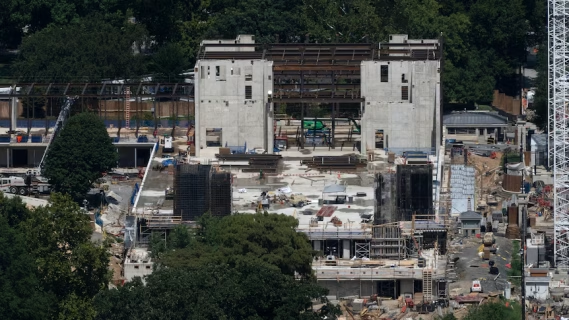
The U.S. Supreme Court voted 5-4 on August 31, 2026, allowing construction to continue on the White House’s roughly $400 million State Ballroom while a legal challenge concerning its congressional authorization moves forward in lower courts. Clark Construction and AECOM are constructing the 90,000-square-foot addition, with the structural framework expected to be completed by November and the entire project targeted for completion by August 2028.
A Legal Reprieve, Not a Final Ruling
The order settles, for the time being, a legal standoff that had threatened to bring the aboveground portion of the ballroom to a court-ordered halt. The dispute began after the National Trust for Historic Preservation sued to stop construction, arguing that a sitting president cannot independently demolish and reconstruct part of the White House without approval from Congress. U.S. District Judge Richard Leon, a George W. Bush appointee, sided with the Trust in March 2026 and ordered above-ground construction to stop, a decision the U.S. Court of Appeals for the D.C. Circuit upheld on August 7.
The administration asked the Supreme Court to step in on August 14. Chief Justice John Roberts issued a temporary administrative stay one week later, followed by the full court’s August 31 unsigned order concluding that the Trust likely does not have legal standing to bring the case — without deciding whether the project itself is lawful. Roberts sided with the court’s three liberal-leaning justices in dissent, breaking from the conservative majority. In his written opinion, he said the ruling should not be viewed as a victory for the separation of powers.
Solicitor General D. John Sauer had argued before the court that construction needed to continue without interruption, pointing to a 250-person workforce operating 20 hours a day, 7 days a week to keep the project ahead of schedule and below budget. The government also invoked a national-security argument involving an underground military installation being constructed alongside the ballroom, which the majority viewed favorably. The justices found that the injury described by the Trust amounted to little more than one member’s objection to the structure’s size and massing, which the majority said did not meet the concrete and particularized injury requirement for standing. National Trust President and CEO Brent Leggs said the organization was deeply disappointed by the Supreme Court’s decision, while emphasizing that the case remains unresolved on its merits.
The Build: Contractor, Design Changes and a Rising Price Tag
The project has expanded significantly since the White House initially announced it. Clark Construction was selected as general contractor and AECOM as lead engineer on July 31, 2025, with McCrery Architects responsible for designing a $200 million, 650-seat ballroom on the East Wing site. Demolition of the East Wing began that October, and within days it became apparent that the entire structure, rather than a partial renovation, would be demolished, increasing the estimated project cost to $300 million.
In December 2025, the White House replaced McCrery Architects with Shalom Baranes Associates as lead designer after reported disagreements over the ballroom’s scale; McCrery remained involved as a consultant. Seating capacity increased from the original 650 to as many as 1,350 during the same period, while President Trump announced another cost increase to $400 million at a White House event that month — effectively doubling the initial estimate in less than six months, as CRO reported in its coverage of the ballroom’s changing cost. The estimate has remained at roughly $400 million throughout the Supreme Court proceedings.
What’s Underway, and What’s Left
Court filings submitted with the administration’s emergency application indicate that the ballroom’s structural framework is scheduled for completion in November 2026, with much of the exterior facade expected to be finished by April 2027 and the full 90,000-square-foot building substantially completed by August 2028 — comfortably within President Trump’s second term. Underground construction has continued throughout the litigation because Judge Leon’s original order exempted security-related work below grade. This includes reconstruction of the Presidential Emergency Operations Center, the White House’s underground shelter complex, which CRO covered separately as part of the wider construction programme (CRO).
A Pattern in Trump-Era Construction Disputes
The ballroom is not the only major U.S. project under this administration to face litigation concerning federal authority. CRO has also followed the stop-start progress of the Revolution Wind offshore project off Rhode Island, which was halted by a stop-work order before a federal court issued a preliminary injunction allowing construction to resume (CRO). While that dispute focused on federal permitting authority over privately developed energy infrastructure, the ballroom case concerns presidential authority over a federal building itself — but both cases demonstrate how quickly court decisions can either accelerate or suspend active construction projects aligned with the administration’s priorities.
Washington’s Wider Building Boom
The ballroom’s legal dispute has played out alongside significant redevelopment activity elsewhere in the capital that has faced fewer legal obstacles. Several miles from the White House, The RMR Group completed the 20 Mass redevelopment at 20 Massachusetts Avenue NW, transforming a former government office building into a 274-key Royal Sonesta hotel, 183,000 square feet of Class A office space, and 13,800 square feet of retail — a project that proceeded through conventional review and procurement processes to an award-winning NAIOP DC|MD finish, unlike the ballroom’s compressed and congressionally unauthorized route. The comparison highlights a wider point about the ballroom dispute: the issue is less about Washington’s ability to deliver major construction projects, where large redevelopment schemes continue on conventional schedules, and more about the process required for an individual federal project.
Open Questions
The Supreme Court’s order leaves several issues unresolved. The justices did not determine whether construction of the ballroom is lawful, only that the Trust likely lacks standing to challenge it — leaving the underlying question for lower courts to consider even as construction progresses. Funding also remains only partially transparent: the White House says the project is being financed entirely by Trump and private donors, but it has not published a complete contributor list or disclosed individual donation amounts. And although court filings outline an accelerated construction programme, the administration has increased its cost and capacity estimates at least three times since mid-2025, leaving uncertainty over whether the current $400 million figure will remain intact through the anticipated 2028 completion.
Frequently Asked Questions
Is the White House ballroom funded by taxpayers?
The White House says the roughly $400 million project is being funded entirely by President Trump and private donors, although it has not released a complete list of contributors.
When will the White House ballroom be finished?
Court filings referenced during the Supreme Court proceedings put completion of the structural framework in November 2026, with the entire project expected to be finished by August 2028.
Can the ballroom project still be blocked in court?
Yes. The Supreme Court addressed only the National Trust’s standing to bring the lawsuit, rather than determining whether the project is lawful, leaving that issue to the lower courts.
Project Fact Sheet
- Project Name: White House State Ballroom (East Wing redevelopment)
- Location: White House campus, Washington, D.C., on the site of the demolished East Wing
- Project Value: Approximately $400 million, as announced by President Trump in December 2025, up from an initial $200 million estimate in July 2025
- Client/Owner: Executive Office of the President
- Main Contractor: Clark Construction
- Engineering: AECOM
- Lead Architect: Shalom Baranes Associates (replaced McCrery Architects in December 2025; McCrery remains a project consultant)
- Key Components: Approximately 90,000-square-foot (8,400-square-metre) ballroom with reported seating capacity of up to 1,350; adjoining reconstruction of the Presidential Emergency Operations Center below grade
- Funding Source: Private donations from President Trump and unnamed donors, according to White House statements
- Construction Start: September 2025, with East Wing demolition beginning in October 2025
- Expected Completion: Structural framework by November 2026; facade largely complete by April 2027; full completion by August 2028, according to court filings
- Workforce: Approximately 250 workers reportedly working 20-hour shifts, seven days a week, according to Solicitor General filings
Project Team
- Owner/Client: Executive Office of the President / The White House
- Main Contractor: Clark Construction
- Engineering Support: AECOM
- Lead Architect: Shalom Baranes Associates
- Original Architect/Consultant: McCrery Architects
- Plaintiff: National Trust for Historic Preservation (Brent Leggs, President and CEO)
- Government Counsel: U.S. Solicitor General D. John Sauer

Leave a Reply