
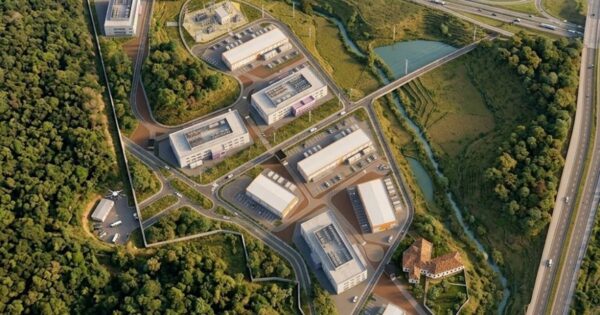
Terranova, the Latin American hyperscale platform backed by Actis, has begun construction on Campus Campinas, a data centre campus in Barão Geraldo, Campinas, São Paulo state. The first phase represents an investment of more than US$500 million for 216 MW of IT capacity, expandable to 386 MW, on a 944,000 sq m site with development phases extending through 2029.
Campinas mayor Dário Saadi handed over the construction permit at a ceremony at Fazenda Pau D’Alho on August 20, 2026, according to the municipal government. The project is the first to receive a municipal tax incentive within the Polo de Inovação para o Desenvolvimento Sustentável, the innovation district Campinas established alongside Unicamp and the region’s research institutions.
What is being built on the Pau D’Alho site
The campus covers approximately 944,000 sq m, with about 115,000 sq m allocated to buildings and around 285,000 sq m designated as green space or earmarked for donation to the municipality. Terranova has also committed to transferring public roads and water and sewage treatment facilities to the city, a detail reported by Telesíntese that has received little attention in English-language coverage.
Electrical infrastructure is central to the development. A dedicated substation with an initial 300 MW capacity is scheduled to be energised in December 2027 and can eventually scale to 1 GW. Phase one will use 216 MW for IT load. The cooling system employs a closed-loop liquid design, which Terranova says will reduce electricity consumption and effectively eliminate water use during processor cooling. The company describes it as the first liquid-cooled campus operating at scale in the region, although that should be treated as a company claim rather than a verified first, as several Brazilian developments have announced similar technology and none has yet reached operation.
Peak construction employment is expected to reach approximately 3,000 direct and indirect workers, before falling to around 650 permanent operational positions over five years. Terranova has also said it plans to establish training partnerships with regional universities and research centres, although no specific agreements have yet been identified.
The grid connection came first
The sequencing of the project is notable for anyone following Brazilian data centre development risk. Terranova obtained authorisation from the Operador Nacional do Sistema Elétrico for 300 MW of grid access at the Campinas site in December 2025, around eight months before receiving the construction permit. In a market where transmission access can be a greater constraint than land availability or capital, the ONS authorisation was the milestone that effectively enabled the rest of the project to move forward.
The same dynamic is shaping the company’s next development. Terranova controls a one million sq m site in Praia Grande on the São Paulo coast, close to the municipality’s submarine cable landing point, with completion of the acquisition dependent on ONS approval of a request for 450 MW. Then chief executive José Eduardo Quintella outlined both projects in an interview with Teletime in February 2026, where he also said Campinas was selected because of its connectivity density and the presence of hyperscalers and competitors.
Campinas is now a two-campus corridor
The site sits within what has become one of the densest concentrations of hyperscale development in Latin America. In neighbouring Paulínia, CloudHQ’s GRU Technology Campus is planned for 288 MW to 360 MW of IT capacity across six buildings, with expansion potential beyond 400 MW, against a total investment CloudHQ estimated at US$2 billion to US$3 billion when construction began in 2023. Terranova’s campus is smaller in its first phase and has a faster route to market, entering construction with grid access already secured.
Investment is coming from several directions. Tecto Data Centers, backed by BTG Pactual, committed US$2 billion through 2028 to five Brazilian sites in April 2026, including a 200 MW campus at Santana de Parnaíba. The scale compared with earlier Brazilian projects is significant. When V.tal announced its R$250 million V.O.A edge facility in Porto Alegre, the development was designed for 3 MW initially and 6 MW eventually. Campus Campinas is roughly seventy times larger on an initial-phase basis. Arizton Advisory and Intelligence projects Latin American data centre investment to exceed US$17.63 billion by 2031.
What is still unresolved
No anchor tenant has been announced. Terranova has not identified which operators will take capacity, and no cloud or hyperscale agreements have been disclosed. A 216 MW development without announced offtake represents a speculative position, even with Actis providing substantial financial backing.
No main contractor has been identified. Neither Terranova nor the municipality has named an EPC or general contractor for a development of this scale, which is notable at the construction-permit stage.
The federal tax regime anticipated by much of the sector also remains unresolved. REDATA, created through Provisional Measure 1,318/2025, expired on February 25, 2026 after the Senate failed to vote before the deadline. Its proposed replacement, Bill 278/2026, remains awaiting Senate consideration, with industry groups publicly calling for action during the August sitting. Terranova is therefore proceeding under a municipal incentive that is already in place while the proposed federal incentive remains uncertain, creating a materially different risk profile from many of the assumptions underpinning 2025 data centre announcements.
Key Project Data
- Project Name: Campus Campinas
- Location: Fazenda Pau D’Alho, Barão Geraldo, Campinas, São Paulo, Brazil
- Developer: Terranova, backed by Actis
- Project Value: More than US$500 million for phase one (Terranova, August 2026). Local media reported an initial R$5 billion rising to R$20 billion across all phases (Prefeitura de Campinas and Campinas media, August 2026)
- Site Area: Approximately 944,000 sq m, with about 115,000 sq m built and 285,000 sq m designated as green area or donated to the municipality
- IT Capacity: 216 MW in phase one, expandable to 386 MW
- Substation: 300 MW initial capacity, energisation scheduled for December 2027, expandable to 1 GW
- Grid Authorisation: 300 MW of access granted by ONS in December 2025
- Cooling: Closed-loop liquid cooling
- Construction Start: August 2026, following permit issuance on August 20, 2026
- Phasing: Additional phases scheduled through 2029
- Jobs: Approximately 3,000 direct and indirect positions at peak construction, with about 650 permanent roles over five years
- Incentives: First recipient of a municipal tax incentive within the PIDS innovation district
Project Team
- Developer and Operator: Terranova
- Investor: Actis
- Host Municipality and Permitting Authority: Prefeitura de Campinas
- Grid Access Authority: Operador Nacional do Sistema Elétrico
- Main Contractor: Not yet disclosed
- Anchor Tenant: Not yet disclosed

Leave a Reply