
Updated May 25, 2026 – Turkey’s first nuclear power plant has entered one of its most critical pre-operational stages, with Unit 1 of the Akkuyu Nuclear Power Plant now undergoing final testing and commissioning procedures ahead of 2026 operations start in the coming months. Unit 3 Akkuyu Nuclear Power Plant has also reached another key construction milestone with the installation of the main overhead crane inside the turbine hall.
Mid-2026 Update: Final Checks Underway at Unit 1
Latest May 2026 update from project developer Akkuyu Nuclear JSC confirms that inspection, hydraulic testing and functional verification activities are progressing at the Mediterranean coast project in Mersin Province as Turkey moves closer to becoming a nuclear-energy-producing nation.
According to Sergei Butckikh, General Manager of Akkuyu Nuclear JSC, the project team is currently carrying out:
- hydraulic testing of the primary circuit,
- hot and cold functional testing,
- inspection of integrated reactor systems,
- and preparations for loading imitation fuel assemblies before actual nuclear fuel operations commence.
These procedures are among the final and most technically demanding stages before a nuclear reactor enters operation.
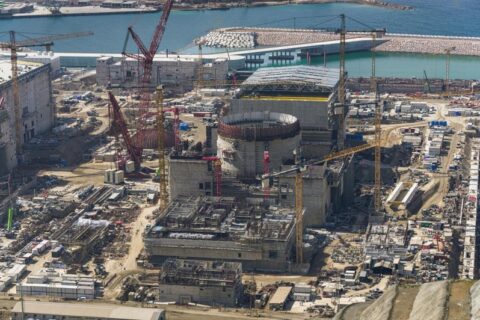
Construction and installation works are also continuing simultaneously across Units 2, 3 and 4 at the site.
Unit 3 Construction Milestone
Reactor Unit 3 of Akkuyu Nuclear Power Plant has also reached another key construction milestone with the installation of the main overhead crane inside the turbine hall. The heavy-lift bridge crane, designed to support installation, handling and future maintenance of major turbine-generator equipment, is an important piece of infrastructure marking progress in the plant’s conventional island works. Once fully operational, it will enable precise lifting operations during turbine assembly. Later, it will also support long-term servicing of the unit throughout its operational life.
Developed under a landmark intergovernmental agreement between Turkey and Russia, the Akkuyu Nuclear Power Plant is expected to play a transformative role in Turkey’s long-term energy security strategy. Akkuyu is expected to reduce dependence on imported natural gas. This is also while supplying approximately 10% of national electricity demand once all four reactors are operational.
Akkuyu Nuclear Power Plant and Turkey’s Growing Energy Portfolio
The Akkuyu Nuclear Power Plant is central to Turkey’s ambition to diversify its energy portfolio and establish a domestic nuclear generation industry.
The project is being developed under a Build-Own-Operate (BOO) model led by Russia’s state nuclear corporation Rosatom through subsidiary Akkuyu Nuclear JSC. The facility consists of four Russian-designed VVER-1200 Generation III+ reactors with a combined installed capacity of approximately 4,800 MW.
Construction officially began in 2018, with the project becoming Turkey’s first commercial nuclear development after decades of planning attempts.
Once fully operational, Akkuyu is expected to generate approximately 35 billion kWh annually and significantly reduce Turkey’s reliance on imported fossil fuels. The plant is also designed for a 60-year operational lifespan, with potential extension to 80 years.
Beyond power generation, the project has also become a cornerstone of Turkey’s wider nuclear strategy. This strategy also includes planned nuclear plants in Sinop and Thrace alongside growing interest in small modular reactors (SMRs).
Finance and Project Structure
Akkuyu Nuclear Power Plant is estimated to represent an investment of between US$20 billion and US$25 billion, making it one of the largest foreign direct investments in Turkey’s history.
Rosatom maintains majority ownership and operational control of the project through Akkuyu Nuclear JSC. Turkish firms have participated through subcontracting, engineering, logistics and construction packages.
The project has also faced geopolitical and financing complexities in recent years due to international sanctions affecting Russian-linked entities, although construction activities have continued.
Technology and Safety Features at Akkuyu Nuclear Power Plant in Turkey
Akkuyu uses VVER-1200 pressurized water reactor technology incorporating Generation III+ safety systems, including:
- passive safety mechanisms,
- double containment structures,
- core catcher systems,
- and advanced cooling technologies designed to meet modern international nuclear safety standards.
The site has additionally been engineered to withstand major seismic events. This is a particularly important consideration given Turkey’s earthquake risk profile.
Environmental monitoring systems are also being deployed at the plant. This includes real-time seawater discharge monitoring infrastructure aligned with Turkish environmental regulations.
Project Development Outlook
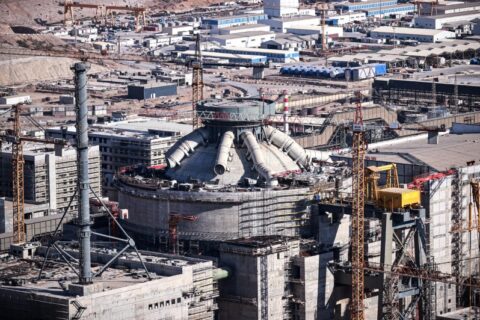
The transition of Akkuyu Unit 1 into final commissioning activities marks a defining milestone for Turkey’s energy sector.
If successfully brought online in the coming months, the reactor would officially make Turkey a nuclear power-generating nation for the first time. It will also establish Akkuyu as one of the most strategically important energy assets in the Eastern Mediterranean.
The project also has wider geopolitical significance. It reflects deepening long-term energy cooperation between Turkey and Russia. This is while positioning nuclear power as a central pillar of Turkey’s future electricity strategy.
Despite ongoing scrutiny surrounding financing structures, foreign ownership and energy security considerations, Akkuyu remains on track to full commissioning in the coming years.
Akkuyu Nuclear Power Plant Project Fact Sheet
Location: Mersin Province, Turkey
Project Type: Nuclear power plant
Technology: VVER-1200 Generation III+ reactors
Total Installed Capacity: 4,800 MW
Number of Units: 4
Capacity per Unit: 1,200 MW
Developer/Operator: Akkuyu Nuclear JSC / Rosatom
Project Model: Build-Own-Operate (BOO)
Estimated Cost: US$20-25 billion
Unit 1 Status: Final testing and commissioning stage
Expected Contribution: Approximately 10% of Turkey’s electricity demand
Expected Annual Generation: Approx. 35 billion kWh
Operational Lifespan: 60 years with 20-year extension potential
Development and Construction Timeline
2010: Turkey and Russia sign intergovernmental agreement
2015: Official project launch ceremony
2018: Construction of Unit 1 begins
2020: Construction of Unit 2 begins
2021: Construction of Unit 3 begins
2022: Construction of Unit 4 begins
2023: First nuclear fuel delivered to site
2025: Major commissioning activities initiated
May 2026: Unit 1 enters final testing and inspection phase
Rosatom Nears Completion on One of the World’s largest Nuclear Projects in Turkey,The Akkuyu Nuclear Power Plant
Reported March 23, 2026 – Recent developments indicate that the Akkuyu Nuclear Power Plant in Turkey, being built by Russia’s state nuclear firm Rosatom, has entered its final phase, with Unit 1 reported to be about 99% complete and targeting first electricity generation in 2026, while the remaining three reactors are progressing toward full completion by around 2028.
The four-unit plant, each with roughly 1,200 MW capacity, is expected to play a major role in Turkey’s energy mix and is notable as the world’s first nuclear project implemented under a build-own-operate model.
Russia at the Center of Vietnam’s Nuclear Re-entry
At the same time, Vietnam is re-entering the nuclear energy space after a decade-long pause, and as of March 2026 has signed a cooperation agreement with Russia to develop the Ninh Thuan 1 plant, its first nuclear power facility, envisioned as two large reactors with a combined capacity of about 2,400 MW.
This creates a clear linkage between the two projects: both are driven by Rosatom’s export model and reflect how emerging economies are turning to nuclear energy to meet rising electricity demand, with Akkuyu serving as a near-completion example of Russia-led nuclear deployment, while Vietnam’s revived programme represents the next wave of similar projects likely to follow in its path.
Akkuyu Nuclear Power Plant Construction Progresses
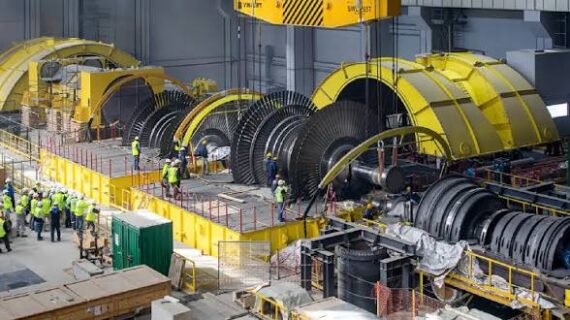
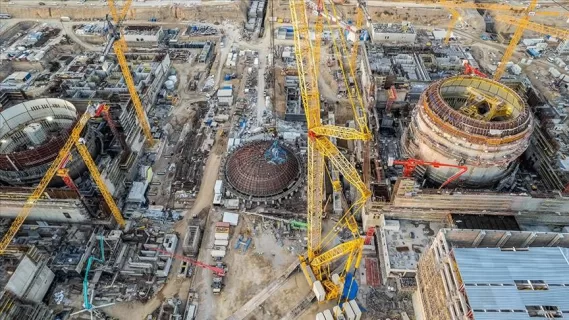
Reported September 21, 2024 – The Akkuyu Nuclear Power Plant (NPP) is gradually taking shape, with plans to start in 2025. This significant development will bring much energy to Turkey, filling the demand and attending to climate objectives. The world’s biggest nuclear construction site has four reactors being built simultaneously. Moreover, energy from this plant alone will provide 10% of Turkey’s energy demand, a noteworthy figure.
Even though it will be opened in 2025, with the first reactor named by then, it will not be fully completed until 2028. While there may be concerns with nuclear energy, this plant has not stopped. The large-scale project is over 30,000 workers strong and is a milestone for both Turkey and the nuclear energy supply. Furthermore, meeting environmental requirements, it is expected to reduce Turkey’s carbon emissions by 30 million tonnes each year through clean, carbon-free energy.
State of Affairs Regarding the Akkuyu Nuclear Power Plant
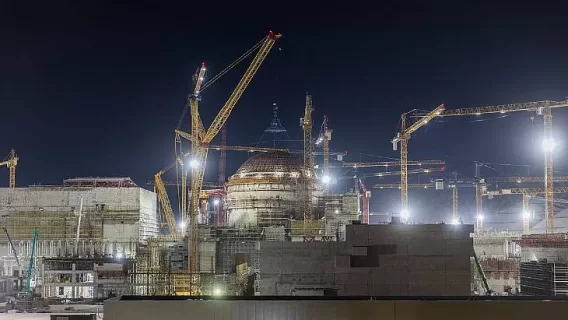
Akkuyu Nuclear Power Plant is imbued in numerous controversies, but Turkey is focused on ensuring its delivery. Looking into the future while designing the plant, developers have also incorporated some of Turkey’s past nuclear goals.
In the 1950s, Turkey’s nuclear ambitions were first talked about. Today, it is aims a target capacity of 20,000 megawatts by 2050. Also prioritized alongside the plant’s power output is its environmental impact. In developing the plant, maximizing energy production and protecting the environment have always come first in discussions.
In May 2010, Russia and Turkey signed an agreement that a subsidiary of Rosatom would build, own, and operate a power plant in Akkuyu. Construction of the first reactor commenced in April 2018. Russian nuclear construction company Atomstroyexport (ASE) and Turkish construction company Özdoğu also signed the site preparation contract. The contract includes excavation work at the site. Currently, the project is taking shape as Turkey seeks to commence an expeditious construction.
Also read: Construction of Europe’s First Semiconductor Plant Breaks Ground: A Monumental Achievement
Significance of One of the Largest Nuclear Plants in the World
The significance of the Akkuyu nuclear power plant is expected to be unprecedented in Turkey and Europe. The nation’s energy consumption has grown because of Turkish economic volume, industrialization, and population growth. The way to meet this energy need is to have a sustainable energy resource. However, Turkey does not have enough reserves of fossil fuels such as oil and natural gas.
The current account deficit is one of the main problems of the Turkish economy. When it is considered the increase in the importation of fossil fuel costs and these fuels’ damage to the environment, Turkey has the need for environmentally friendly and sustainable energy sources. The plant’s construction aligns with this objective as the government plans to meet energy needs with the plant. Once completed, Turkey aims to reduce the current account deficit by reducing energy imports. In addition, environmental protection will be ensured as much as provided for economic growth.
Project Team
Developers
- Rosatom: The main developer, investor, and contractor under the build-own-operate (BOO) model.
- Akkuyu Nukleer: Project company responsible for implementation, construction, and operation (a Rosatom subsidiary).
Core Russian Consortium Partners
- Atomstroyexport: EPC and nuclear construction
- Rosenergoatom: Operational expertise
- Inter RAO: Energy investment
- Atomtechenergo: Commissioning and startup
- Atomenergoremont: Maintenance support
Construction Contractors
- Titan-2 IC Ictas Insaat A.S. (T2IC): Initially the main EPC construction contractor.
- TSM Enerji Insaat Sanayi Ltd: Later appointed as the new main contractor after restructuring.
- Ozdogu Insaat: Early site preparation and excavation works.
Turkish Partner Consortium
- Cengiz Holding
- Kolin Insaat
- Kalyon Insaat
These firms were intended to acquire up to 49% stake in the project company.
Equipment and Engineering Suppliers
- GE Steam Power (now part of Arabelle Solutions): Supplies steam turbines for all units.
- Assystem: Provides engineering and project management support.
- Sintek Group: One of the major on-site contractors for auxiliary systems.
Also read: A third and fourth Turkey Nuclear Power Plant to be Constructed
Also read: Construction proceeds at Turkey’s first nuclear plant



Leave a Reply