
The NHS net zero health service ambition has moved into a more demanding construction phase as England expands investment in modern healthcare infrastructure. Since the original £500 million decarbonization framework, policy has shifted toward whole-life carbon reduction, cleaner energy and climate resilience. The NHS now reports a 14% reduction in carbon emissions since 2019, including a 10% reduction from its estate.
The latest 10 Year Capital Plan also commits major funding to rebuild and modernize NHS facilities. The health capital budget will rise to £15 billion in 2029-30, supporting new buildings, refurbishment and infrastructure upgrades.
NHS Net Zero Health Service Provider Enters New Construction Phase
The NHS Net Zero Building Standard now provides the main technical framework for sustainable healthcare construction. It applies to new buildings and major upgrades costing at least £25m at the relevant business-case stage.
The standard addresses operational energy, embodied carbon, building performance and whole-life environmental impacts. It also requires project teams to develop energy and carbon strategies that guide design and construction decisions.
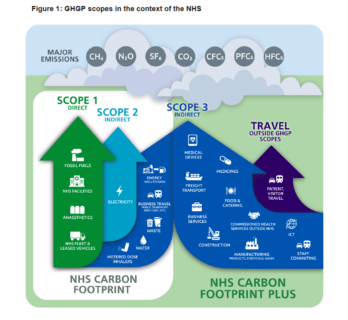
Moreover, the Government has strengthened future procurement requirements. From April 2027, relevant NHS suppliers must report emissions and publish carbon reduction plans covering specified Scope 1, 2 and 3 emissions.
Therefore, contractors pursuing major NHS construction work will face greater carbon-reporting requirements. The changes will increasingly connect procurement decisions with measurable environmental performance.
NHS Net Zero Health Service Provider Expands Green Investment
The NHS has also accelerated investment in renewable energy and efficiency across its estate. During 2025-26, the Government invested £130m with Great British Energy in NHS solar projects.
A further £25 million will support solar installations across up to 40 NHS sites during 2026-27. The program also includes £4 million for electric vehicle charging infrastructure.
Earlier this year, 82 NHS trusts received support from a £74 million clean-energy program. The funding covers technologies including solar panels, batteries, heat pumps and efficient lighting.
Meanwhile, new hospitals are adopting standardized designs through the Hospital 2.0 program. The approach combines modern construction methods, digital technology and sustainability requirements.
Eleven NHS trusts and construction partners signed delivery agreements in July 2026. The partnerships will deliver the first wave of Hospital 2.0 schemes across England.
Kier Construction remains among the contractors supporting the program. Its involvement extends across the wider NHS construction pipeline as healthcare infrastructure investment gathers pace.
The sustainability agenda also reaches major specialist facilities outside conventional hospital construction. The £3.52 billion Harlow Health Security Campus demonstrates how large healthcare developments must combine complex construction with modern environmental requirements.
The Harlow scheme is moving toward renewed procurement after years of reviews and delays. Early works are scheduled from 2028, with main construction expected in late 2029.
The development will include high-containment laboratories, offices, logistics facilities, an energy center and supporting infrastructure. Its scale makes energy performance and resilient infrastructure important considerations during delivery.
The NHS also plans to update its Estatecode in autumn 2026. The revised framework will strengthen expectations around estates strategies, infrastructure assessments and long-term capital planning.
These developments show how the NHS net-zero agenda has moved beyond a standalone decarbonisation framework. It now influences procurement, design, construction, energy infrastructure and long-term estate management.
The sector’s next challenge will involve delivering these requirements alongside rising construction costs and pressure for faster project delivery.
The decarbonization layout
The decarbonization framework agreement features several key changes to the construction layout of the NHS. These include changes to the:
- insulations in the external and internal walls
- the heat pumps – a switch to ground and air-source pumps will be made
- electric heating solutions
- PV systems
- ventilation systems
- and lighting works

Framework agreement for the world’s first net zero health service provider
This project is part of the over £1bn public sector investment by the Department of Energy Security and Net Zero. The Senior Category Manager at NHS SBS, termed the latest approved NHS decarbonization framework as a response to the “profound and growing threat to health posed by climate change”. Also added by Anjub Ali were two key vision scopes of the project, emphasizing on the need for “modernized” and “decarbonized” NHS buildings and assets.
The framework’s scope covers the following broad areas:
- completions and direct awards in 7 geographical regions
- utilization by both public and domestic projects
- inclusion of other public sector authorities like local and national housing associations
Also in the framework are the bars met by the selected suppliers. These include the environmental assessment on the impact of their service delivery. The assessments looked at how much the suppliers’ equipment and energy consumption care for the environment as established by data from previous projects.
Some of the contractors selected in the bid to make NHS the world’ s first net zero national health service include:
- CLC Contractors
- Kier Construction
- MTX Contracts
- Seddon Construction
- Vital Energi Utilities
- Lorne Stewart PLC
- Ashe Construction
- and Oakes Energy Services.
Climate change is an area of contention in discourses in public spaces, and so is health and its related issues. NHS SBS has a conceptual merger to make better two areas that lie at the center of major modern issues in the world right now. More is definitely set to come out of this inception.
Project fact sheet
Initiative: NHS net-zero healthcare construction and estate decarbonisation program.
Original framework: £500 million NHS Decarbonisation of Estates framework.
Original framework objective: Support the transition toward a net-zero NHS.
NHS net-zero target: Net zero emissions by 2045.
Current carbon progress: NHS emissions have fallen 14% since 2019.
Estate emissions progress: NHS estate emissions have fallen 10% since 2019.
10 Year Capital Plan: Long-term program for NHS buildings, infrastructure and equipment.
Capital budget: Expected to reach £15 billion in 2029-30.
NHS Net Zero Building Standard: Applies to qualifying new buildings and major upgrades.
Minimum project threshold: £25 million for applicable investments at the specified business-case stage.
Key construction priorities: Energy efficiency, whole-life carbon, climate resilience and sustainable materials.
Renewable investment: £130 million invested in NHS solar projects during 2025-26.
Further solar funding: £25 million planned for up to 40 NHS sites during 2026-27.
Clean-energy program: £74 million supporting 82 NHS trusts and other public-sector sites.
Technologies supported: Solar power, batteries, heat pumps and efficient lighting.
Procurement change: New NHS carbon reduction requirements begin from April 2027.
Supplier requirements: Relevant suppliers will report emissions and publish carbon reduction plans.
Hospital 2.0: Standardized approach for designing and delivering future NHS hospitals.
Hospital 2.0 construction partners: Ten major construction organizations form the alliance.
Current delivery pipeline: Eleven NHS hospital partnerships signed in July 2026.
Estate strategy: NHS England plans a revised Estatecode for autumn 2026.
Project team
National health policy: Department of Health and Social Care.
Healthcare delivery: NHS England.
Net-zero program: Greener NHS.
Sustainable procurement: NHS England Net Zero and Sustainable Procurement Team.
Framework procurement: NHS Shared Business Services.
Construction partners:
- Kier Construction.
- Bovis Construction,
- Dragados,
- Integrated Health Projects
- John Graham Construction
- Laing O’Rourke
- Morgan Sindall Construction
- Sacyr UK
- Skanska Construction UK
- Willmott Dixon Construction
Energy partner: Great British Energy.
Capital program: UK Government and NHS England.
Estate delivery: NHS trusts and integrated care boards.
Specialist healthcare development: UK Health Security Agency for the Harlow Health Security Campus.
Harlow specialist contractor: Kier for the H50 high-containment laboratory package.
Also read: Lendlease final bow out in international construction operations
Also read: Suffolk Construction wins Dartmouth College decarbonization project

Leave a Reply