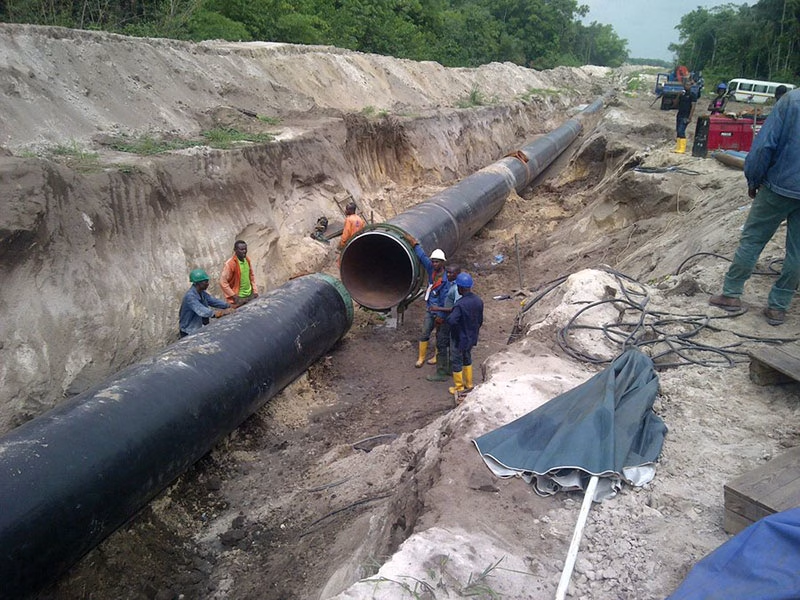
The Trans-Saharan Gas Pipeline (TSGP) has entered a decisive operational phase following the signing of three acceleration agreements between Algeria, Nigeria, and Niger in early 2025. President Abdelmadjid Tebboune recently confirmed that Sonatrach plans to begin physical construction of the Nigerien segment in mid-2026, leveraging the fact that over 70% of the required infrastructure within Algerian and Nigerian borders is already complete. The project, estimated at $13 billion, aims to transport 30 billion cubic meters of gas annually over 4,128 km, directly plugging into Algeria’s established Mediterranean hubs like Hassi R’Mel to reach Italy and Spain by 2027.
The TSGP seeks to rival the Nigeria-Morocco Gas Pipeline (NMGP) primarily through speed and cost-efficiency. While Morocco’s Atlantic route is a $25 billion, 7,000 km “marathon” project involving 13 countries and extensive new offshore construction, Algeria is positioning the TSGP as a “sprint” that utilizes existing pipelines. By offering a shorter, overland route that is nearly half the price, Algeria aims to lock in Nigerian gas supplies and European purchase agreements before the more complex Moroccan corridor can break ground. This rivalry has turned the Sahara and the Atlantic into a “zero-sum” race, as analysts suggest European demand and Nigerian reserves may only realistically support one of these mega-pipelines in the long term.
June 18, 2025
Feasibility study update for the Trans-Saharan gas pipeline project is progressing and will be finished by September. Engineering firm Penspen based in the UK was hired in March to get it done in six months. Establishing technical and economic viability for this giant of a $13bn–$25bn project is what the study seeks to accomplish. With a stretch of over 4,000 kilometres from Nigeria to Algeria, the pipeline will carry up to 30 billion cubic metres of natural gas a year.
Penspen performed the initial study in 2006 and is now looking to update past findings and routing alternatives. The company operates from its UK and Middle East headquarters with some assistance from Sidara brand Dar, which works in Nigeria, Niger, and Algeria. Route analysis, market research, and environmental and social appraisal are also included in construction planning. Moreover, the team is assessing legislative requirements and developing front-end engineering design scope. The Trans-Saharan Gas Pipeline will transform regional energy transport infrastructure.
Also read:
The longest natural gas pipelines in the world
Significance of the Trans-Saharan Gas Pipeline Project
Trans-Saharan gas pipeline project has enormous strategic importance for Africa and the rest of the world. It aims to provide a safe method of transporting natural gas from sub-Saharan Africa to Europe. This is important in reducing Europe’s dependence on finite energy sources and enhancing global energy security. Furthermore, the project has the capacity to drive industrialization, infrastructure, and employment levels in transit countries. Above all, it consolidates regional cooperation among Nigeria, Niger, and Algeria. Such cooperation is expected to promote political stability as well as investor confidence.
With the growing energy needs of Africa, the pipeline will be critical to meeting regional consumption needs and enabling exports. The feasibility update currently available also ensures that modern standards are applied in building the project. It is composed of very rigorous research on environmental, legislative, and economic considerations. This means there is a clear scope for potential future engineering and designing work. Moreover, successful completion of the study will impact the follow-on project implementation steps and investment planning in the long term.
Also read:
Latest Developments on Trans-Saharan Gas Pipeline Project (TSGP)
Trans-Saharan road construction to be completed in June this year


Leave a Reply