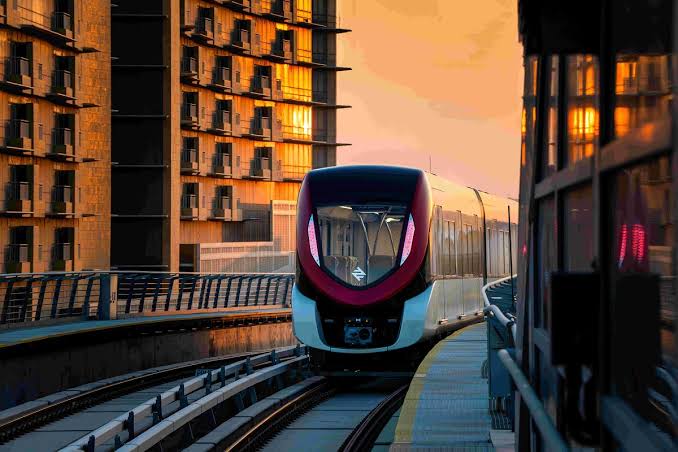
A US-French consortium led by Parsons Corporation has won management of the $2.75 billion Riyadh Metro Red Line extension. The Royal Commission for Riyadh City picked the group, Riyadh Metro Transit Consultants, in March. The appointment was announced on Monday by Parsons.
Since 2013, RMTC has been involved in the Riyadh subway project. It has partners on the extension: France-based Systra and Egis. In January, AGBI reported that RCRC had awarded the extension contracts. But the commission did not reveal names at the time. The design and build award was later confirmed by RCRC. It went to a consortium led by Italy’s Webuild, with India’s Larsen & Toubro, Saudi Arabia’s NESMA and France’s Alstom.
Other Projects
Another major rail project in the Arab nation making headway is the Bir Al-Abd Arish Railway. Egypt’s Transport Minister Kamel Al-Wazir has visited the track-laying works on the 83-kilometre Bir Al-Abd Arish Railway. The $500 million-plus line is the core of Sinai’s approximately 500-kilometre rail initiative. The ministry said on Monday that the broader project will link Sinai to Egypt’s national rail network.
The broader project includes rehabilitating, upgrading and building the Ferdan-East Port Said-Bir Al-Abd-Arish-Taba railway. It will be used for passengers and freight, linking residential communities, industrial areas and mining zones throughout the peninsula.
Scope of implementation on the Riyadh Metro Red Line Extension
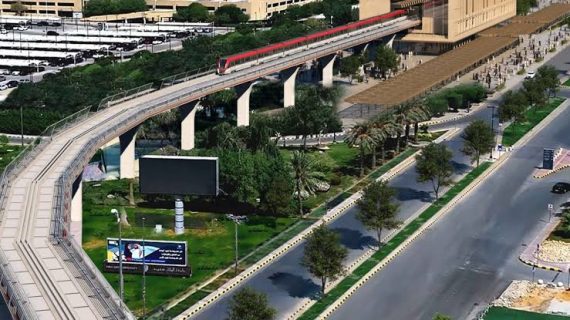
The extension is 8.4 kilometres long from King Saud University to Diriyah Gate. It consists of 1.3 kilometres of elevated viaduct and 7.1 kilometres of bored tunnel, and has five stations. There are three stations buried in the ground. There are two serving the King Saud University area, including the medical city and health colleges.
Webuild estimates the design and build contract to be worth $2.75 billion. The consortium of Webuild has a 30.1 percent stake. The scope includes the driverless line, signalling systems and tunnel boring machine excavation. Three stations will be built in Diriyah, one of which is to be an interchange station with Line 7 in the future.
RCRC anticipates completion in about six years. The extension will reduce the number of cars on the roads of Riyadh. It will also bring sustainable transport to Diriyah, the historic first Saudi capital and a UNESCO World Heritage site.
Outlook for the Riyadh Metro network
The new section connects to a system that has a good track record. In late 2024, RMTC completed the first phase of Riyadh Metro. The build resulted in the world’s longest driverless metro network, covering 176 kilometres and six lines. Lines 1 and 2 were constructed by the BACS consortium, which won a 7.5 billion euro contract. The FAST consortium then provided Lines 4, 5 and 6 for $7.82 billion.
In the meantime, RCRC is already looking to expand further. The commission announced in November that 145 companies had shown interest in a high speed rail project across the city. They cover developers, suppliers, operators and designers.
The management team thus finds itself back on familiar territory. The original build was directed by RMTC and the construction contract is with Webuild’s consortium. The metro link to Diriyah Gate is thus expected to be completed in approximately six years.
Project Overview
- Project Value: $2.75 billion design and build
- Location: Riyadh, Saudi Arabia
- Client: Royal Commission for Riyadh City
- Management: Parsons-led RMTC consortium
- Status: Construction management awarded
Scope
- 8.4 kilometres of new track
- 7.1 kilometres in bored tunnel
- 1.3 kilometres on viaduct
- Five stations, three underground
Project Highlights
- Links King Saud University to Diriyah
- Also part of world’s longest driverless network
- Serves UNESCO World Heritage site
- Webuild consortium also holds 30.1 percent
Key Developments
- Design and build awarded January 2026
- RCRC named Webuild-led consortium
- RMTC selected in March 2026
- Parsons also announced role Monday
Key Challenges
- Six-year construction timeline
- Also tunnel boring through dense city
- Interchange works with future Line 7
- Also managing live metro operations
Outlook
- Completion expected around 2032
- Diriyah Gate gains metro access
- High speed rail interest at 145 firms
- Network expansion also continues




Leave a Reply