
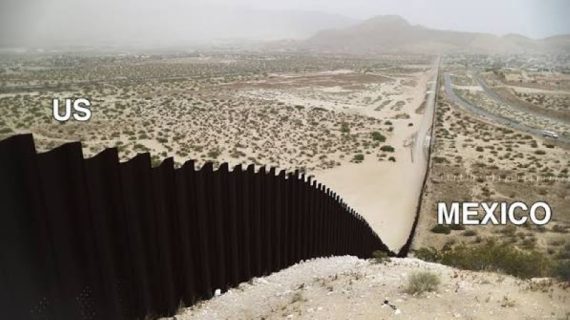
The US-Mexico border wall construction project is entering another major phase under President Donald Trump, but its growing financial commitment is renewing questions about whether the massive infrastructure investment is proportionate to the security challenges it seeks to address.
What began as Trump’s flagship border infrastructure pledge during his first presidential campaign has evolved into a much broader program. It now involves steel barriers, vehicle barriers, patrol roads, surveillance cameras, lighting and detection technology.
How Much Does the US-Mexico Border Wall Project Cost?
The financial commitment has also increased significantly. In July 2025, Congress approved approximately US$46.55 billion for US Customs and Border Protection (CBP) to construct, upgrade and replace components of the border barrier system. This allocation is substantially larger than the original US$15 billion-plus figure associated with the earlier border wall project. The Congressional Budget Office also estimated that the new funding would increase federal outlays by approximately US$44.6 billion over the 2025-2034 period. The Congressional Budget Office also noted that construction spending would extend over several years.
However, the scale of the investment raises an important question: is physical border infrastructure the most effective use of such substantial public resources? The Trump administration maintains that barriers, combined with surveillance technology and additional Border Patrol personnel, are necessary to deter illegal crossings and disrupt drug trafficking. The Trump administration also aims to “strengthen operational control of the southern border”. Furthermore, CBP argues that its Smart Wall approach integrates physical barriers with cameras, sensors, lighting and patrol roads to improve detection and response capabilities.
The Challenge with Texas’s Big Bend Region
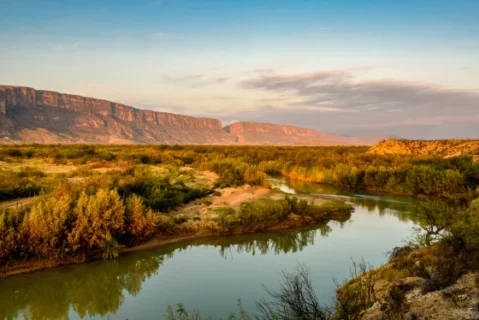
Nevertheless, the security justification is being questioned in some of the areas earmarked for construction. In Texas’s Big Bend region, for example, the administration’s proposed infrastructure program covers more than 300 miles of the border sector, despite the area accounting for only approximately 1.3% of US-Mexico border apprehensions in fiscal year 2025. The region also recorded relatively low migrant apprehension figures compared with other border sectors. Critics consequently question whether extensive physical barriers are necessary across remote landscapes where natural terrain already presents significant obstacles to crossing.
Environmental considerations have further complicated the US-Mexico border wall construction project. Construction in the Big Bend region has faced opposition from conservation organizations, local communities and politicians from both parties. This is mainly over potential damage to wildlife habitats, protected landscapes, historic sites and the Rio Grande river corridor.
On November 9, 2026, the US Supreme Court cleared the way for the Big Bend border wall construction to resume after temporarily suspending a lower federal court injunction. The ruling allows the Trump administration to proceed while litigation continues. It, however, does not fully resolve the underlying environmental and legal dispute. CBP has also awarded five contracts worth more than US$6 billion for border security improvements in the Big Bend region alone, including fencing, vehicle barriers and surveillance technology.
Is the Border Wall Really Necessary?
At this point, the debate extends beyond the initial construction expenditure. It now includes long-term maintenance, surveillance operations, staffing and the effectiveness of different border security approaches. While physical barriers can complicate unauthorized crossings and provide Border Patrol agents with additional response time, their effectiveness is not all certain. Effectiveness of the border wall will depend on the terrain, technology, staffing and the ability to address vulnerabilities beyond the barriers themselves.
Ultimately, the US-Mexico border wall remains one of the largest and most contentious infrastructure projects in the United States. Whether its expanding financial commitment delivers security benefits proportionate to its cost will depend on measurable outcomes. This will include changes in unauthorized crossings, drug interdictions, operational efficiency and long-term maintenance expenditure.
As construction of the US-Mexico border wall advances, the question is no longer simply how much of the border can be fortified, but whether the billions being invested are delivering the most effective and sustainable approach to border security.
What is the “US-Mexico Border Wall” Program?
Reported August 28, 2026 – The US-Mexico border wall is a border infrastructure project being developed along sections of the southern United States border. The project is intended to add new barrier infrastructure across parts of Arizona, New Mexico, California, and Texas.
The Customs and Border Protection (CBP) announced plans to construct more than 150 miles of approximately 30-foot-high border wall across Arizona, New Mexico, and California. Construction was also continuing at multiple sites in the affected states, including Texas.
The construction program continued as the United States responded to the COVID-19 pandemic and implemented measures aimed at limiting the spread of the virus. According to CBP, construction activities at the border had not been affected by the public health situation.
At the time, the United States had recorded thousands of confirmed COVID-19 cases and hundreds of deaths, while businesses and government authorities implemented restrictions and other measures in response to the outbreak. Despite the wider disruptions, construction crews continued working at several border wall sites.
Also read: SWVC awarded US $524m for border wall construction in Arizona
Outlook on the US-Mexico Border Wall
Recently, the Trump administration has paused construction of the Big Bend border project in Texas national park as fierce bipartisan opposition completely stalls the project. The government officially halted the massive $1.7 billion project. Big Bend National Park features rich biodiversity and spectacular views. The Department of Homeland Security planned extensive border infrastructure here. Consequently, bulldozers broke ground earlier this month on public lands. Now, Customs and Border Protection Commissioner Rodney Scott paused activities. He announced a personal evaluation of the rugged Texas site. Ultimately, the federal government will consult closely with local stakeholders. The US-Mexico Border wall has been a contentious topic that has often taken center stage since Trump got into office in his first term.
Construction of the Border Wall
Building work continues in many parts of the United States, but for the US-Mexico border wall, skilled welders, engineers and contractors travel from states far north from the border. Along the border, they work together, car-pool, stay at local hotels and motels, and eat together at restaurants over several consecutive days, before travelling back to their families which is a clear health hazard to their health and that of their families.
Trump pledged to build a “big, beautiful wall” along the 2,000-mile southern border (and make Mexico pay for it) as part of a presidential campaign in 2016 permeated by anti-immigration sentiments.
Project Overview
- Project: US-Mexico Border Wall
- Location: Southern U.S. border
- Developer: U.S. government / CBP
- Status: Construction underway
Scope
- Border barrier infrastructure
- Arizona, New Mexico and California
- Construction also continuing in Texas
- Approximately 150+ miles planned
Project Highlights
- Approximately 30-foot-high barriers
- Skilled workers and contractors involved
- Construction continued during COVID-19
- Part of wider border infrastructure programme
Key Developments
- CBP announced plans for 150+ miles of new wall
- Work continued at multiple border sites
- Construction crews travelled from across the U.S.
- Health concerns were raised over worker travel
Outlook
- Construction programme continued despite pandemic disruption
- Multiple border sections remained under development
- Project formed part of the Trump administration’s border security

Leave a Reply