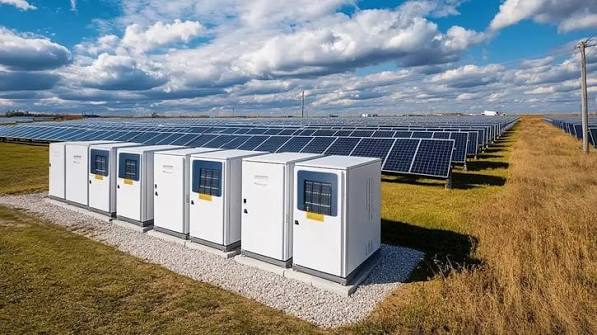
Calibrant Energy has closed a $145 million debt financing facility led by Investec to support solar and battery storage projects across multiple U.S. electricity markets, including a 120 megawatt-hour (MWh) battery energy storage system serving a hyperscale data center customer in PJM. Announced November 10, 2026, the financing combines the recapitalization of operating assets with funding for new construction as the company expands its energy infrastructure portfolio.
Citi, Liberty Bank and Siemens Financial Services also participated in the facility. Calibrant said construction mobilization has begun for the 120 MWh battery project, although it has not identified the data center customer, project location, battery supplier or expected completion date.
The transaction comes as data center developers face increasing difficulty securing electricity and timely grid connections. Calibrant is positioning battery storage as a way for large electricity users to manage their demand more flexibly, potentially reducing the infrastructure requirements associated with connecting new facilities.
$145M financing supports existing and new energy assets
The Investec-led facility covers solar and battery storage projects across several U.S. power markets. Its structure serves two purposes: refinancing or recapitalizing operating assets and providing capital for new construction.
This makes the transaction broader than a single-project construction loan. Calibrant is using the financing to support an established portfolio while advancing additional infrastructure for large commercial and industrial electricity users.
The company has not disclosed how the $145 million is divided between operating assets and new developments. It has also not identified the individual projects included in the financing, provided the loan’s maturity or interest rate, or disclosed how much capital will support the 120 MWh data center installation.
Calibrant develops, finances, owns and operates distributed energy infrastructure, including solar generation and battery storage. Its turnkey model allows customers to obtain energy infrastructure without funding the full upfront construction cost themselves.
Backed by Macquarie Asset Management, Calibrant reported more than 2.2 gigawatts (GW) of power capacity and 5.9 gigawatt-hours (GWh) of battery storage across projects in operation, under construction or covered by exclusive development agreements.
The company also disclosed that its portfolio includes additional battery storage sites associated with the same hyperscale data center customer involved in the 120 MWh project. However, it has not provided their locations, capacities or individual development schedules.
120 MWh battery project targets PJM data center power constraints
The largest specifically identified battery installation within the financing portfolio is a 120 MWh system serving an undisclosed hyperscale data center customer in the PJM electricity market.
Calibrant said site mobilization has begun, marking a move from project financing toward construction. The company has not released the system’s power rating in megawatts, so its discharge duration cannot yet be established.
That distinction is important when evaluating the project’s ability to support a data center. A battery’s MW rating determines how much electricity it can deliver at a given moment, while its MWh capacity measures the amount of energy it can store and discharge.
For example, a 120 MWh battery rated at 30 MW could theoretically deliver its full rated output for four hours. However, Calibrant has not confirmed that configuration, and the actual discharge duration will depend on the project’s undisclosed power rating and operating conditions.
The company says its engineered storage systems allow energy-intensive customers to control when and how they draw electricity from the grid. By charging batteries during selected periods and discharging them when demand rises, data centers can potentially reduce peak grid demand and offer utilities a more flexible load.
Calibrant argues that this approach can support faster interconnection timelines and reduce the need for costly grid infrastructure upgrades that might otherwise affect other electricity customers.
However, the announcement does not identify which specific grid upgrades the 120 MWh project could avoid, the utility responsible for its interconnection or the operating restrictions attached to the customer’s electricity supply. The extent to which the battery can accelerate the data center’s connection will depend on those arrangements.
Previous projects demonstrate Calibrant’s data center strategy
The PJM installation builds on Calibrant’s earlier partnerships with data center operators seeking alternatives to lengthy utility infrastructure upgrades.
In October 2025, Calibrant and Aligned Data Centers announced plans for a 31 MW/62 MWh battery system at Aligned’s Hillsboro campus in Oregon. The companies designed the installation to help the data center obtain grid power and scale its operations years earlier than conventional utility upgrades would otherwise allow.
The project involves coordination with a regional utility to use battery storage as a flexibility resource. Rather than treating the data center as an inflexible electricity consumer, the arrangement allows its power demand to respond to grid requirements.
Calibrant also partnered with Iron Mountain in February 2026 to deploy a 23 MWh battery system at an Iron Mountain data center in New Jersey. The installation is designed to integrate with an existing 7.2 MW rooftop solar facility.
These projects demonstrate two applications of Calibrant’s model: using battery storage to facilitate data center grid access and combining storage with existing on-site renewable generation.
The new 120 MWh project is larger in energy-storage capacity than either of those previously announced installations. Its commercial arrangement and technical configuration, however, remain undisclosed.
PJM’s large-load connection rules add to the urgency
The financing comes as PJM works to accommodate growing electricity demand from data centers and other large consumers while protecting grid reliability and existing ratepayers.
The regional transmission organization coordinates wholesale electricity markets and grid operations across parts of the Mid-Atlantic and Midwest. Its service territory includes major data center markets in Virginia, Pennsylvania, Ohio, Maryland and other states.
On June 18, 2026, the Federal Energy Regulatory Commission (FERC) issued show-cause orders directing all six regional grid operators under its jurisdiction to justify or reform their rules for connecting large electricity users.
PJM subsequently advanced proposals addressing large-load connections, including an Interim Resource Adequacy Service framework for new customers bringing additional power supply or seeking alternative service arrangements.
As of November 10, PJM’s published large-load information listed key elements of its proposed framework as pending FERC approval. FERC’s extended deadline for responses in the relevant proceedings was November 16, 2026.
The regulatory process highlights the difficulty of accommodating large new electricity consumers while ensuring that existing customers do not absorb the cost of infrastructure built primarily to serve them.
Battery storage can help address part of this challenge by allowing customers to manage electricity demand more flexibly. However, it cannot independently replace generation capacity or remove all transmission and distribution constraints.
For Calibrant, the commercial opportunity lies in developing assets that allow data center operators and utilities to coordinate electricity consumption more effectively.
Battery storage becomes part of the data center power strategy
Calibrant’s financing illustrates how investment in battery infrastructure is expanding beyond traditional renewable energy projects into solutions designed around large electricity consumers.
The company’s portfolio includes operating facilities, projects under construction and developments still covered by exclusive agreements. The 5.9 GWh figure therefore represents its broader development and operating pipeline, not installed storage capacity alone.
A comparable approach is emerging in Utah, where Lydian Energy has brought its 150 MW/600 MWh Faraday battery storage project into commercial operation. The facility supports Meta’s Eagle Mountain data center through a long-term agreement with PacifiCorp, demonstrating how utility-contracted storage can also support the electricity requirements of hyperscale computing facilities.
The two developments illustrate different approaches to the same infrastructure challenge. Calibrant’s financing includes battery systems serving large power users through its distributed energy model, while Lydian’s Faraday project supplies contracted storage capacity to a utility supporting a named data center customer.
For Calibrant, the next milestone will be advancing the 120 MWh installation through construction and commissioning. The project’s location, customer identity, MW rating and expected completion date remain among the key details still to be disclosed.

Calibrant Energy New U.S. Projects Factsheet
Financing: $145 million debt facility
Lead financier: Investec
Other participating lenders: Citi, Liberty Bank and Siemens Financial Services
Company: Calibrant Energy
Backer: Macquarie Asset Management
Financing purpose: Recapitalization of operating assets and funding for new solar and battery storage construction
Geographic scope: Multiple U.S. power markets
Featured data center project: 120 MWh battery energy storage system serving an undisclosed hyperscale data center customer in the PJM market
Project status: Site mobilization underway
Additional development: Calibrant says it is advancing additional battery storage sites for the same hyperscale customer
Company portfolio: More than 2.2 GW of power capacity and 5.9 GWh of battery storage in operation, under construction or covered by exclusive development agreements



Leave a Reply