
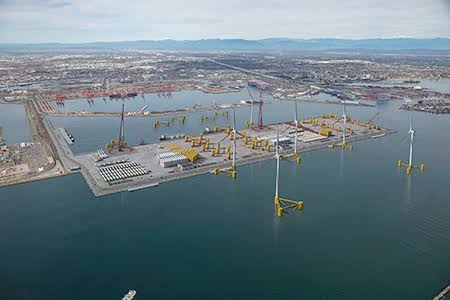
The Pier Wind terminal project is advancing through planning and preconstruction at the Port of Long Beach, California, as officials prepare for a proposed 2027 construction start. The $4.7 billion offshore wind infrastructure development would create a 400-acre terminal for assembling, staging and deploying floating offshore wind turbines. However, the port must advance engineering, environmental assessments, permitting and financing before full construction can begin.
The Port of Long Beach received a $20 million grant from the California Energy Commission in October 2025. The port committed another $11 million to support the project’s planning and design activities. The funding will support engineering, environmental reviews, cost estimates and engagement with surrounding communities and industry stakeholders.
Pier Wind represents a significant investment in California’s offshore wind supply chain. The proposed terminal would accommodate large turbine components and floating foundations that require specialized waterfront facilities, heavy-lift equipment and deep-water access.
Pier Wind Terminal Project Advances Through Preconstruction
The Port of Long Beach plans to develop the terminal in its outer harbor, near Pier 400 and Navy Mole. The project includes a terminal area and a transportation corridor to move oversized components between storage, assembly and marine loading areas.
The proposed infrastructure would accommodate turbine towers, blades, nacelles and floating foundation subassemblies. Workers would assemble these components at the terminal before integrating them into floating offshore wind turbine systems.
The development also requires marine construction, waterfront improvements and supporting logistics infrastructure. These facilities would allow the port to handle large components that conventional cargo terminals cannot efficiently accommodate.
The California Energy Commission’s grant supports planning and design rather than full-scale construction. Consequently, the port must complete the necessary technical and environmental work before committing to major building activities.
Pier Wind Terminal Project Targets 2027 Construction
The port has previously outlined plans to begin construction as early as January 2027. Under its earlier development schedule, the first 100 acres could enter service in 2031, with the entire terminal potentially operating by 2035. These dates remain targets rather than confirmed delivery commitments.
The terminal would help California pursue its target of developing 25GW of offshore wind capacity by 2045. Floating wind technology could enable projects in deeper Pacific waters, where fixed-bottom foundations prove less suitable.
However, the project’s progress depends on environmental review, permitting, engineering decisions and funding availability. Changes in federal offshore wind policy also create uncertainty for developers, manufacturers and port infrastructure investors.
The Trump administration’s renewed challenge to the Revolution Wind project’s federal permit illustrates these risks. The 704MW offshore wind farm off Rhode Island began delivering electricity in March 2026, yet federal officials sought another review of its construction and operations approval in October.
The two developments highlight different stages of offshore wind investment. Revolution Wind is delivering electricity while facing regulatory uncertainty, whereas Pier Wind remains in preconstruction as California develops the port capacity needed for future projects.
If the port completes the required approvals and secures sufficient funding, Pier Wind could become a major assembly and deployment hub for floating offshore wind turbines along the US West Coast.
Also Read: Egypt to construct 3-gigawatt wind farm in West Sohag
How many jobs the Port of Long Beach wind project will create
Plezia is certain that a workforce can be found to build the wind farms, which she estimates would require 2,000 to 3,000 employees. Plezia stated that the Port provides public infrastructure that enables “private equity”. “Private equity will be authorised, but without port infrastructure, it will not be possible. The question is how much public financing is available. I believe it will be a blend of public and private.”
Project fact sheet
Name: Pier Wind Terminal Development Project.
Location: Outer harbour, Port of Long Beach, Long Beach, California, United States.
Estimated project cost: $4.7 billion.
Type: Offshore wind turbine assembly, staging, storage and deployment terminal.
Proposed terminal area: Approximately 400 acres, with an additional transportation corridor.
Main infrastructure: Waterfront facilities, heavy-lift wharves, component storage areas, turbine assembly space and marine logistics infrastructure.
Primary purpose: Support the assembly and deployment of floating offshore wind turbine systems.
California Energy Commission grant: $20 million approved in October 2025.
Port contribution: $11 million committed towards planning and design.
Proposed construction start: January 2027, subject to approvals and project readiness.
Earlier development target: First 100 acres potentially operational in 2031.
Full development target: Entire terminal potentially operational by 2035.
Current status: Planning, design and preconstruction.
Key outstanding requirements: Engineering, environmental assessments, permitting, community engagement and financing.
Strategic objective: Support California’s ambition to develop 25GW of offshore wind capacity by 2045.
Project team
Owner and lead agency: City of Long Beach Harbor Department, operating as the Port of Long Beach.
Planning and design funding agency: California Energy Commission.
Project engineering and development coordination: Port of Long Beach engineering department.
Environmental review and permitting coordination: Port of Long Beach, relevant state agencies and other responsible permitting authorities.
Community and stakeholder engagement: Port of Long Beach, working with nearby communities, California Native American tribes, industry stakeholders and public agencies.
Construction contractors: Final major construction appointments have not been confirmed in the cited sources.
Terminal operators: Final operational arrangements have not been confirmed in the cited sources.
Turbine manufacturers and equipment suppliers: Final project-specific supply contracts have not been confirmed in the cited sources.
Offshore wind developers expected to benefit: Developers pursuing floating offshore wind projects along the US West Coast.

Leave a Reply