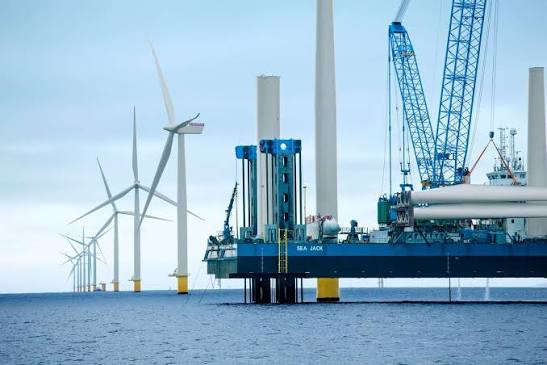
Revolution Wind project faces renewed federal scrutiny after the Trump administration moved to revisit its construction and operations permit. The 704-megawatt offshore wind farm, located off Rhode Island, began supplying electricity in March 2026.
However, the latest legal challenge threatens to complicate final construction activities and the project’s transition into full commercial operation. The development represents a major renewable energy investment, although its final capital cost requires verification against current developer disclosures.
The US Justice Department asked a federal court to return the Interior Department’s approval for further agency review. According to Bloomberg’s report, the administration wants officials to reassess compliance with the Outer Continental Shelf Lands Act. Consequently, the dispute has reopened uncertainty around a major renewable energy development that has already overcome earlier federal stop-work orders.
Revolution Wind Project Faces Renewed Federal Permit Scrutiny
The latest challenge focuses on federal approval of the project’s construction and operations plan. The Interior Department has agreed that further review should examine compliance with federal offshore development requirements.
The administration argues that previous approval overlooked potential impacts on fishing, scientific research and historic landmarks. Nevertheless, developers secured federal approval in November 2023 after an extensive environmental review.
The Bureau of Ocean Energy Management approved the construction and operations plan on November 17, 2023. The approval allowed developers to install up to 65 wind turbines and two offshore substations.
The latest legal action follows earlier attempts to halt construction. In August 2025, federal authorities ordered work to stop, prompting the developers to challenge the decision in court.
A federal judge subsequently allowed construction to resume in September 2025. Another suspension order followed in December, but a court granted preliminary relief in January 2026.
These disputes disrupted construction schedules and increased financial pressure. Eversource disclosed additional cost-related liabilities in 2026 as developers addressed construction overruns and other expenses.
Revolution Wind Project Advances Despite Legal Uncertainty
Despite the regulatory dispute, Revolution Wind began delivering electricity to New England’s grid on March 13, 2026. The development therefore represents an operational milestone rather than a project awaiting its first construction activities.
Once fully operational, the 704MW facility expects to supply enough electricity for more than 350,000 homes and businesses. Rhode Island has contracted 400MW, while Connecticut will receive the remaining 304MW.
The project includes 65 wind turbines and two offshore substations. Submarine export cables will carry generated electricity to the mainland, where underground transmission infrastructure connects the facility to the existing grid.
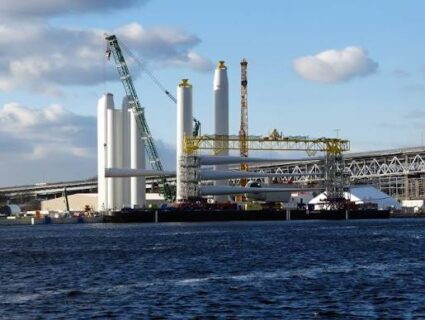
The cable system reaches land at Quonset Business Park in North Kingstown, Rhode Island. From there, underground transmission infrastructure connects the facility to the Davisville substation.
Meanwhile, construction activities have supported regional port infrastructure and employment. The project has also contributed to supply-chain activity associated with offshore wind development.
However, the renewed permit challenge could complicate final commissioning and the project’s transition to full commercial operations. The developers must therefore manage outstanding construction activities alongside the evolving regulatory process.
The project highlights the importance of supporting infrastructure for offshore wind development, including specialized ports capable of handling turbine components and floating foundations. A similar investment is planned at the Port of Long Beach, where the $4.7 billion Pier Wind project will provide 400 acres for assembling and staging offshore wind turbines, with construction expected to begin in 2027.
Revolution Wind Project Faces Questions over Completion
The renewed challenge raises questions about the regulatory outlook for offshore wind construction across the United States. Developers must navigate another federal review while advancing the facility towards full operation.
However, the latest filing does not automatically cancel the existing authorization. The court process and any resulting agency decision will determine the practical consequences for construction and operations.
The dispute also comes amid broader discussions about federal infrastructure permitting reform. Therefore, its outcome could influence investor confidence in other offshore wind developments.
For Revolution Wind, the immediate priority remains completing outstanding work and maintaining electricity deliveries. Its path towards full commercial operation will depend on construction progress and the outcome of the renewed permit challenge.
Project fact sheet
Name: Revolution Wind offshore wind farm.
Type: Utility-scale offshore wind generation and transmission infrastructure.
Location: Federal waters off Rhode Island, United States.
Offshore distance: Approximately 15 miles south of the Rhode Island coast.
Estimated project cost: A definitive current total was not confirmed in the cited official project information.
Installed generation capacity: 704 megawatts.
Wind turbines: Up to 65 turbines.
Offshore substations: Two.
Federal permitting authority: Bureau of Ocean Energy Management.
Construction and operations plan approval: November 17, 2023.
Construction commencement: 2023.
First electricity delivery: March 13, 2026.
Expected beneficiaries: More than 350,000 homes and businesses.
Electricity allocation: 400MW for Rhode Island and 304MW for Connecticut.
Power purchase arrangements: Fixed-price, 20-year agreements with utilities in Rhode Island and Connecticut.
Transmission infrastructure: Submarine export cables, underground onshore cables and connection to the Davisville substation.
Construction status: More than 90% complete as of March 2026, according to the project’s official construction updates.
Current challenge: Federal legal action seeking reconsideration of the project’s construction and operations plan approval.
Project team
Developer: Ørsted.
Joint venture partner: Skyborn Renewables.
Investor backing: Global Infrastructure Partners.
Turbine supplier: Siemens Gamesa.
Federal permitting authority: Bureau of Ocean Energy Management.
Federal department overseeing the permit review: US Department of the Interior.
Legal representative for the federal government: US Department of Justice.
Onshore transmission infrastructure: Underground cable routes connecting the coastal landfall to the Davisville substation.
Coastal landfall and construction logistics location: Quonset Business Park, North Kingstown, Rhode Island.
Grid connection facility: Davisville substation, Rhode Island.
Electricity purchasers: Utilities serving Rhode Island and Connecticut.
Construction workforce: Local union workers and specialist offshore wind contractors.


Leave a Reply