
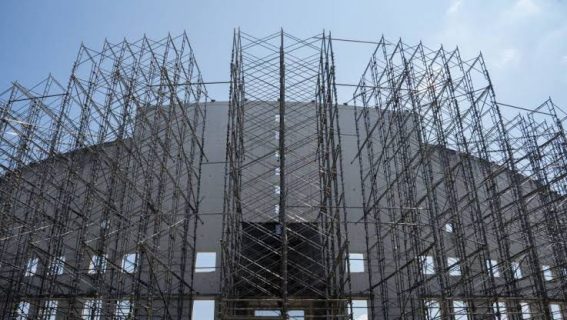
The White Stadium redevelopment project in Boston, Massachusetts, has reached a major construction milestone following completion of its structural framework. The achievement advances the transformation of the historic Franklin Park sports facility into a modern athletics complex.
In addition, the development will provide a permanent home for Boston Public Schools (BPS) student-athletes and professional women’s soccer club Boston Legacy FC. A topping-off ceremony marked the installation of the final structural beam, bringing together city officials, construction teams, students and community representatives.
The project combines public and private investment exceeding $325 million, with the City of Boston and Boston Legacy FC sharing responsibility for the redevelopment.
White Stadium Redevelopment Project Completes Structural Framework
The topping-off ceremony took place in Franklin Park, marking the completion of the stadium’s principal structural framework. Mayor Michelle Wu joined Boston Legacy FC Controlling Owner Jennifer Epstein and BPS leadership. Representatives from BOND Building Construction, students, residents and park advocates also attended.
Construction teams have installed nearly 2,500 tons of structural steel across the stadium. The final beam carried signatures from students, community members, Boston Legacy FC players and local leaders. Consequently, the milestone recognized the contribution of the community to the stadium’s transformation.
The completed framework allows contractors to advance into the next construction phase. Crews will progress utility connections, install precast concrete panels and undertake waterproofing works. Furthermore, contractors will enclose the building to support interior construction throughout the winter.
Over the coming year, construction activities will concentrate on interior spaces and stadium amenities. Teams will also develop the athletics facilities, including the running track and playing field. Landscaping and remaining external improvements will complete the wider site development.
White Stadium Redevelopment Project Advances Interior and Site Works
The next phase will focus on preparing the stadium’s enclosed spaces for interior installations. This includes facilities supporting student-athletes, coaches, professional players and community programs.
When completed, the stadium will accommodate approximately 10,500 permanent spectators. Its sporting facilities will include a regulation natural grass playing surface and an eight-lane track. The track will meet Massachusetts Interscholastic Athletic Association (MIAA) standards.
Moreover, the redevelopment will introduce modern athletic, educational and community facilities. Boston Public Schools will retain ownership of the stadium. Therefore, the development will continue serving as a public educational and recreational asset.
The project also establishes an unusual arrangement between public education and professional women’s soccer. Boston Legacy FC will share the stadium with Boston Public Schools athletics programs. Consequently, students will gain access to facilities supporting competitive sports and wider athletic development.
According to the City of Boston, approximately 95% of stadium use will remain dedicated to BPS students and school programming. The arrangement will preserve the stadium’s public purpose while accommodating professional women’s soccer.
The redevelopment also reflects wider investment in major American sports infrastructure. In Florida, the Tampa Bay Rays stadium project is advancing under a $2.36 billion construction plan, following approval of a $21 million community benefits agreement. Both developments combine stadium construction with broader community investment and urban development objectives.
White Stadium Redevelopment Project Builds Community Benefits
Beyond the stadium itself, the redevelopment forms part of a broader investment in Franklin Park and surrounding communities.
The City and Boston Legacy FC have awarded $61 million in construction contracts to local businesses and minority- and women-owned enterprises. These awards include $35 million for women-owned businesses and $23 million for minority-owned businesses. Additionally, Black-owned businesses have secured $16 million in contracts.
The project has also committed another $3 million to local, minority-owned and women-owned businesses. Those contracts remain subject to further awards.
Furthermore, Boston Legacy FC has committed $252 million towards privately funded community benefits over 15 years. The commitment represents the largest community and public benefits agreement in Boston’s history.
Community engagement has also influenced transportation planning around Franklin Park. The City organised four community meetings in September 2026. Subsequently, it launched a neighbourhood parking protection survey in October.
More than 800 residents submitted responses to the survey. Their feedback will inform a transportation plan expected in winter 2027.
The redevelopment follows decades of use at White Stadium, which originally opened in 1949. The construction programme therefore combines modern sporting infrastructure with the preservation of an established public facility.
The overall investment exceeds $325 million, combining $135 million in public construction funding and more than $190 million from Boston Legacy FC. The city’s contribution operates under a Guaranteed Maximum Price contract. Meanwhile, the private investment supports redevelopment of the stadium’s West Grandstand.
The project represents a significant infrastructure investment in Boston’s sporting and educational facilities. Its structural milestone now brings the development closer to delivering a shared athletics destination for students and professional athletes.
Project Fact Sheet
Name: White Stadium Redevelopment Project.
Location: Franklin Park, Boston, Massachusetts, United States.
Address: 450 Walnut Avenue, Boston, Massachusetts.
Original construction: 1949.
Scope: Comprehensive renovation and modernisation of the existing stadium.
Total construction investment: More than $325 million.
Public investment: $135 million.
Private investment: More than $190 million from Boston Legacy FC.
Public funding arrangement: Guaranteed Maximum Price construction contract.
Structural milestone: Installation of the final structural beam and completion of the structural framework.
Structural steel: Nearly 2,500 tons installed.
Stadium capacity: Approximately 10,500 permanent seats.
Playing surface: Regulation natural grass.
Athletics facilities: MIAA-standard eight-lane running track.
Additional facilities: Athletic spaces, community rooms, kitchen, study areas and office spaces.
Primary users: Boston Public Schools student-athletes and Boston Legacy FC.
Public access commitment: 95% of stadium use reserved for BPS students and school programming.
Community investment: $252 million in privately funded community benefits over 15 years.
Local procurement: $61 million in contracts awarded to local and diverse businesses.
Expected completion: 2027, according to the City of Boston’s project information.
Project Team
Owner: Boston Public Schools (BPS), retaining public ownership of the stadium.
Public Project Sponsor: City of Boston.
City Administration: Mayor Michelle Wu.
Private Funding Partner: Boston Legacy FC.
Controlling Owner, Boston Legacy FC: Jennifer Epstein.
General Contractor: BOND Building Construction (BOND).
Public Facilities Oversight: City of Boston Public Facilities Department.
Education Leadership: Boston Public Schools Superintendent Mary Skipper.
Project Delivery Leadership: Carleton Jones, Executive Director, City of Boston Public Facilities Department.
Construction Workforce: Ironworkers Local 7 and other skilled construction trades.
Community Stakeholders: Franklin Park Coalition, local residents and Boston Public Schools students.
Construction and Design Partners: BOND Building Construction, Boston Legacy FC, Able Company, the City of Boston and associated design and trade partners.



Leave a Reply