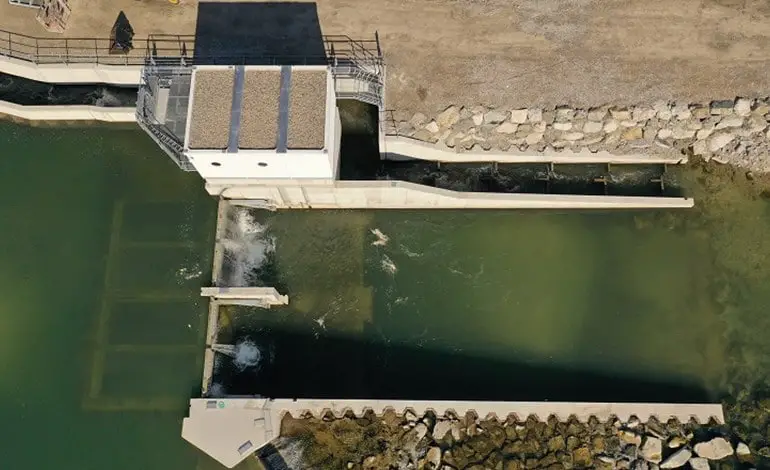
The Großweil Shaft Hydropower Plant continues to demonstrate how innovative civil engineering can support renewable energy generation while reducing impacts on river ecosystems. Since becoming the world’s first operational shaft hydropower facility, the project has remained an important reference for sustainable hydropower construction.
As of 2026, the demonstration plant continues generating electricity on Bavaria’s Loisach River while providing valuable operational and environmental data for future low-impact hydropower developments across Europe.
Großweil Shaft Hydropower Plant reaches operational maturity
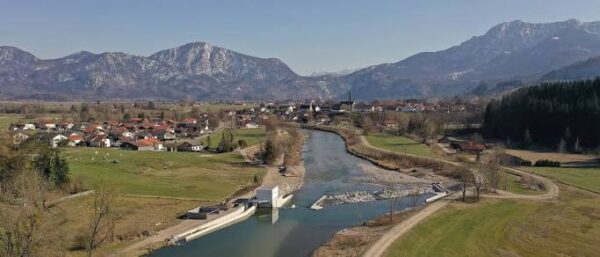
The Großweil Shaft Hydropower Plant has moved beyond its launch phase and is now firmly established as an operational demonstration project. Located near Großweil in Bavaria, Germany, the facility continues supplying renewable electricity while supporting ongoing research into environmentally compatible hydropower technology.
Developed through years of research by the Technical University of Munich (TUM), the project introduced a fundamentally different approach to small-scale hydropower construction. Instead of building a conventional powerhouse beside the river, engineers placed the turbine and generator inside a vertical underground shaft beneath the riverbed.
This design significantly reduces the visual footprint of the installation while preserving much of the natural river landscape. The compact construction method also limits land use and integrates more effectively into environmentally sensitive locations.
Großweil Shaft Hydropower Plant informs future hydropower construction
As of 2026, researchers continue monitoring the project’s hydraulic, structural and ecological performance. Operational data collected from the plant is helping engineers refine the Hydroshaft technology for wider commercial deployment.
Recent scientific studies indicate that the project has successfully demonstrated the technical feasibility of underground shaft hydropower systems. However, researchers also found opportunities to further improve fish protection around turbine passages. These findings are shaping the next generation of environmentally friendly hydropower facilities rather than diminishing the project’s engineering significance.
The project therefore remains a living research laboratory for sustainable infrastructure. Engineers continue evaluating turbine efficiency, sediment transport, river hydraulics and aquatic biodiversity under real operating conditions.
The demonstration has also attracted international attention from governments, utilities and engineering firms seeking practical solutions that balance renewable electricity generation with environmental conservation.
Großweil Shaft Hydropower Plant complements Britain’s energy storage strategy
While the Großweil Shaft Hydropower Plant focuses on environmentally sensitive run-of-river electricity generation, Britain’s latest hydropower programme addresses a different challenge.
Britain’s proposed $4.1 billion Britain hydropower storage project aims to strengthen national energy security through pumped-storage hydropower capable of storing surplus renewable electricity for later use.
Together, the two projects demonstrate how hydropower construction is evolving in different directions. Germany is refining environmentally integrated hydropower technology, while Britain is investing in large-scale energy storage infrastructure that supports an increasingly renewable electricity grid.
The projects also highlight growing investment in modern hydropower solutions as countries seek reliable low-carbon electricity while reducing dependence on fossil fuels and improving energy resilience.
Project fact sheet
Project name: Großweil Shaft Hydropower Plant
Location: Großweil, Bavaria, Germany
River: Loisach River
Project type: Run-of-river shaft hydropower plant
Technology: Hydroshaft underground turbine system
Status (2026): Operational demonstration and research facility
Commercial operation: Ongoing
Primary objective: Generate renewable electricity with minimal environmental impact
Key innovation: Underground powerhouse installed beneath the riverbed
Engineering features:
- Vertical shaft construction
- Underground turbine chamber
- Reduced surface infrastructure
- Lower visual impact
- Smaller construction footprint
Research areas:
- Fish migration
- Turbine performance
- River hydraulics
- Sediment transport
- Ecological monitoring
Strategic importance: Demonstrates next-generation low-impact hydropower technology suitable for environmentally sensitive waterways.
Project team
Project developer: Technical University of Munich (TUM)
Technology developer: Hydroshaft technology research team
Technology commercialization: Hydroshaft GmbH
Research lead: Chair of Hydraulic and Water Resources Engineering, TUM
Project location partner: Municipality of Großweil
Environmental monitoring: Technical University of Munich researchers
Regulatory stakeholders: Bavarian water and environmental authorities
Industry partners: German hydropower engineering specialists and renewable energy contractors
Project purpose: Demonstration, research and commercial validation of Hydroshaft technology
Current focus (2026): Long-term operational monitoring, environmental optimization and preparation for wider deployment of shaft hydropower systems in Europe.


Leave a Reply