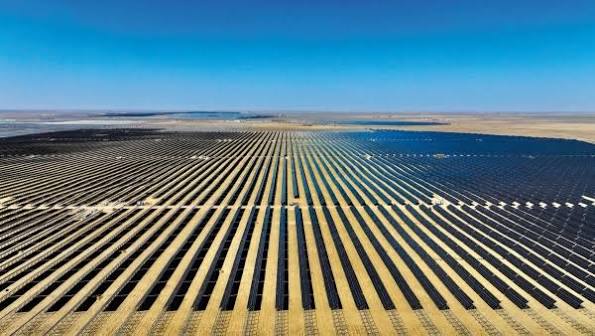
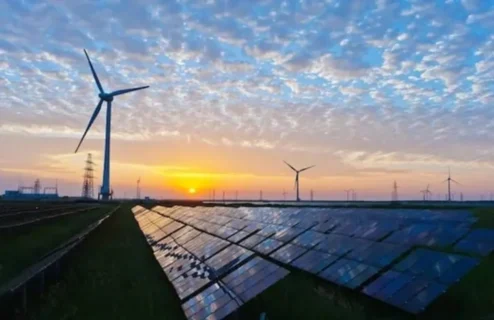
The Hangjin Banner solar project has achieved full-capacity grid connection in Ordos, Inner Mongolia, marking a major renewable construction milestone. The 1.1 GW development combines 800 MW of solar photovoltaic capacity with 300 MW of wind generation. Consequently, the project can now supply renewable electricity to the West Inner Mongolia power grid. It expects to generate approximately 2.4 billion kWh of electricity annually.
The project also introduces an integrated approach to renewable energy construction in desert terrain. Developers combined the power infrastructure with sand-control measures and desert vegetation. Therefore, the scheme addresses both electricity generation and land restoration within the same development.
The Hangjin Banner solar project forms part of China’s broader expansion of renewable energy infrastructure across Inner Mongolia. Its completion also demonstrates how large-scale solar and wind projects can integrate environmental restoration into construction planning.
Hangjin Banner Solar Project reaches full grid connection
The latest milestone moves the project from construction into grid-connected operation. POWERCHINA achieved full-capacity grid connection for the 1.1 GW wind-solar development this week.
The solar component accounts for 800 MW of the project’s total capacity. Meanwhile, the wind component contributes another 300 MW to the integrated renewable facility.
Together, the two generation sources should produce about 2.4 billion kWh annually. The electricity will feed into the West Inner Mongolia power grid.
The grid connection therefore represents the project’s most significant construction milestone. It confirms completion of the infrastructure required to connect the renewable generation assets to the regional electricity network.
Furthermore, the achievement adds new renewable generation capacity to one of China’s major clean-energy regions. Inner Mongolia continues to develop large wind and solar projects across its extensive desert and semi-arid areas.
The project also reflects China’s strategy of building renewable energy bases alongside supporting grid infrastructure. Such developments require coordinated civil works, electrical systems, transmission facilities and generation assets.
Hangjin Banner Solar Project integrates desert-control construction
Beyond generation capacity, the project incorporates measures designed to control shifting desert sands. Construction teams deployed photovoltaic arrays alongside straw checkerboard barriers and desert vegetation.
The approach supports China’s Three-North Shelterbelt Forest Program, which targets ecological protection and desertification control. As a result, the project combines renewable infrastructure with environmental engineering.
The location also presents demanding construction conditions. Hangjin Banner lies within the wider Kubuqi Desert landscape, where strong winds can move loose sand across infrastructure corridors.
Recent research has examined how photovoltaic developments in Hangjin Banner can influence soil and vegetation restoration. Studies have identified the area’s harsh climate, low rainfall and significant aeolian activity.
Therefore, desert-control measures can support the long-term operation of renewable infrastructure. Stabilized ground can help protect access routes, equipment areas and other project facilities.
The wider Hangjin Banner area has also continued expanding dedicated sand-control construction. Xinhua reported ongoing installation of straw checkerboard barriers in the Kubuqi Desert in May 2026.
Hangjin Banner Solar Project advances automated construction
The project also introduces automation into large-scale photovoltaic construction. POWERCHINA deployed intelligent PV installation robots during the project works.
Each robot can install more than 800 photovoltaic modules per day. Consequently, automated installation can accelerate repetitive construction activities across extensive solar fields. It can also improve consistency during high-volume module deployment.
The technology becomes particularly relevant as China continues developing renewable projects across desert regions. Large projects require substantial module installation, civil works and electrical infrastructure within tight construction schedules.
Meanwhile, the completed project strengthens the renewable infrastructure base around Ordos. It also provides another example of combining solar, wind and ecological construction within one development.
The project does not disclose an official total investment figure in the latest reports. Therefore, the $1 billion-plus value should remain an indicative industry estimate rather than an announced project cost.
The achievement nevertheless demonstrates the scale of capital and construction required for modern renewable energy infrastructure. More importantly, the full-capacity grid connection confirms that the Hangjin Banner Solar Project has reached its operational milestone.
China is also advancing another major solar construction project in Qinghai. The Delingha solar tower project involves a 200 MW concentrated solar power facility and uses tower-based solar thermal technology. Construction began under POWERCHINA Northwest as EPC contractor, with CGN New Energy as the investor.
Project fact sheet
Name: Hangjin Banner Wind-Solar Project.
Type: Integrated utility-scale solar and wind power development.
Location: Hangjin Banner, Ordos, Inner Mongolia, China.
Total installed capacity: 1.1 GW.
Solar photovoltaic capacity: 800 MW.
Wind power capacity: 300 MW.
Current status: Full-capacity grid connection achieved.
Grid connection: West Inner Mongolia power grid.
Grid connection milestone: August 2026.
Expected annual electricity generation: Approximately 2.4 billion kWh.
Solar technology: Utility-scale photovoltaic generation.
Wind technology: Utility-scale wind generation.
Environmental component: Desertification control and ecological restoration.
Sand-control technology: Straw checkerboard barriers.
Ecological framework: China’s Three-North Shelterbelt Forest Program.
Robot productivity: More than 800 modules installed per day by each robot.
Project developer/contractor: Power Construction Corporation of China (POWERCHINA).
Operational milestone: Full-capacity grid connection achieved in August 2026.
Project team
Project developer: Power Construction Corporation of China (POWERCHINA).
Main construction contractor: POWERCHINA.
Grid connection authority/interface: West Inner Mongolia power grid.
Environmental program: China’s Three-North Shelterbelt Forest Program.
Current project responsibility: POWERCHINA has confirmed full-capacity grid connection.

Leave a Reply