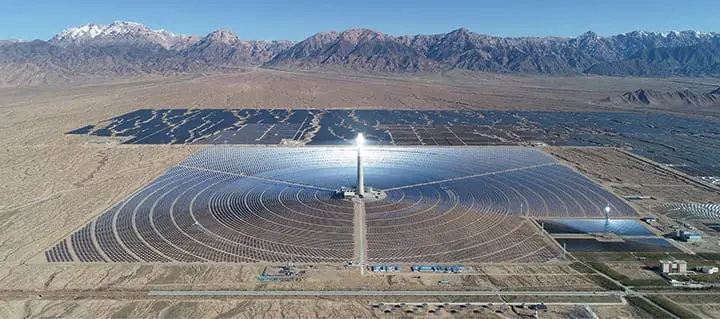
The Delingha solar project has reached full-capacity operation in Qinghai, China, completing its transition from construction to commercial renewable generation. The $625 million development combines 800 MW of photovoltaic capacity with a 200 MW solar tower facility. Together, the systems provide 1 GW of renewable generation within the Delingha Solar Industrial Park. The project also incorporates molten-salt thermal storage to improve the reliability of solar power supply.
The development represents a major milestone for China’s concentrated solar power construction program. Its solar tower component ranked among the world’s largest single-unit tower CSP facilities during construction. Moreover, the hybrid design combines conventional photovoltaic generation with dispatchable solar thermal power.
Major Construction Milestones of Delingha Solar Project
Construction of the Project began on March 13, 2024. The 200 MW tower CSP component formed the centerpiece of the development.
The receiver tower reached its final height of approximately 188.5 meters in October 2024. Meanwhile, construction teams progressed with the power block, heliostat field and thermal storage infrastructure.
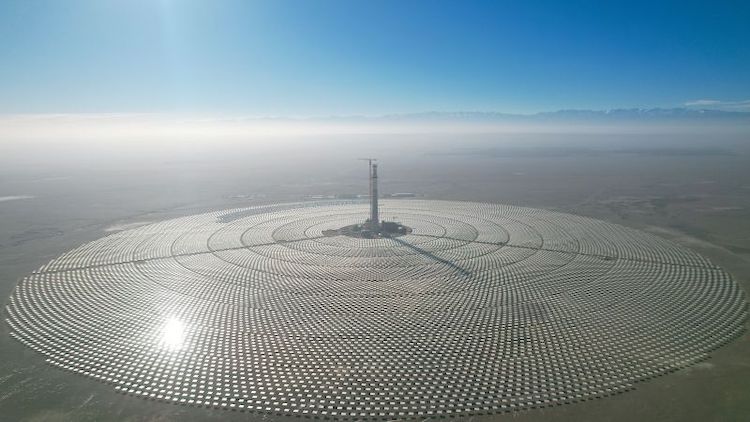
The project installed 21,534 heliostats across the solar field. These mirrors concentrate sunlight onto the receiver positioned at the tower’s summit.
The photovoltaic component also advanced separately during construction. The 800 MW PV facility achieved full-capacity grid connection in December 2024.
Furthermore, the CSP facility completed its first turbine roll in January 2026. This milestone demonstrated progress toward integrated operation of the solar thermal generation system.
By May 2026, the entire 1 GW first-phase development had reached full-capacity operation. The milestone now places the completed project among China’s major hybrid renewable energy developments.
Scope of Delingha Solar Project
The project covers two complementary renewable generation technologies. The first component provides 800 MW through conventional photovoltaic generation.
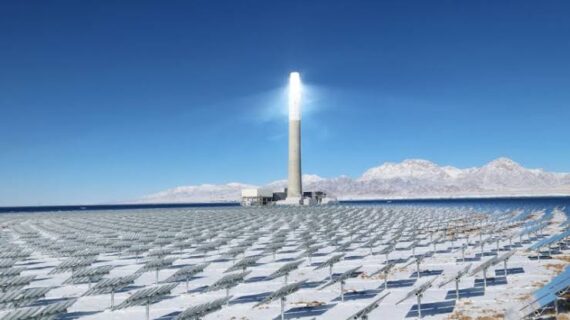
The second component provides 200 MW through tower-based concentrated solar power technology. The CSP facility uses thousands of heliostats to concentrate sunlight onto a central receiver.
Molten salt absorbs and stores the concentrated solar heat. The thermal storage system provides approximately six hours of energy storage.
The facility has an effective thermal storage capacity of about 2,646 MWhth. Therefore, the CSP plant can continue producing electricity after solar irradiation declines.
The project also includes a 100 MW electric heating system. This system can convert surplus photovoltaic electricity into thermal energy for storage.
Additionally, the development includes supporting electrical infrastructure. A 330 kV booster substation forms part of the project’s grid connection system.
The completed development expects to generate approximately 1.8 billion kWh annually. It could also save around 550,000 tonnes of standard coal every year.
Furthermore, the project could reduce annual carbon dioxide emissions by approximately 1.3 million tones. These benefits strengthen the environmental case for combining PV generation with thermal storage.
The wider development program targets 2 GW across two phases. Each phase includes 800 MW of PV and 200 MW of CSP.
The completed 1 GW facility represents the first phase of that larger renewable energy program. Consequently, further construction could expand the site’s hybrid generation capacity.
Delingha Solar Project Strengthens China’s CSP Pipeline
The project’s completion demonstrates China’s continued investment in concentrated solar power infrastructure. Unlike standalone PV plants, tower CSP facilities can store thermal energy for later electricity generation.
This capability provides additional flexibility for power-system operators. It also allows renewable generation to extend beyond periods of maximum solar irradiation.
The Delingha development therefore combines large-scale generation with energy storage infrastructure. That approach addresses some of the intermittency challenges associated with conventional solar PV.
The project also creates a construction model that integrates several specialist disciplines. These include civil engineering, solar-field construction, thermal systems, power generation and electrical infrastructure.
Meanwhile, the project’s scale demonstrates the engineering requirements of utility-scale tower CSP. The 188.5-metre receiver tower supports a field containing more than 21,000 heliostats.
The project also connects with China’s broader renewable construction expansion. Inner Mongolia’s Hangjin Banner development recently achieved full-capacity grid connection. That 1.1 GW project combines 800 MW of solar PV with 300 MW of wind generation.
Together, the projects demonstrate China’s increasingly diversified renewable construction pipeline. One combines solar and wind, while the other integrates PV with dispatchable solar thermal generation.
How the plant will work
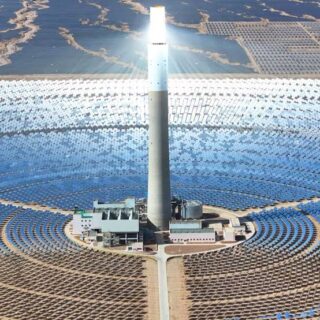
The project adopts the hybrid form of photovoltaic and molten salt solar thermal power generation. It then uses the heat from solar field and the residual electricity of curtailment wind and solar power in the area to heat the molten salt in the thermal energy storage tank. Next, it generates high-temperature steam through the salt-water heat exchanger to drive the steam turbine generator to generate electricity.
Also Read:Astronergy to supply PV modules for 6th phase of one of the world’s largest IPP solar projects
The world’s largest solar tower Capacity
The Delingha Solar Hybrid project has a total capacity of 2000MW. It will spread across a planned area of about 53,000 mu (3529.8 million square meters). The total design annual utilization hours of this 200MW CSP plant is [projected to be] 1,319 hours, [for] an annual power generation of 263.88 million kWh. After the whole project is completed and put into operation, the annual on-grid electricity could reach 3.65 billion kWh. Mr. Ke Xijun, the head of the project said.
The project will be built into the first new energy hybrid demonstration project in the western part of the Haixi region with a molten salt CSP plant as the peak shaving power supply, helping the construction of a national clean energy industry highland in Qinghai Province and contributing to the achievement of the carbon neutral goal.
Also Read: Manchester City FC’s 4.39MW solar power plant to be the world’s largest by a football club
Cosin Solar won the contract for Solar Field and MSR Systems equipment supply for the Delingha Solar. They will mainly be responsible for the engineering, equipment supply, system integrations, related commissioning and operation guidance services of the solar field and MSR system.
The Jinta Zhonguang CSP project
Cosin solar is also building the 100 MW Jinta Zhonguang CSP project. The project will have an expected generation of 209 GWh/year and will be constructed over an area of 3.62 km². Construction began in 2022 and is expected to be completed later this year. The Jinta Zhongguang project was originally one of three Three Gorges Renewables’ demonstration projects in 2016. However, Three Gorges failed to start this one in time, and Cosin took it over and was given more time to complete it. In December last year, the installation of the 25594th heliostats was successfully completed in the Jinta ZhongGuang Solar “CSP + PV” hybrid pilot project 100MW CSP project. This marked the completion of the assembly and installation of all the heliostats in the project.
Also Read: BayWa r.e. Commences construction of 188 Megawatt Wind and Solar Leading Project in Spain
Project fact sheet
Project name: Delingha Solar Tower Project.
Official development: CGN Delingha 1 GW Integrated CSP and PV Project.
Location: Delingha City, Haixi Mongolian and Tibetan Autonomous Prefecture, Qinghai, China.
Project value: Approximately RMB4.5 billion, equivalent to about US$625 million.
Total first-phase capacity: 1 GW.
Solar PV capacity: 800 MW.
Tower CSP capacity: 200 MW.
Technology: Tower-based concentrated solar power with molten-salt storage.
Thermal storage duration: Approximately six hours.
Thermal storage capacity: Approximately 2,646 MWhth.
Heliostats: 21,534.
Receiver tower height: Approximately 188.5 metres.
Expected annual generation: Approximately 1.8 billion kWh.
Expected annual standard coal savings: Approximately 550,000 tonnes.
PV grid connection: December 2024.
Expected annual CO₂ reduction: Approximately 1.3 million tonnes.
CSP first turbine roll: January 2026.
Full-capacity operation: Achieved by May 2026.
Grid infrastructure: 330 kV booster substation.
Electric heating system: 100 MW.
Wider planned capacity: 2 GW.
Second phase scope: 800 MW PV and 200 MW CSP.
Current status: First-phase 1 GW project fully operational.
Construction start: March 13, 2024.
Project team
Project owner: CGN Solar Energy Delingha Co., Ltd.
Parent company: China General Nuclear Power Corporation (CGN).
Lead EPC contractor: PowerChina Northwest Engineering Corporation.
EPC consortium member:
- PowerChina Hubei Electric Engineering Co., Ltd.
- Northwest Hydropower Engineering Co., Ltd.
Solar-field and molten-salt systems supplier: Cosin Solar.
Preliminary design: PowerChina Northwest Engineering Corporation.
Design supervision: Northwest Electric Power Design Institute of China Power Engineering Consulting Group.
Current operational responsibility: CGN Solar Energy Delingha Co., Ltd.
Current project status: First-phase 1 GW development operating at full capacity.