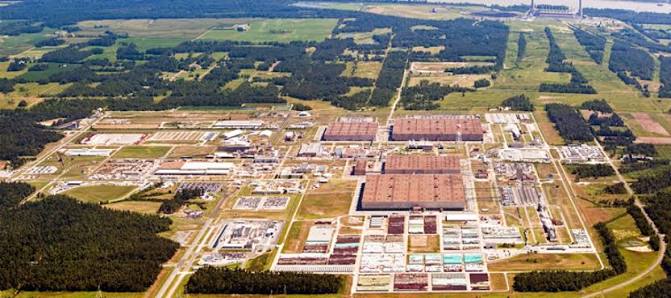
A coalition led by Brookfield and NextEra Energy has unveiled plans to develop a $100 billion artificial intelligence data center campus at the U.S. Department of Energy’s Paducah Site in western Kentucky, transforming part of the former uranium enrichment complex into one of the largest AI infrastructure developments ever proposed in the United States.
The privately funded project will redevelop federal land at the historic Paducah site into a hyperscale computing campus supported by dedicated power generation built specifically for the facility. When fully completed in 2032, the campus is expected to provide up to 1.8 gigawatts (GW) of utility capacity and more than 1.2 GW of computing capacity.
To meet those power requirements, NextEra Energy will develop up to 4.6 GW of new generation resources, including as much as 2 GW of natural gas-fired generation and up to 2.6 GW of battery energy storage. The generation assets will be financed and constructed exclusively for the project, allowing the campus to operate without shifting infrastructure costs to existing residential or small-business electricity customers.
Brookfield to Lead Data Center Development as NextEra Builds Dedicated Po
The announcement brings together Brookfield, NextEra Energy, Big Rivers Electric Power Corporation, Jackson Purchase Energy Cooperative and Paducah Power System as partners in the development. Brookfield will develop and operate the AI campus, while NextEra Energy will own and build the dedicated power infrastructure.
Jobs
The partners expect the project to create approximately 8,000 construction jobs and support around 600 permanent operations jobs once the campus enters service.
The project stems from the Department of Energy’s Request for Offers, which the agency issued in November 2025 to seek proposals for repurposing portions of the Paducah Site under its American Energy Hubs initiative. After evaluating the proposals, DOE selected Brookfield to lease the land and develop the data center campus and selected NextEra Energy to build and own the dedicated generation resources. The partners must still negotiate and execute definitive agreements before moving the project forward.
Energy Secretary Chris Wright described the development as a model for future AI infrastructure projects, saying it shows how developers can pair large-scale computing facilities with new electricity generation instead of relying solely on existing regional power supplies. He added that the approach provides a roadmap for building major digital infrastructure without increasing electricity costs for surrounding communities.
The former Paducah uranium enrichment site was selected partly because of its existing industrial infrastructure. The property already has high-capacity electric transmission, water systems, fiber connectivity, transportation infrastructure and large tracts of developable land, reducing the amount of new site infrastructure required before construction can begin.
Regional Utilities to Supply Electricity for Paducah AI Campus
Wholesale electricity for the campus will be provided through Big Rivers Electric Power Corporation, while Jackson Purchase Energy Cooperative will deliver retail electric service. Paducah Power System will support the project as a local utility partner. The proposed power service arrangement will require additional oversight and approval from the Kentucky Public Service Commission before implementation.
According to Brookfield CEO Bruce Flatt said the Paducah development represents the starting point for the company’s broader plan to invest $100 billion in artificial intelligence infrastructure across the United States, with the Kentucky campus serving as its first major deployment under that strategy.
NextEra Energy Chairman, President and CEO John Ketchum said the project demonstrates an approach in which large AI data centers finance their own generation and transmission infrastructure while strengthening local grid reliability and supporting regional economic development.
As AI data center developers pursue projects requiring unprecedented amounts of electricity, energy strategies are evolving beyond traditional grid connections. While the proposed Paducah campus plans to secure 4.6 GW of dedicated on-site power, other projects are strengthening existing electricity networks through large-scale storage, including Ohio’s Flint Grid, a 1+ GWh battery energy storage project under construction near the New Albany data center corridor.
Additionally, the Paducah development reflects the accelerating pace of AI infrastructure investment across the United States, where developers are pairing hyperscale computing campuses with dedicated energy systems to meet rapidly growing power demands. A similar trend is underway in Texas, where the Snyder AI Data Center Campus recently broke ground on a major AI-focused facility backed by large-scale power infrastructure, underscoring how energy availability is becoming a defining factor in the next generation of hyperscale data center developments.
Project Factsheet: Paducah AI Data Center Campus
- Project: DOE Paducah AI Data Center Campus
- Location: Paducah Site, Western Kentucky
- Total Investment: $100 billion (privately funded)
- Project Type: Hyperscale AI data center campus
- Developer: Brookfield
- Power Infrastructure Developer: NextEra Energy
- Project Partners: Brookfield, NextEra Energy, Big Rivers Electric Power Corporation, Jackson Purchase Energy Cooperative and Paducah Power System
- Expected Completion: 2032
- Compute Capacity: More than 1.2 GW
- Utility Capacity: Up to 1.8 GW
- Dedicated Generation: Up to 4.6 GW
- Natural Gas Capacity: Up to 2 GW
- Battery Energy Storage: Up to 2.6 GW
- Construction Jobs: Approximately 8,000
- Permanent Operations Jobs: Approximately 600
- Site Background: Redevelopment of the former DOE uranium enrichment facility under the Department of Energy’s American Energy Hubs initiative
- Regulatory Status: Subject to negotiation of definitive agreements and approval of the power service arrangement by the Kentucky Public Service Commission.


Leave a Reply