Google India Data Centre construction in Andhra Pradesh has encountered mounting environmental and legal challenges as concerns over water availability and wildlife protection intensify around one of the world’s largest planned artificial intelligence infrastructure investments. While site works continue near Visakhapatnam, activists, local residents and environmental groups have questioned the project’s location, prompting court proceedings that could influence how India approves future hyperscale data center developments.
The $15 billion project forms a cornerstone of India’s ambition to become a regional AI and cloud computing hub. However, its environmental footprint has shifted attention from its economic promise to its long-term sustainability. The debate now centers on whether large-scale digital infrastructure can coexist with sensitive ecosystems and communities already facing water stress.
Google India Data Centre faces water and wildlife scrutiny
The project occupies land near Visakhapatnam in Andhra Pradesh, close to the Kambalakonda Wildlife Sanctuary. Environmental groups argue that construction activity threatens biodiversity and places additional pressure on natural resources.
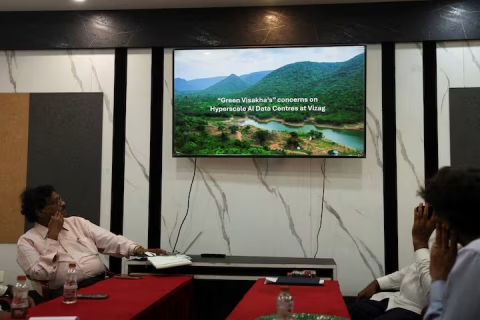
Campaigners have filed public interest litigations before the Andhra Pradesh High Court, alleging authorities approved the development without adequately assessing its cumulative environmental impacts. They contend that regulators overlooked potential effects on water resources and nearby wildlife habitats.
Water availability has become the central issue. Visakhapatnam already faces a daily water deficit of about 70 million litres. Opponents argue that a hyperscale AI data centre could worsen shortages unless sustainable water sources support future operations.
Environmental groups have also raised concerns about the project’s proximity to the Kambalakonda Wildlife Sanctuary. According to court filings, parts of the development lie less than one kilometre from the protected area, increasing fears over habitat disturbance during construction and operation.
State authorities reject claims that the project threatens public water supplies. Officials maintain that environmental approvals complied with applicable regulations and insist household and agricultural water allocations will remain protected.
Google has defended the project by highlighting advanced cooling technology designed to reduce water consumption. The company also says noise mitigation measures will limit operational impacts on neighbouring communities and wildlife.
Also read: Adani’s $11.6 Billion Odisha Data Center Project Proposed in India as Land Search Begins
Google India Data Centre highlights India’s AI infrastructure dilemma
The dispute reflects broader challenges facing India’s rapidly expanding data centre sector. Demand for AI computing continues to accelerate, yet access to land, electricity and water increasingly shapes project viability.
India currently hosts a relatively small share of global data centre capacity despite generating a significant portion of worldwide digital data. Consequently, governments continue encouraging large investments to strengthen domestic computing infrastructure and attract global technology companies.
Nevertheless, resource constraints have become a growing consideration for developers. Investors and environmental organisations increasingly expect technology companies to demonstrate responsible water management alongside energy efficiency and carbon reduction.
The Andhra Pradesh High Court will continue hearing petitions related to the project later this month. The proceedings could establish an important benchmark for environmental oversight of future AI infrastructure developments across India.
Despite the legal uncertainty, the project remains strategically important for India’s digital economy. Its eventual outcome will likely influence how governments balance economic growth, technological competitiveness and environmental stewardship as AI infrastructure expands nationwide.
The environmental scrutiny surrounding the Andhra Pradesh development comes as hyperscale AI infrastructure investment accelerates globally, with Saudi Arabia also advancing major digital capacity through the $3 billion Saudi data center campus developed by HUMAIN and Blackstone-backed AirTrunk.
Also read: $35 Billion DeepSeek Data Center: Construction Planned for 1GW AI Infrastructure in Inner Mongolia
Project fact sheet
Project name: Google India Data Centre Project
Value: $15 billion
Location: Visakhapatnam, Andhra Pradesh, India
Project type: Hyperscale AI data centre campus
Development status: Site works underway while environmental and legal challenges continue
Primary purpose: Artificial intelligence computing and cloud infrastructure
Strategic significance: Google’s first AI data centre campus in India and among its largest global investments
Key environmental issues: Water demand, biodiversity protection, proximity to Kambalakonda Wildlife Sanctuary and environmental approvals
Legal status: Public interest litigations under review by the Andhra Pradesh High Court
Economic objective: Expand India’s AI computing capacity while supporting digital infrastructure growth
Expected timeline: Multi-year development programme extending through the decade
Project team
Project developer: Google
Infrastructure partner: Adani Group
Telecommunications partner: Bharti Airtel
Host government: Government of Andhra Pradesh
State leadership: Andhra Pradesh Chief Minister N. Chandrababu Naidu
Regulatory authority: Andhra Pradesh High Court
Environmental stakeholders: Human Rights Forum, local environmental groups and community representatives
Project location authority: Visakhapatnam District Administration
Technology scope: AI infrastructure, cloud computing and hyperscale data centre operations

Leave a Reply