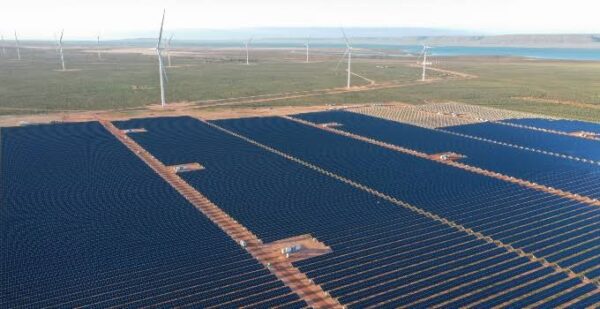
Port Augusta Renewable Energy Park has moved from construction milestone to full operation, establishing a major hybrid renewable facility in South Australia. The 317MW project combines wind and solar generation near Port Augusta.
Iberdrola completed construction in 2022 and began commissioning the facility in October that year. The development now provides a useful benchmark for Australia’s expanding renewable construction pipeline.
Port Augusta Renewable Energy Park reaches full operation
The A$500 million project comprises a 210MW wind farm and a 107MW solar photovoltaic facility. The investment equals approximately US$323 million based on the exchange rate used by Iberdrola when reporting the project value.
The facility includes 50 wind turbines, each rated at 4.2MW, alongside approximately 250,000 solar panels. Together, these assets create an integrated renewable generation complex.
Construction created around 200 jobs and involved Australian, Spanish and international suppliers. The project also introduced construction methods designed to reduce environmental disturbance across the solar site.
In particular, contractors used vegetation rolling to prepare parts of the solar site. The technique retained soil stability, vegetation cover and plant roots during construction.
Iberdrola completed the wind farm installation in September 2021. The company subsequently completed the wider hybrid facility before commissioning began in 2022.
The facility entered commercial operation after registration with the Australian Energy Market Operator. It now operates as Iberdrola’s first renewable energy complex in Australia.
Port Augusta Renewable Energy Park strengthens grid infrastructure
The project connects to South Australia’s transmission network through a 275kV substation and export connection. The connection transfers generated electricity toward the Davenport substation.
The hybrid configuration combines different renewable generation profiles across the day. Solar production supports daytime generation, while the region’s wind resource strengthens output during later hours.
The facility can generate enough clean electricity to meet the equivalent annual demand of approximately 180,000 Australian homes. Iberdrola estimates that it can prevent around 400,000 tones of carbon dioxide emissions annually.
The project also occupies approximately 5,400 hectares southeast of Port Augusta. Its infrastructure includes the wind turbines, solar modules, substation and associated transmission facilities.
The development therefore demonstrates how co-located renewable generation can share infrastructure. This approach can reduce duplication across transmission and grid connection facilities.
Australia’s renewable construction pipeline expands beyond Port Augusta
Port Augusta now provides an operating example as Australia develops larger renewable energy projects. Bungaban Wind Energy Project in Queensland represents a substantially larger proposed wind development. Its 1.4GW capacity highlights the rapid expansion of Australia’s utility-scale renewable construction pipeline.
The Bungaban project recently received federal environmental approval and targets construction from 2027. Its development also includes associated solar generation and battery storage.
Meanwhile, Port Augusta demonstrates the operational potential of combining wind and solar generation within one renewable energy complex. The project’s construction involved multiple specialist contractors across generation and grid infrastructure.
Vestas supplied and installed the 50 wind turbines, while Longi supplied the solar modules. Elecnor delivered the substation, transmission line, storage areas and access roads. Sterling and Wilson constructed the solar facility.
The project also sits within a broader renewable energy transformation around Port Augusta. Nearby developments include additional solar generation, battery storage and infrastructure linked to South Australia’s evolving energy system.
With Port Augusta operating since 2022, the project has moved beyond its original construction objectives. Its current role demonstrates the continuing contribution of hybrid renewable infrastructure to South Australia’s electricity network.
Project Fact Sheet
Name: Port Augusta Renewable Energy Park
Type: Hybrid wind and solar renewable energy project
Location: Port Augusta, South Australia, Australia
Distance from Port Augusta: Approximately 8km southeast
Total installed capacity: 317MW
Wind capacity: 210MW
Solar PV capacity: 107MW
Wind turbines: 50
Turbine capacity: 4.2MW each
Solar modules: Approximately 250,000
Project investment: A$500/ $323 million
Construction commencement: 2020
Wind farm installation completed: September 2021
Construction completed: 2022
Commissioning: October 2022
Current status: Operational
Annual electricity supply: Equivalent to approximately 180,000 homes
Estimated annual emissions avoided: Approximately 400,000 tonnes of CO2
Site area: Approximately 5,400 hectares
Grid connection: 275kV substation and export connection
Grid destination: Davenport substation
Construction employment: Approximately 200 jobs
Owner and operator: Iberdrola
Original developer: DP Energy
Market registration: Australian Energy Market Operator
State: South Australia
Project Team
Owner: Iberdrola
Original project developer: DP Energy
Wind turbine supplier and installer: Vestas
Solar module supplier: Longi
Substation contractor: Elecnor
Transmission line contractor: Elecnor
Access roads contractor: Elecnor
Storage area contractor: Elecnor
Solar construction contractor: Sterling and Wilson
Grid market operator: Australian Energy Market Operator
Electricity network infrastructure: South Australian transmission network
Grid connection: Davenport substation
Electricity generation licensing authority: Essential Services Commission of South Australia
Also Read: West Australia’s largest wind farm, Yandin, goes online.



Leave a Reply