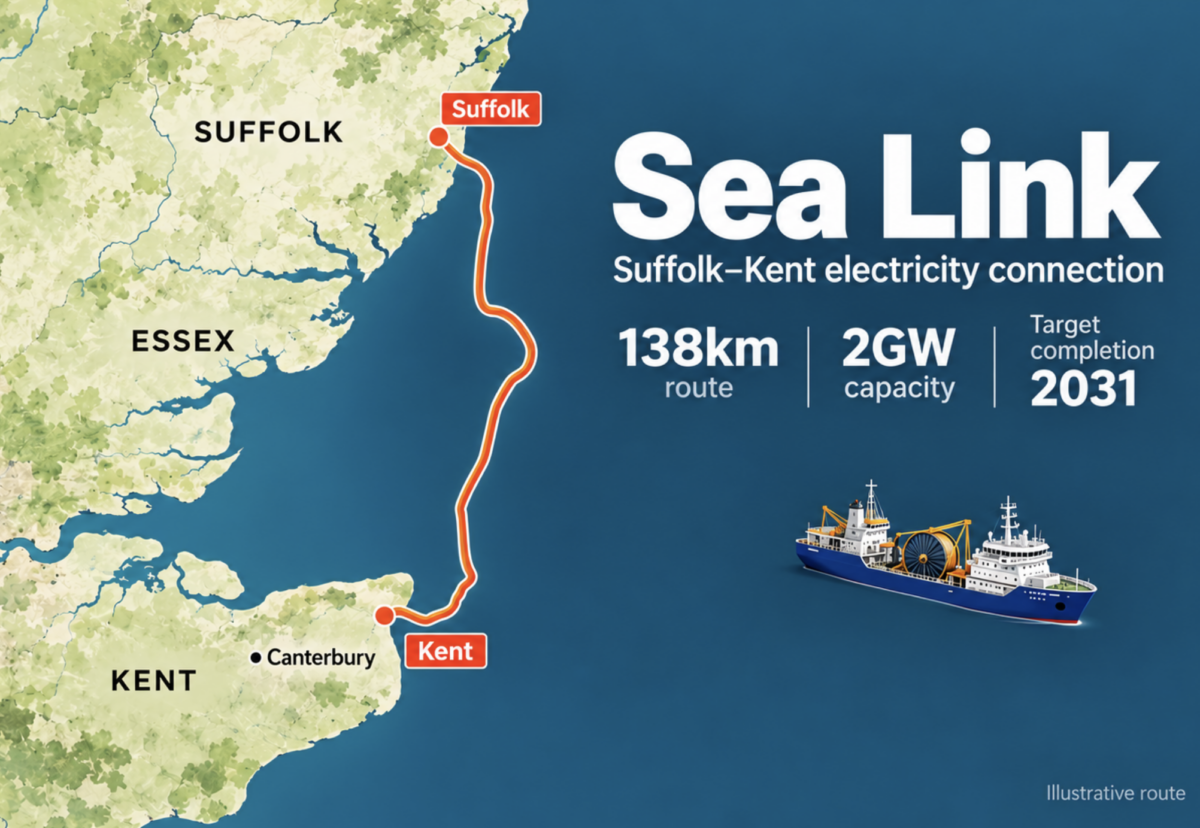
The Sea Link power project has secured UK government development consent, clearing a major planning hurdle for a £3 billion electricity transmission construction scheme connecting Kent and Suffolk. The 138 kilometer infrastructure project will strengthen electricity transmission between eastern England and the southeast. Furthermore, it will help transport renewable electricity to areas experiencing growing demand.
National Grid plans to begin construction in early 2027, with completion targeted for 2031. The approval marks an important step towards expanding Britain’s electricity transmission capacity and reducing constraints on renewable energy distribution.
Sea Link power project advances towards offshore construction
The approved route will carry electricity through 122km of subsea high-voltage direct current (HVDC) cables. These cables will cross the southern North Sea and Thames Estuary between the two counties.
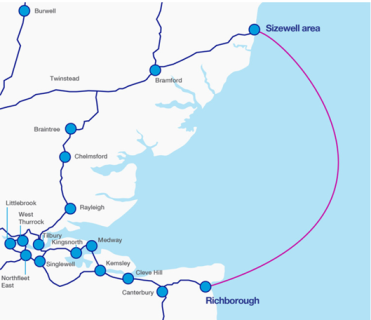
In Kent, the cable will come ashore at Pegwell Bay. It will then connect to a new converter station near Minster. The development also includes a new substation beside the converter facility.
Additionally, National Grid will remove approximately 2.2km of existing overhead lines. It will construct 3.5km of replacement overhead lines to connect the new substation.
In Suffolk, the cable will reach land north of Aldeburgh. The route will connect to another converter station near Saxmundham. Approximately 10km of underground HVDC cable will link the landfall infrastructure to this facility.
Furthermore, approximately 1.9km of high-voltage alternating current (HVAC) cable will connect the converter station to the new Kiln Lane substation near Friston.
The two converter stations will enable electricity to move between the transmission networks. They will convert direct current into alternating current and vice versa, depending on transmission requirements.
Consequently, the infrastructure will allow electricity to flow in either direction. This flexibility will help balance supply and demand across the electricity network.
The project will also strengthen connections between East Anglia and southeast England. In particular, it will help address transmission bottlenecks affecting renewable electricity distribution.
The Sea Link development also complements Britain’s proposed LionLink power project, a cross-border electricity transmission scheme connecting the UK and the Netherlands. Developed by National Grid Ventures and Dutch transmission operator TenneT, LionLink will integrate offshore wind generation with both countries’ electricity networks.
The proposed 2GW connection will strengthen renewable energy distribution across the North Sea, while sharing transmission infrastructure with offshore wind farms. Both projects also involve converter station infrastructure near Saxmundham, creating opportunities for coordinated construction and reduced disruption.
Sea Link power project secures construction delivery partners
National Grid has appointed Siemens Energy to deliver the converter stations in Kent and Suffolk. The contractor will also undertake the associated Minster substation works.
Meanwhile, Sumitomo Electric will supply and install the cable system. The company will manufacture the subsea cables at its new £350 million facility at the Port of Nigg in Scotland.
The manufacturing facility represents an important investment in Britain’s domestic electricity infrastructure supply chain. National Grid says the factory will directly create more than 200 skilled jobs.
Additionally, marine contractor Van Oord is working with Sumitomo Electric on the subsea cable delivery. Their responsibilities support the installation of the offshore connection.
The project therefore combines specialist electrical engineering, cable manufacturing and marine construction capabilities. However, National Grid has not yet announced a comprehensive construction timetable for individual work packages.
The UK government granted the Development Consent Order on October 30, 2026. This followed examination of the application by the Planning Inspectorate.
National Grid will now review the consent requirements and progress detailed construction planning. It will also coordinate environmental commitments, traffic management and engagement with affected communities.
The government has also outlined community benefits for both counties. National Grid will provide more than £1 million each for community funds in Kent and Suffolk.
These funds could support community facilities, green spaces and local skills development.
The estimated project value requires a distinction between the headline figure and regulatory funding. National Grid submitted costs of £3.2 billion, in 2023/24 prices, to Ofgem. The regulator proposed allowing approximately £2.9 billion, with its final funding decision outstanding.
At the November 2, 2026 exchange rate of approximately £1 to $1.339, the £3 billion headline estimate converts to approximately $4.02 billion.
The development forms part of National Grid’s wider Great Grid Upgrade program. This program aims to expand transmission capacity and connect more domestic renewable electricity generation.
Furthermore, the government expects the infrastructure to improve energy security and reduce electricity wastage. It will help move electricity from generation centers to consumers across Britain.
Project Fact Sheet
Name: Sea Link electricity transmission project.
Type: High-voltage electricity transmission infrastructure.
Location: Kent and Suffolk, England, United Kingdom.
Developer: National Grid Electricity Transmission.
Estimated project value: £3 billion.
Cost submission: £3.2 billion in 2023/24 prices.
Ofgem proposed allowance: £2.9 billion, pending final funding determination.
Transmission capacity: 2GW.
Total connection length: 138km.
Subsea cable length: Approximately 122km.
Technology: High-voltage direct current (HVDC) and high-voltage alternating current (HVAC).
Kent landfall: Pegwell Bay.
Suffolk landfall: North of Aldeburgh.
Kent converter station: Near Minster.
Suffolk converter station: Near Saxmundham.
Associated infrastructure: New Minster substation, underground cables, overhead line replacement and connections to Kiln Lane substation.
Cable manufacturing location: Port of Nigg, Scotland.
Development consent: Granted October 30, 2026.
Expected construction commencement: Early 2027.
Expected completion: 2031.
Electricity supply equivalent: Approximately two million homes.
Wider program: National Grid’s Great Grid Upgrade.
Project Team
Developer and project promoter: National Grid Electricity Transmission.
Converter station contractor: Siemens Energy.
Substation contractor: Siemens Energy (Minster associated works).
HVDC and HVAC cable supplier and installation contractor: Sumitomo Electric.
Subsea cable manufacturing partner: Sumitomo Electric, Port of Nigg factory.
Marine construction and installation partner: Van Oord.
Planning and development consent authority: UK Secretary of State for Energy Security and Net Zero.
Planning examination authority: Planning Inspectorate.
Electricity transmission regulator: Office of Gas and Electricity Markets (Ofgem).
Government department: Department for Energy Security and Net Zero.




Leave a Reply