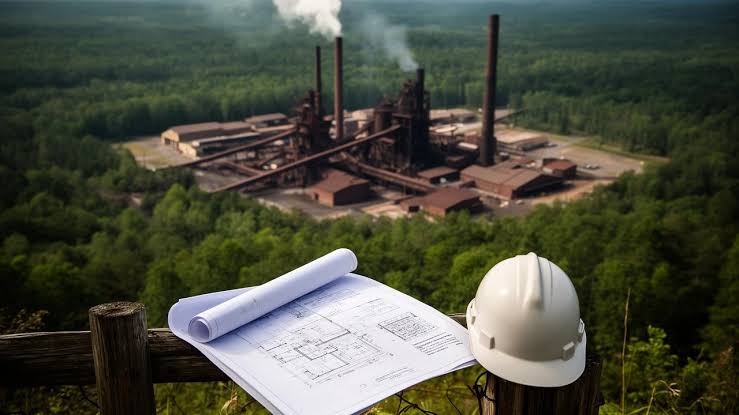
Korea Zinc Project Crucible, a $7.4 billion integrated smelter and critical minerals processing facility in Tennessee, addresses a key weakness in the U.S. critical minerals supply chain: limited domestic processing capacity. As a result, the plant will be able to manufacture 12 different nonferrous metals, including 11 U.S. government-designated critical minerals. Production is expected to start in 2029 and all processes are expected to be fully operational in 2030. Meanwhile, the U.S. Department of Commerce has committed up to $210 million in government funding while the Department of Defense and other financial institutions are providing or arranging up to $4.7 billion in debt financing.
Project Crucible will be located on the former site of a zinc smelter owned by Nyrstar and acquired by Korea Zinc earlier this year in Clarksville, Tennessee. In particular, the plant will manufacture semiconductor grade sulfuric acid and several key minerals such as gallium, germanium, indium and antimony. Project Crucible is thus a transformational investment in U.S. critical mineral security and supply chain resilience.
The facility making headway is the Hanwha Defense manufacturing campus which will invest $2.2 billion to establish an advanced manufacturing campus at the U.S. Army Pine Bluff Arsenal in Arkansas. The plant is thus the first munitions plant the company has built in the United States. The Hanwha Defense manufacturing facility will manufacture propellant charges for 155mm artillery and base-bleed units for U.S. Army readiness. Meanwhile, construction is expected to be finished by 2030 and operations will start in 2031.
Outlook on Project Crucible by Korea Zinc
Korea Zinc’s integrated smelting technology is able to extract several metals from complex raw materials and smelting by-products. In particular, China is the world’s largest producer of critical minerals, with 99 percent of the world’s gallium production, 70 percent of the world’s refined indium, and 86 percent of the world’s refined bismuth in 2024. The U.S. imports 100 percent of its gallium and 85 percent of its antimony, with China providing a large share of U.S. consumption.
In addition, Project Crucible will generate about 540,000 metric tons per year, which is about half the capacity of Korea Zinc’s Onsan smelter in Ulsan. Commerce Secretary Howard Lutnick called Project Crucible a “transformational deal that will change the critical minerals landscape in the United States.
Project Crucible receives FAST-41 Framework Designation and Environmental Clearance.
Project Crucible was designated as part of the U.S. government’s FAST-41 permitting framework, the first time a Korean company has been designated under the program. The coordinated federal permitting approach is designed to increase the predictability of the permitting process and speed project delivery. Further, the Department of War finished its final environmental assessment and found that Project Crucible would not have significant environmental effects. The U.S. government has an equity stake via Crucible JV, holding 2.21 million newly issued Korea Zinc shares and a 10.59 percent stake in the company.
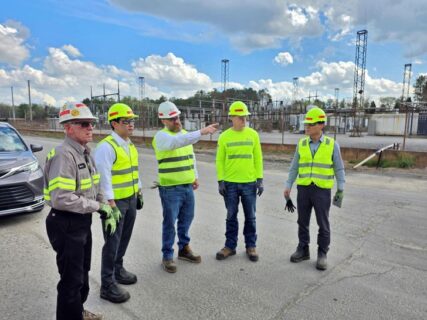
Project Overview
- Project Name: Project Crucible
- Project Value: $7.4 Billion
- Location: Clarksville, Tennessee
- Developer: Korea Zinc
- U.S. Government Funding: $210 Million (Commerce Department)
- Total Financing: $4.7 Billion (Defense Department and others)
- Status: Environmental clearance granted, construction underway
Scope
- Integrated smelter and minerals processing facility
- 12 nonferrous metals production (11 critical minerals)
- 540,000 metric tons annual capacity
- Semiconductor-grade sulfuric acid production
- Multi-metal recovery from raw materials and byproducts
Project Highlights
- Addresses China’s 99% gallium production dominance
- U.S. government equity stake (10.59%)
- FAST-41 permitting framework designation
- Production begins 2029, full operation 2030
- Environmental assessment completed
Key Developments
- Project officially launched April 2026
- Commerce commitment of $210 million announced
- FAST-41 framework designation first for Korean company
- Environmental assessment completed September 2026
- U.S. government equity position established
Key Challenges
- Internal Korea Zinc ownership dispute with MBK Partners
- Shareholder opposition to planned investment
- Managing complex multi-metal production at scale
- Meeting 2029-2030 production timeline
- Integrating existing Clarksville smelter infrastructure
Outlook
- Construction proceeding at Clarksville site
- Production beginning 2029
- Full operational capacity 2030
- Supports U.S.-Korea critical minerals supply chain
- Potential expansion beyond Tennessee location


Leave a Reply