Australia’s proposed 900MW Oven Mountain Pumped Hydro Project in New South Wales (NSW) has been cancelled and officially abandoned after developer Alinta Energy determined that project costs and financing delays affecting critical infrastructure had made the development commercially unviable. The decision ends years of planning for one of the Australia’s major long-duration energy storage projects.
Oven Mountain Pumped Hydro Project was expected to support NSW’s transition to renewable energy. This would have been alongside other major hydro projects such as Snowy 2.0 Hydro Project also in NSW, expected to add about 2 GW of generation and 350 GWh of storage to the electricity grid.
Alinta Energy’s Statement on Oven Mountain Pumped Hydro Project Cancellation
In a statement, Alinta Energy said the decision followed an extensive assessment of the development. The company cited economic and timing challenges affecting key project elements, including a critical transmission line. These were the main reasons cited for discontinuing work on the project.
The decision also follows years of technical studies, planning, stakeholder engagement and development activities.
Oven Mountain Pumped Hydro Project: A Major Energy Storage Development
The Oven Mountain Pumped Hydro Project was planned for a site northwest of Kempsey in northern New South Wales. The proposed off-river facility was designed to deliver 900 megawatts (MW) of generating capacity.
If realized, it would have provide up to eight hours of storage. This is equivalent to approximately 7.2 gigawatt-hours (GWh) of energy.
Project Design
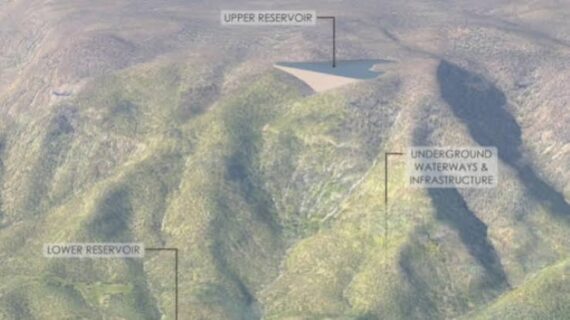
The Oven Mountain Pumped Hydro Project featured two reservoirs separated by an elevation difference of 600 metres. During periods of surplus electricity supply, water would be pumped to the upper reservoir before being released through turbines to generate electricity when demand increased.
Unlike conventional hydropower developments that depend on river flows, off-river pumped hydro facilities use a closed-loop or near-closed-loop reservoir arrangement to store and release energy. The technology can provide longer-duration storage. This also helps balance variable electricity generation from other renewables such as wind and solar farms.
Oven Mountain was expected to supply dispatchable electricity during periods of high demand or reduced renewable generation. Its planned capacity was sufficient to supply electricity equivalent to the consumption of more than 600,000 homes, according to Alinta.
The development had also received critical state significant infrastructure status under the former NSW government. This goes to reflect its intended contribution to the NSW’s future electricity system.
Transmission Infrastructure Contributed to Project Cancellation
The cancellation of Oven Mountain Pumped Hydro Project also highlights the importance of coordinated transmission investment in delivering large-scale energy storage infrastructure. Alinta identified difficulties surrounding a critical transmission line, alongside economic and timing constraints, as key factors that prevented the project from proceeding.
Large pumped hydro developments require substantial upfront investment. This is expected to cover reservoirs, tunnels, underground power stations, waterways and grid connections. Their construction schedules can extend over several years, leaving developers exposed to financing costs, construction risks and changes in electricity market conditions.
Transmission infrastructure is particularly important. This is because storage facilities must be able to absorb electricity from the grid when supply is abundant and deliver it when demand rises. Delays affecting grid connections can undermine and affect project schedules and commercial returns, even where the underlying energy storage technology is established.
In 2024, Alinta entered an early contract agreement with Malaysian construction and engineering company Gamuda and Spain’s Ferrovial Construction through a joint venture. The agreement covered project design and constructability work. This marked an important step in development planning before the eventual cancellation of 900MW Oven Mountain Pumped Hydro Project in NWS, Australia.
Alinta Energy Ownership Changes as Australia Expands Renewable Energy Storage
The decision to abandon the project also comes amid changes in the ownership of Alinta Energy. Singapore-based Sembcorp Industries completed its acquisition of the company in June 2026, following the announcement of the transaction in December 2025.
Sembcorp said the acquisition would combine Alinta’s operating assets and development pipeline with its broader energy capabilities. Alinta’s portfolio included approximately 3.4GW of operating capacity and a 10.4GW development pipeline, according to the company’s acquisition announcement.
However, the cancellation of Oven Mountain demonstrates the challenges developers face in converting proposed infrastructure into operational assets. Large-scale storage projects must compete for capital. This is while accounting for construction complexity, grid availability, financing conditions and the pace of technological change.
The NSW government has meanwhile reported substantial growth in renewable energy and large-scale battery storage since the 2023 state election. A government spokesperson said operational renewable energy capacity had increased by more than 88%. On the other hand, NSW’s operational large-scale battery storage had expanded more than twentyfold.
The government also noted that public funding programs supporting developments such as Oven Mountain were realistic enough. The programs, according to NSW government, recognized that not every supported project would eventually be completed.
What the Cancellation of Oven Mountain Pumped Hydro Project in NSW Means for Australia’s Energy Transition
The loss of Oven Mountain removes a proposed source of long-duration storage from NSW’s future electricity supply plans. This is at a time when the state is preparing for the retirement of ageing coal-fired power stations and greater reliance on renewable generation.
Additionally, pumped hydro can store substantial quantities of electricity for extended periods. This can complement shorter-duration battery systems and help maintain supply when wind and solar output falls. However, such developments often require lengthy approval processes, significant civil engineering works and substantial capital commitments before generating revenue.
Battery storage is also increasingly becoming an alternative for developers. This is because of the comparably quicker construction timelines and modular deployment. Nevertheless, pumped hydro remains relevant for applications requiring large-scale storage over extended periods. This is also particular to where suitable geography and transmission connections are available.
The cancellation also reinforces the need to align energy storage development with transmission planning, project financing and procurement schedules. Without reliable grid infrastructure and commercially viable construction arrangements, much needed projects will continue to struggle with progress from planning to delivery.
Although Oven Mountain Pumped Hydro Project will no longer proceed under Alinta’s plans, the broader need for dependable, long-duration electricity storage remains an important issue for NSW. The Australian state continues to work toward maintaining grid reliability while expanding renewable energy capacity.
Oven Mountain Pumped Hydro Energy Storage Project Fact Sheet
Project type: Off-river pumped hydro energy storage facility
Project status: Cancelled
Location: Near the Macleay River, between Armidale and Kempsey, New South Wales
Renewable energy zone: New England Renewable Energy Zone (REZ)
Original developer: Alinta Energy
Planned generating capacity: 900 MW
Storage duration: 8 hours
Storage capacity: 7.2 GWh
Key infrastructure: Two reservoirs, water conveyance tunnels, an underground power station. Turbines, grid connection infrastructure and access roads were also included in the project’s plan.
Reservoir elevation difference: 600 metres.
Estimated capital cost: A$1.97 billion
Original construction workforce: 800 workers during construction
Expected operational workforce: 95 direct and indirect jobs
Original construction timeline: Construction was planned to begin around 2025–2026
Previous construction completion target: 2030–2031
Reason for cancellation: Cost and timeline challenges
Project Team
Project developer: Alinta Energy
Early Contractor Involvement (ECI) joint venture: Gamuda and Ferrovial Construction
Owner’s engineer: AECOM
Engineering support: Lombardi Engineering
Geotechnical investigations contractor: WSP
Civil engineering: Turnbull Engineering
Federal funding and energy agency: Australian Renewable Energy Agency (ARENA)
State planning authority: NSW Department of Planning, Housing and Infrastructure
Local government stakeholder: Kempsey Shire Council
Traditional Owners and community stakeholders: The Thunggutti people, the Traditional Custodians of the project area.




Leave a Reply