
Updated October 22, 2026 – The estimated cost of Australia’s Snowy 2.0 pumped hydro project has more than doubled from its 2023 budget of A$12 billion as of October 2026. Snowy 2.0 now has a revised target cost of A$22.2 billion and an allowance for a higher-cost scenario of A$25 billion.
The project’s targeted completion has also been pushed back to late 2029. This replaces the previous December 2028 deadline for full commercial operation. The revised estimate also follows a comprehensive reassessment by principal contractor Future Generation Joint Venture (FGJV). The reassessment identified design immaturity, construction complexity, lower-than-target contractor productivity and escalating costs for equipment, services and labor as key factors behind the increase.
Despite the cost and schedule pressures, construction continues. 65% of the project’s tunnel boring work completed and excavation of the underground power station complex is now around 90% complete. Permanent concrete pouring at the underground power station also began in September 2026. Consequently, all six reversible turbines have arrived in Australia ahead of installation.
Snowy Hydro is also strengthening project oversight, cost controls and contractor management as it works to complete the 2,000-megawatt pumped hydro facility. The facility is designed to provide long-duration energy storage and support the integration of renewable electricity into Australia’s grid. This is while other projects such as the 900MW Oven Mountain Pumped Hydro Project – also in New South Wales – get officially withdrawn from development and construction.
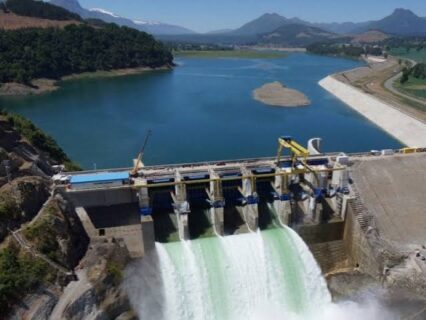
Snowy 2.0 Pumped Hydro Project Fact Sheet
Project type: Pumped-storage hydropower and long-duration energy storage
Location: Snowy Mountains, New South Wales
Project owner and developer: Snowy Hydro Limited
Principal contractor: Future Generation Joint Venture (FGJV)
FGJV consortium members: Webuild, Clough and Lane Construction
Installed generation capacity: 2,000 MW (2GW)
Purpose: To store surplus electricity by pumping water uphill and generate electricity during periods of high demand, supporting renewable energy integration and grid reliability.
Project scope: Construction of an underground power station. 27 km of water conveyance tunnels. The tunnels will connect upper and lower reservoirs. Underground infrastructure.
Upper reservoir: Tantangara Reservoir
Lower reservoir: Talbingo Reservoir
Turbines: Six reversible pump-turbine units
Energy storage duration: 350 GWh of storage capacity, equivalent to up to 175 hours at full 2,000 MW output.
Original estimated cost: A$2 billion when first proposed. The original project cost and scope subsequently changed as of 2026.
Previous revised budget: A$12 billion following the 2023 project reset.
Latest target cost: A$22.2 billion as of October 22, 2026.
Higher-cost scenario: A$25 billion. This is a scenario allowance and not the confirmed final expenditure.
Latest target completion: Late 2029.
Construction status: Ongoing. As of the October 2026 cost reassessment, machine tunnelling was 65% complete. Drill-and-blast tunnelling was at 95% complete. Underground power station cavern excavation was at 90% complete and construction design at 96% complete.
Workforce: More than 5,000 people working on the project
Key construction activities: Tunnel boring, underground excavation, power station construction, concrete works, and installation of electromechanical equipment.
Main project challenges: Design immaturity, geological and engineering complexity, lower-than-target contractor productivity, cost escalation and schedule delays.
Project importance: The project is intended to strengthen Australia’s electricity grid by providing large-scale, long-duration storage to complement wind and solar generation.
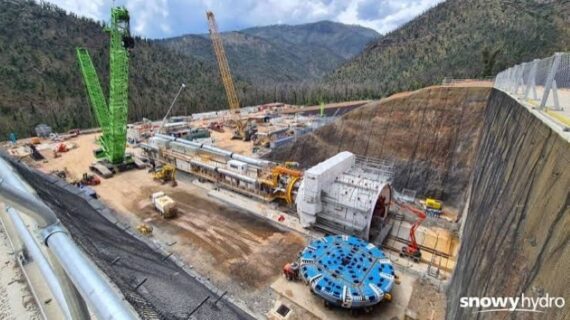
Tunneling Work Continues at Snowy 2.0 Pumped-Hydro Project in Australia
Reported February 16, 2026 – Snowy 2.0 pumped-hydro expansion in Australia remains one of the most ambitious grid-scale storage projects underway in the world as countries continue to scale their own energy transition strategies. As of early 2026, tunneling progress has advanced significantly after earlier geological delays, with major underground works continuing and transmission integration planning underway. Once operational, the scheme will add about 2 GW of generation and 350 GWh of storage, providing long-duration backup for Australia’s rapidly expanding wind and solar portfolio.
Project Team
Developer
- Snowy Hydro
Primary Contractors
- Future Generation Joint Venture — EPC civil works
- Voith Hydro — turbines & generators
- Webuild — tunnelling partner
- Clough — JV partner
Key Stakeholders
- Australian Federal Government (owner)
- NSW Government
- Australian Energy Market Operator
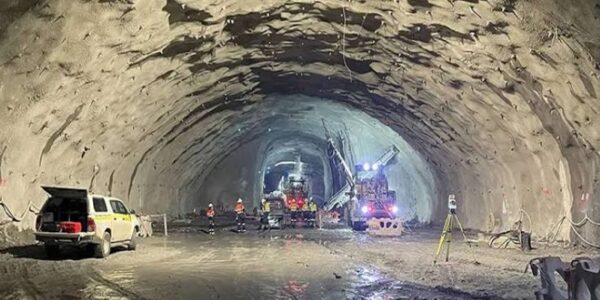
Cost of Snowy 2.0 pumped hydro project Surges to $12 Billion in Half a Year
Reported August 20, 2023 – The cost associated with the Snowy 2.0 pumped hydro project has experienced a twofold increase over the last six months, approaching nearly $12 billion as indicated by a recent cost evaluation. This surge has compelled the Albanese government to undertake a crucial and financially significant decision regarding the project’s continuation.
Initially unveiled by former prime minister Malcolm Turnbull in March 2017, the ambitious expansion of the Snowy pumped hydro project to 2000 megawatts had an initial projected completion date of 2021 and an estimated cost of $2 billion. However, by May of this year, the cost had expanded to $5.9 billion, and the expected completion date was pushed to 2029.
Trouble in sight
However, due to concerns of falling behind schedule, Snowy’s CEO Dennis Barnes initiated an internal assessment. Three reliable insiders, requesting anonymity for candidness, disclosed that the updated cost has now approached approximately $12 billion.
Climate Change and Energy Minister Chris Bowen was expecting to receive advice from Snowy on Tuesday regarding the substantial cost escalation. On Thursday, the board of the government-owned corporation is set to deliberate on the review and the revised corporate strategy, which will be published after the meeting.
According to information received, this review will, for the first time, attribute the cost increase to a failure in adequately factoring in geological conditions such as soft soil in Snowy 2.0’s design, which was formulated under the previous Coalition government. This will be in addition to factors such as inflation, labor costs, and delays stemming from COVID-19 restrictions.
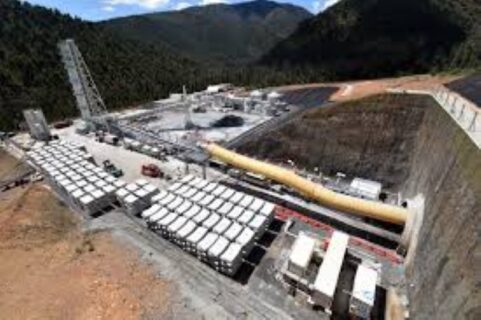
Enhanced Generation Capacity of Snowy 2.0 pumped hydro project
Snowy 2.0 is poised to increase the scheme’s overall generation capacity to 375,000 megawatt-hours, equivalent to sustaining 2000 megawatts for an entire week. In contrast, Tesla’s prominent battery installation in South Australia can provide 150 megawatts for a duration of 195 megawatt-hours, allowing for peak power output for approximately 1.5 hours.
A representative from Snowy mentioned that the company would refrain from commenting on conjecture, but assured that a comprehensive and transparent project update would be shared when appropriate.
“In May, Snowy Hydro communicated its intention to recalibrate the project’s delivery schedule and budget for the national energy storage initiative, Snowy 2.0. This endeavor involves collaboration with its key contractor, the Future Generation Joint Venture,” the spokesperson stated.
“The process for revising the budget is well underway, although it’s an ongoing effort.”
Significant delays in construction occurred earlier this year due to Florence. Snowy’s substantial tunnel-boring apparatus encountered difficulties within soft rock underneath Kosciuszko National Park.
Snowy 2.0 holds significance in promoting the transition to clean energy. This is by providing support to renewable sources during periods of low wind and sunlight. This initiative also employs excess electricity to elevate water to higher levels. The hydro pumps then subsequently releases it to drive turbines during peak demand periods.
Bowen refrained from offering remarks. He, however, previously stated that Snowy 2.0 plays a crucial role in the government’s commitment to increasing the proportion of renewable energy in the electricity grid to 82 percent by 2030. This move is pivotal for achieving the emission reduction goal of 43 percent by the decade’s conclusion.
Also Read: Delivery of Snowy Hydro 2.0 Project in Australia to be extended and cost increased


Leave a Reply