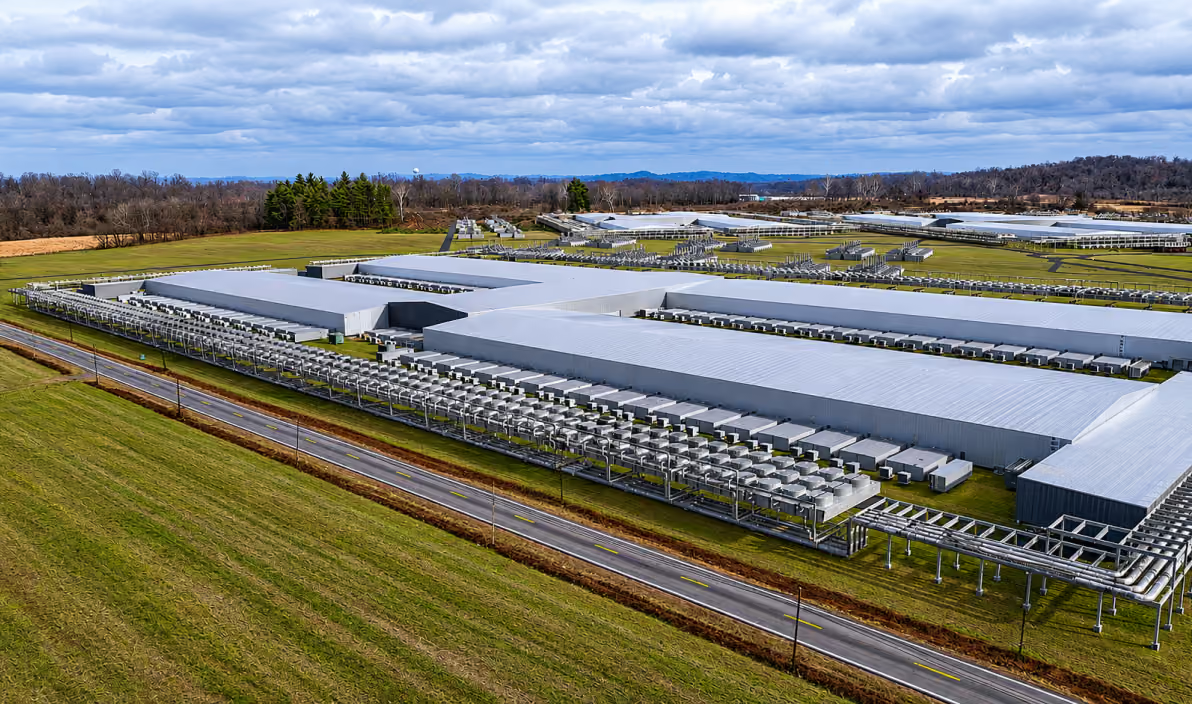
Americans love AI until it shows up in their backyard.
An Economist/YouGov poll conducted August 28–31, 2026 found that 51% of Americans consider new data center construction a bad thing for the country, compared with just 20% who consider it a good thing. The opposition becomes even stronger at the local level: 63% said they would oppose a new data center being built in their community, while only 19% would support one. Most importantly for utilities and policymakers, 60% believe a new data center would increase their electricity costs.
That is not simply a backlash against technology. It is a question of who pays.
America needs more computing capacity. Artificial intelligence is becoming part of research, manufacturing, health care, defense and business. The country cannot afford to fall behind in the infrastructure race.
But private demand should not become public liability simply because it is labeled AI infrastructure.
If the buildout continues, developers and policymakers need to accept a straightforward principle: data centers should pay the incremental local costs of the power, water and infrastructure they require, while communities should receive measurable benefits for the public resources they provide.
The electricity-bill test
The first question for any community is simple: Will AI data centers increase my electricity bill?
That question deserves more than assurances.
A hyperscale campus can require enormous amounts of electricity and trigger investment in substations, transmission lines, generation and other infrastructure. If utilities build those assets specifically to serve a large new load, the developer should carry the appropriate cost and financial risk rather than shifting it automatically to households and small businesses.
Ohio provides an example of what that framework can look like.
AEP Ohio says its data-center tariff requires developers to make binding commitments, provide collateral, demonstrate financial viability and accept an exit fee if a project is canceled or fails to meet its contractual obligations. The utility reported in February that data centers had signed binding contracts covering 5,642 megawatts under the tariff, while total contracted data-center projects in its service territory reached 17,861 MW.
That approach addresses one of the industry’s biggest risks: speculative demand.
A developer should not be able to request enormous amounts of future capacity, prompting a utility to plan billions of dollars of infrastructure, and then walk away without consequence if the project never materializes.
The same principle should apply nationally.
If a data center requires a new substation, transmission upgrade or dedicated generation project, regulators should identify who benefits, who pays and what happens if the projected load never arrives.
The answer should not automatically be the residential ratepayer.
The Duane Arnold restart also comes as the U.S. power sector faces a much larger investment challenge from rapidly growing electricity demand. As utilities and developers add generation to support new loads, the question is increasingly shifting from whether America needs more power to who should pay for the infrastructure behind that demand.
The stranded-infrastructure test
This issue goes beyond today’s electricity bill.
The AI boom is producing enormous power-demand forecasts, but forecasts are not the same thing as operating facilities. Projects can be delayed, redesigned, downsized or canceled.
That creates a risk of stranded infrastructure.
Utilities need certainty before committing customers’ money to assets designed around speculative demand. Developers should therefore face meaningful financial commitments before major infrastructure construction begins.
That can include deposits, phased interconnection agreements, minimum-demand commitments, collateral and cancellation fees.
Ohio’s experience demonstrates why such mechanisms matter. AEP Ohio said its tariff filtered out projects that were unwilling or unable to make binding financial commitments, reducing the amount of requested capacity that proceeded through the process.
This is not anti-data-center policy.
It is ordinary infrastructure discipline.
The shared-infrastructure test
There is, however, an important distinction.
Not every transmission line, substation or generation asset associated with a data center should automatically be classified as a private expense. Some infrastructure can improve reliability, unlock new generation and benefit other electricity customers.
The correct principle is cost causation and shared benefit.
If a project requires infrastructure primarily because of its own enormous electricity demand, it should pay the incremental cost.
If an upgrade provides broad benefits to the wider grid, regulators can allocate costs among the beneficiaries.
That distinction matters because the goal should not be to punish data centers. The goal should be to prevent ordinary customers from unknowingly financing infrastructure built primarily for private industrial demand.
The federal government’s recent Ohio data-center agreement offers one model. The Department of Energy says SB Energy and AEP Ohio plan $4.2 billion in new transmission infrastructure and that SB Energy will pay for that infrastructure rather than shifting those costs to Ohio electricity customers. The agreement also includes a dedicated rate structure designed to ensure the project pays for new power plants and transmission facilities even if it does not use the full amount of electricity initially projected.
That is the kind of accountability communities should expect.
The water and land test
Electricity is only part of the equation.
In some regions, water may be the more politically sensitive resource. Data centers can require water for cooling, while their construction can consume large areas of land and bring new roads, pipelines, substations and other infrastructure.
The right response is not to assume that every data center has the same environmental footprint.
It is to require developers to disclose it.
Before final approval, communities should know:
- How much water the facility expects to consume;
- Where that water will come from;
- What cooling technology the project will use;
- What happens to water consumption during peak conditions;
- What transmission and generation infrastructure the project requires;
- What emissions, noise and traffic the development could create; and
- What additional public infrastructure taxpayers may have to provide.
The technology will continue to change. Cooling systems will become more efficient, power systems will evolve and developers will find new ways to reduce resource consumption.
Regulation should therefore focus on measurable outcomes rather than assumptions.
Communities do not need promises that a project will have no impact. They need enough information to understand the impact before they approve it.
The jobs test
Data centers unquestionably create construction work.
They also create permanent jobs, tax revenue and demand for local services.
But policymakers should distinguish between those benefits rather than treating every announced job as a permanent economic gain.
A major Brookings study updated August 10, 2026 found that large data centers do create local employment, but the effects vary by facility type. The researchers estimated roughly 100 to 200 jobs in a typical treated county, depending on facility type, while finding that wages were unchanged and home prices increased by 2% to 5%. The study also found that hyperscale facilities and colocation facilities produce different local economic effects.
That is a more useful way to discuss the jobs question.
A data center does not need to employ tens of thousands of permanent workers to be economically valuable. But neither should a community justify decades of tax incentives based primarily on construction jobs that disappear once the facility opens.
If public money supports a project, the public should be able to measure the return.

The tax-incentive test
This is where the data-center boom deserves much greater scrutiny. A billion-dollar investment sounds impressive, but investment alone does not establish that taxpayers have received a good deal.
Ohio is now putting that question directly into the political spotlight. U.S. Sen. Bernie Moreno, R-Ohio, has called for an end to data-center tax subsidies, warning that if Big Tech companies and states do not change course, he is prepared to pursue a federal tax on the industry. His latest intervention follows months of criticism over the public incentives offered to data-center projects in Ohio.
Moreno’s criticism is not limited to the broader subsidy debate. In March, he attacked a $4.5 million Ohio sales-tax exemption awarded to Ark Data Centers, a Carlyle Group-owned company, for a $136 million expansion in Akron and Independence. According to Moreno, the project was expected to create only 10 new jobs. He argued that the subsidy amounted to $450,000 for each new position while warning that the project’s electricity demand could also increase costs for Ohio households and businesses.
That is the question policymakers should ask about every major data-center incentive: What does the public receive in return?
How many permanent jobs will the project create?
How much tax revenue will it generate?
How much public infrastructure will it require?
Would the project have been built without the incentive?
And what happens if the developer fails to deliver what it promised?
The answer should not be that every data center is a bad investment. It should be that every incentive must withstand the same basic economic test.
A community should not give away millions of dollars simply because a developer announces a project worth hundreds of millions or billions of dollars. The size of the private investment does not automatically establish the size of the public benefit.
Brookings research provides another reason for caution. Its research on data-center employment effects found that large facilities can create local employment, but the number of permanent jobs varies by facility type and is far smaller than the headline construction investment might suggest.
That does not mean data centers should receive no incentives.
It means incentives should be earned, measurable and enforceable.
If a state promises a tax break in exchange for jobs, investment or infrastructure commitments, those commitments should appear in a public agreement. If the developer misses the targets, the government should have the ability to claw back the benefit.
Moreno’s challenge puts the issue plainly: if governments want to subsidize the AI infrastructure boom, they need to demonstrate why taxpayers should accept the cost.
The burden should not be on residents to prove that a subsidy is a bad deal. The burden should be on the government and developer to demonstrate that it is a good one.
Mason County, Texas, shows why these questions matter at the local level. The county’s $81 billion data-center boom brings major investment and construction jobs, but it also puts schools, water supplies and power infrastructure under the spotlight. The experience offers a real-world test of whether communities can capture the economic benefits of AI development without absorbing its hidden costs.
The transparency test
Backlash grows in the dark.
Louisiana shows why. Local officials used non-disclosure agreements while negotiating a multi-billion-dollar data-center deal, leaving residents demanding answers about the project’s water use and broader community impact.
Tucson’s Project Blue raised similar concerns. NDAs between the developer and city staff restricted information during early planning, fueling opposition over the project’s scale and the lack of public oversight.
The lesson is simple: commercial confidentiality should not hide public obligations. Residents should know the major terms of incentive agreements, expected power and water use, infrastructure commitments and promised community benefits before final approval—not after construction begins.
Contracts do not need to reveal trade secrets.
They should reveal who pays, who benefits and what the community is being asked to accept.
The accountability test
The strongest data-center policy would combine all of these principles.
Developers should provide financial guarantees before major infrastructure commitments are made.
Utilities should use transparent cost-allocation rules.
Large-load customers should face consequences when they abandon projects or dramatically reduce their expected demand.
Tax incentives should include measurable job, investment and revenue targets.
Water commitments should be independently monitored.
Environmental and infrastructure impacts should be publicly reported.
And governments should include clawback provisions when developers fail to deliver what they promised.
None of this requires America to stop building data centers.
It requires America to build them responsibly.
The path forward
The United States needs computing capacity.
It needs power plants, transmission lines, substations, fiber networks and industrial infrastructure capable of supporting the AI economy. The scale of that investment is already enormous.
But economic development is not a blank check.
A community can welcome billions of dollars of private investment while still demanding that the developer pay the infrastructure costs it creates. It can support thousands of construction jobs while asking how many permanent positions will remain after the cranes leave. It can compete for data centers while refusing to give away tax revenue without measurable returns.
That is not hostility toward AI.
It is responsible infrastructure policy.
The best model is therefore not data centers versus communities.
It is data centers with communities—and with clear rules about who pays for what.
Companies that profit from AI should carry the appropriate cost of powering and serving their facilities. Public subsidies should come with measurable public benefits. Large electricity commitments should come with financial accountability. Water and environmental impacts should be disclosed before approvals, not after construction begins.
The AI boom can create enormous economic opportunity for the United States.
But it will earn lasting public support only if Americans believe they are partners in that growth rather than the people left holding the bill.



Leave a Reply