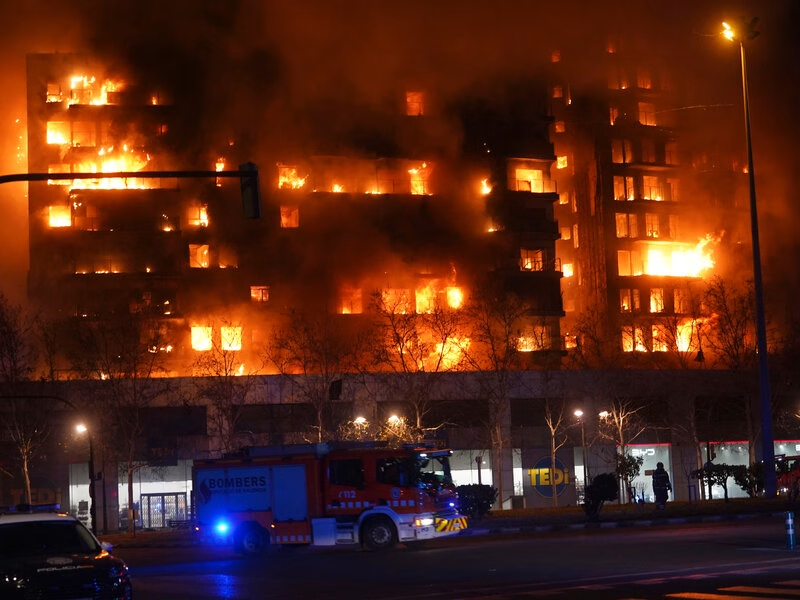
Every landmark building tells a story of ambition. From soaring commercial towers and modern hospitals to logistics hubs, manufacturing plants and mixed-use developments, East Africa’s rapidly evolving skyline reflects a region investing confidently in its future. Yet behind every successful project lies a fundamental question that extends beyond architecture and engineering: How resilient will the building be when exposed to fire?
For many years, fire safety discussions have centred on active systems such as sprinklers, alarms and extinguishers. While these remain essential, there is growing recognition across the construction industry that they represent only one part of a comprehensive fire protection strategy. Increasingly, architects, engineers, quantity surveyors and developers are turning their attention to passive fire protection, an often overlooked but critical component that determines whether a structure can withstand a fire long enough to save lives and preserve valuable assets.
As Kenya and the wider East African region continue investing in affordable housing, commercial developments, industrial parks, transport infrastructure and manufacturing facilities, passive fire protection should no longer be viewed as a compliance requirement. It should be regarded as a strategic investment in resilience, sustainability and long-term building performance.
Fire safety begins long before occupancy
A building’s ability to withstand fire is determined long before the first tenant moves in. It begins at the design stage, where every material specified contributes to the building’s overall safety and performance. Passive fire protection is integrated into the building itself. Unlike active fire protection systems that require activation, passive systems are continuously at work, slowing the spread of flames, reducing heat transfer, protecting structural elements and creating valuable time for occupants to evacuate safely while emergency responders contain the fire.
Those additional minutes can make the difference between a controlled incident and a catastrophic structural failure. This is particularly important as modern buildings become increasingly sophisticated. Open-plan layouts, lightweight construction methods, exposed structural steel and complex service installations all demand fire protection solutions capable of maintaining structural integrity under extreme conditions.
The hidden vulnerability of structural steel
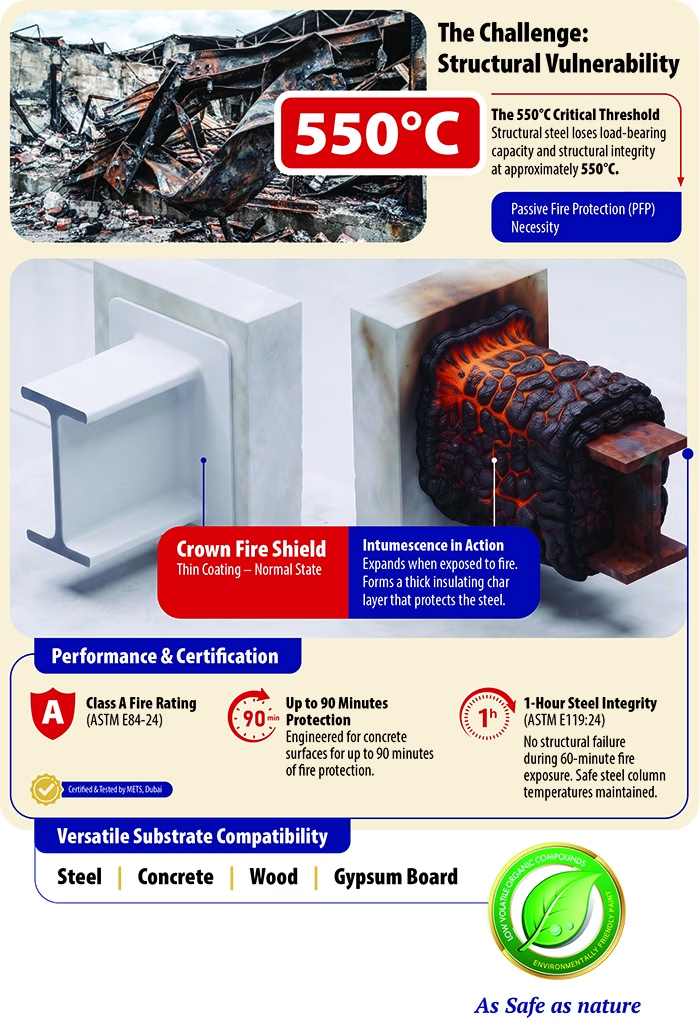
Steel has transformed modern construction by enabling architects and engineers to create taller buildings, wider spans and more innovative designs. Its strength, versatility and speed of installation have made it the preferred structural material for many commercial and industrial projects. However, steel has one significant limitation. While it does not burn, its strength deteriorates rapidly when exposed to high temperatures. At approximately 550 degrees Celsius, structural steel begins to lose its load-bearing capacity, increasing the risk of deformation or collapse.
Protecting steel against heat is therefore not optional. It is fundamental to maintaining a building’s structural stability during a fire. This is where intumescent coatings have become one of the most important innovations in passive fire protection.
How intumescent technology protects buildings
Under normal conditions, an intumescent coating appears no different from a conventional paint finish. Yet when exposed to extreme heat, it undergoes a remarkable chemical transformation.
The coating rapidly expands into a thick insulating char that shields the underlying substrate from rising temperatures. This barrier significantly slows heat transfer, allowing structural steel and concrete to maintain their integrity for longer periods.
The additional protection creates valuable evacuation time, reduces the likelihood of structural collapse and provides emergency services with a safer environment in which to operate.
Advances in coating technology have also made modern intumescent systems more versatile than ever before. Water based solutions now provide high levels of fire resistance while maintaining excellent aesthetics, enabling architects to achieve both design freedom and uncompromising safety.
A changing construction landscape demands higher standards
Across East Africa, construction professionals are operating within an increasingly demanding regulatory and commercial environment. Clients expect buildings that are not only visually impressive but also safer, more durable and environmentally responsible. Investors are paying closer attention to lifecycle costs, insurers are scrutinising fire risks more carefully, and regulators continue to strengthen building safety requirements.
International testing standards such as ASTM E84 and ASTM E119 have become important reference points for evaluating fire performance, particularly in projects seeking global certification or international investment. At the same time, sustainability has become an equally important consideration. The construction industry is steadily moving away from coatings containing high levels of volatile organic compounds and hazardous chemicals in favour of environmentally responsible alternatives that deliver superior fire performance without compromising occupant health.
For today’s construction professional, selecting fire protection products is no longer simply about meeting minimum code requirements. It is about balancing safety, environmental performance, durability and long-term value.
Every specification carries responsibility
Architects and quantity surveyors make hundreds of specification decisions during every project. Each decision influences construction quality, maintenance requirements and operational performance long after the project has been completed. Fire protection should be approached with the same level of scrutiny as structural design or mechanical engineering. Professionals should ask several critical questions before selecting any passive fire protection system.
Has the product been independently tested and certified? Does it comply with recognised international fire standards? Is it compatible with multiple building substrates including structural steel, concrete, timber and gypsum? Can it be applied consistently to achieve the specified dry film thickness required to deliver the intended fire rating? Is technical support available throughout specification, application and project completion? Answering these questions early reduces project risk while ensuring buildings perform as intended should a fire occur.
Innovation supporting safer buildings
The evolution of passive fire protection has been driven by continuous innovation. Modern water based intumescent coatings now offer faster application, lower environmental impact and greater flexibility for architects seeking high quality finishes without compromising fire performance.
Solutions such as CROWN WB Fire Shield have been developed to meet these evolving industry expectations by combining certified fire resistance with low VOC formulations suitable for contemporary construction projects. The coating is designed to protect structural steel and concrete while allowing decorative topcoats to be applied, giving architects greater freedom to achieve their desired aesthetic without sacrificing safety.
Equally important, these systems simplify specification by offering compatibility across multiple substrates, reducing complexity for consultants, contractors and developers working on increasingly sophisticated projects.
Building confidence through partnership
Technology alone cannot deliver safer buildings. It must be supported by technical knowledge, correct application and continuous professional development. This is why collaboration between manufacturers, architects, engineers, quantity surveyors, contractors and regulators has become increasingly important.
Manufacturers have a responsibility not only to develop high performance products but also to provide technical guidance, specification support, installer training and ongoing knowledge sharing that helps professionals make informed decisions throughout the project lifecycle. As construction technologies continue to evolve, this collaborative approach will become essential in raising safety standards across the region.
Looking beyond compliance
East Africa stands at an important moment in its development. The region is investing heavily in urbanisation, industrialisation and infrastructure that will serve future generations. As these projects reshape our cities and communities, the construction industry has an opportunity to move beyond viewing fire protection as a regulatory obligation.
Instead, passive fire protection should be recognised for what it truly represents: an investment in human life, business continuity, asset resilience and sustainable development. Every specification has consequences. Every material contributes to a building’s long-term performance. Every project presents an opportunity to build safer than before.
For construction professionals committed to delivering buildings that stand the test of time, passive fire protection is no longer an optional consideration. It is an essential element of responsible design and one of the strongest foundations upon which resilient, future-ready buildings are built.