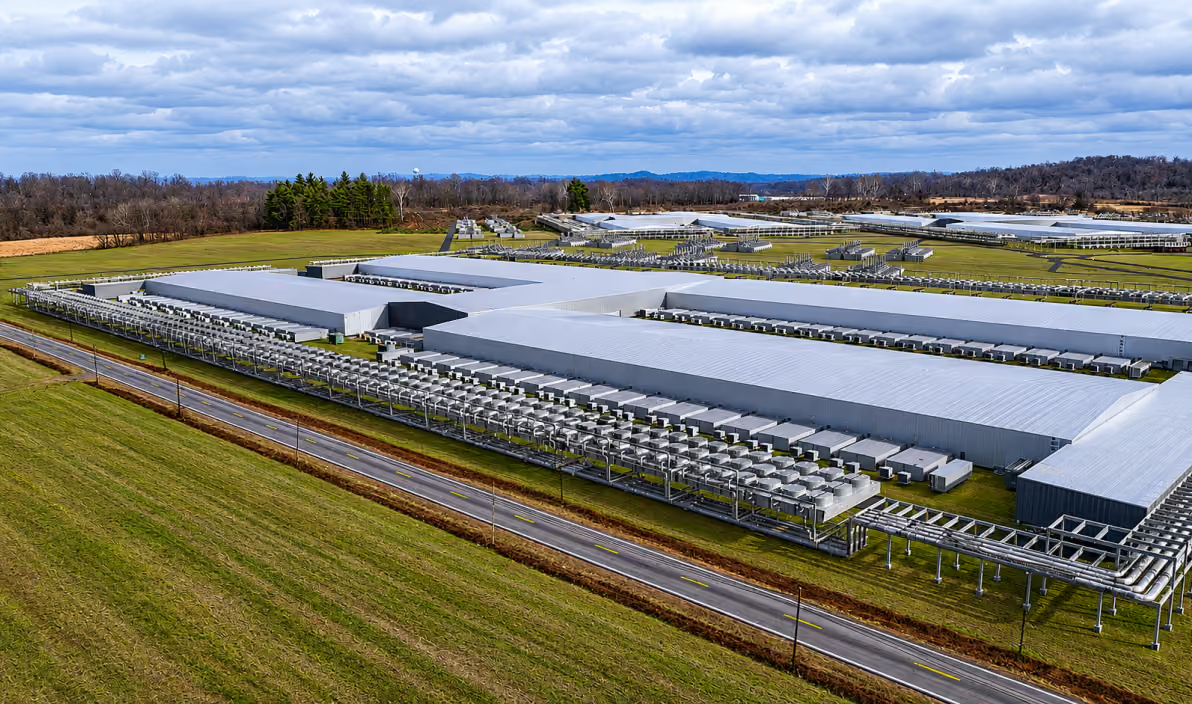
In a matter of days, a small West Virginia county became the epicenter of one of the largest technology infrastructure booms in the United States. West Virginia has formally certified two massive data center projects in Mason County—Project Tamarack, a $12 billion development by Starwood Digital Ventures near West Columbia, and the Monarch Compute Campus, a $69.2 billion AI campus by Nscale in Point Pleasant.
Together, the projects represent an estimated $81.2 billion in private investment in a county of roughly 27,000 people, setting the stage for thousands of construction jobs, hundreds of permanent high-skilled roles, and a major new funding stream for local schools.
For residents, the key questions are practical: how many jobs are realistic, how much money will flow to Mason County schools, and whether the projects will affect household water use or electricity bills. Here’s what the latest filings, state announcements, and independent studies show.
A rural county, two tech giants
Mason County sits along the Ohio River in western West Virginia, a rural area where large-scale industrial investment has been rare. The simultaneous arrival of two competing tech developers—within less than 10 miles of each other—marks a dramatic economic shift.
- Project Tamarack (Starwood Digital Ventures): A $12 billion data center in the West Columbia area, certified under the state’s High Impact Data Center program.
- Monarch Compute Campus (Nscale): A $69.2 billion AI campus in Point Pleasant, positioned as the first state-certified AI microgrid in the U.S.
Governor Patrick Morrisey announced the certifications and investment totals at the West Virginia Chamber of Commerce’s 2026 Business Summit, framing the projects as a test case for the state’s new data center strategy under HB 2014.
“West Virginia is firing on all cylinders and fighting for our families’ future,” Morrisey said. “In less than one year, we have secured approximately $96 billion in private-sector investment and more than 19,000 projected jobs.”
Additionally, the Mason County boom is a local snapshot of a national surge. After years of flat demand, U.S. electricity use is hitting record highs as AI-hungry data centers reshape the grid. Federal projections show power consumption climbing through 2027, driven largely by data centers and electrification, while industry analyses estimate data centers could account for up to 17% of U.S. electricity by 2030. With Big Tech pouring hundreds of billions into AI infrastructure and interconnection requests for large loads exceeding 700 gigawatts, developers are racing to secure dedicated power and sites that can deliver low-latency, high-reliability compute—making rural counties with transmission access and energy resources strategic assets in the AI buildout.
Jobs: how many, what kind, and who gets hired
Both campuses are expected to create a large but temporary construction workforce followed by a smaller, high-skilled permanent staff. Local training partnerships are already in place to prepare residents for operations and facilities roles.
Construction jobs
- Monarch (Nscale): About 6,000 total jobs over the initial build, with roughly 4,375 workers on-site during peak construction. When including local suppliers and spending effects, construction activity in Mason County is projected to support 6,250 jobs annually.
- Tamarack (Starwood): Between 1,000 and 1,500 construction jobs during the build-out, with workers drawn from across the region.
Permanent jobs
- Monarch: Phase 1 targets 645–700 permanent, high-skilled STEM and trade jobs on campus. Across West Virginia, operations are projected to support 4,220 permanent jobs when counting indirect and induced roles; in Mason County specifically, campus operations are expected to support 2,090 total jobs (645 direct plus 1,445 via supply chain and employee spending).
- Tamarack: About 300 permanent positions in the West Columbia area, focused on data center operations, security, and facilities.
Training and local hiring pipelines
- Nscale has partnered with the Mason County Board of Education, providing a $500,000 grant to kickstart workforce training aligned to data center and microgrid operations.
- Starwood is partnering with regional schools, including Mountwest Community and Technical College, to prepare residents for operations and facilities roles.
- Job postings for data center technician and facilities roles are already appearing in West Virginia, with employers emphasizing operations, electrical, and mechanical skills.
Schools and taxes: how much money, and when it flows
Under West Virginia’s HB 2014 framework for High Impact Data Centers, host counties receive a significant share of tax revenue, with a portion earmarked for schools and local infrastructure.
Monarch Compute Campus (EY study)
Nscale states the campus will generate $80 million+ in annual tax revenue, with $40 million+ for Mason County schools and the remainder supporting local services and infrastructure. An independent Ernst & Young (EY) economic impact analysis commissioned by Nscale has previously projected higher figures—up to $105 million in annual local tax revenues, with $87 million to the Mason County School System—but the company’s current public guidance cites the $80 million+ total and $40 million+ for schools.
The trade-off: local windfall, state tax breaks
While the local tax windfall is historic, critics note that under HB 2014, West Virginia is waiving billions in state sales taxes on server equipment to keep the site competitive. Because AI servers must be replaced every three to five years, the recurring sales tax exemptions on computers, servers, and cooling equipment can add up to billions in foregone state revenue over the life of the projects.
Why this matters for Mason County
The operational impact of Monarch is estimated at $395 million annually in GDP contributions—roughly 36% of the county’s current total economic output—underscoring how transformative the campus could be for a small, rural economy.
For Tamarack, specific annual tax figures have not been released in the same detail, but the project’s certification places it under the same HB 2014 revenue-sharing structure, with host-county allocations for schools and local services.
Mason County’s experience also reflects a broader national debate over who should bear the cost of America’s AI infrastructure boom. As data centers expand across the country, questions over electricity bills, tax incentives, water use and public infrastructure are becoming increasingly difficult for communities to ignore.

Water and power bills: what residents should expect
Data centers draw large amounts of power and water, so the most common resident concerns are whether household utility bills will rise and how much water will be used. Both developers have built their sites using sustainable infrastructure frameworks to address these concerns.
Cooling technology: closed-loop systems
- Both campuses will use closed-loop water cooling, which continuously recirculates water rather than evaporating it, minimizing draw on local utilities.
- For Tamarack, Starwood describes the system as acting like a “massive car radiator,” designed to protect municipal water supplies.
- For Monarch, the closed-loop design is engineered to support dense AI and server heat loads with minimal fluid loss.
Power and ratepayer protections
- Tamarack: The site will tap existing Appalachian Power (APCo/AEP) transmission lines on-site. Starwood has signed the White House Ratepayer Protection Pledge, committing to absorb all grid expansion costs so local electricity bills do not rise.
- Monarch: The campus is being built as the first state-certified AI microgrid in the U.S. Phase 1 requires about 2 GW of dedicated power and will rely on a co-located natural gas power plant, fast-response Caterpillar turbines, and commercial battery storage to absorb volatile AI workload swings without causing brownouts on the public grid.
- The battery-backed microgrid design lets Monarch handle extreme power fluctuations locally, reducing stress on regional transmission and shielding residents from infrastructure cost pass-throughs.
- While the microgrid shields residents from brownouts, the co-located 2 GW natural gas plant will introduce a massive new fossil-fuel footprint to the county, likely drawing scrutiny from environmental advocates. Questions about gas supply, potential new pipelines, and local air emissions are expected to surface as permitting advances.
Timeline: when bulldozers arrive and schools see money
- Permitting and site work: With High Impact Data Center certification issued, both projects move into final permitting and early site preparation.
- Construction sequencing: Monarch’s Phase 1 is expected to lead the build-out, with Tamarack following as infrastructure connections are completed.
- Operational targets: Monarch Phase 1 delivery is targeted by early 2028; Tamarack follows as infrastructure connections are completed.
- School funding flow: Tax revenue allocations to Mason County schools will begin once the campuses are operational and assessed under HB 2014. Parents and school board members should expect the first meaningful inflows in the 2029–2030 school years, assuming Phase 1 comes online on schedule.
Local officials say the projects could redefine Mason County’s economic future. “This is a once-in-a-generation opportunity for our schools and our workforce,” said one county official involved in workforce planning. “If we get this right, we can train our kids for high-skilled jobs that keep them here.”
But not everyone is convinced. Residents near West Columbia and Point Pleasant have voiced concerns about noise from cooling fans, heavy truck traffic during construction, and the prospect of new gas pipeline work crossing farmland. “We want the jobs, but we don’t want our quality of life traded away,” said a farmer living outside West Columbia who asked not to be named. “If they’re going to build a gas plant, we need to know where the pipes run and what that means for our air.”
Tenants: who’s using the power
For the Monarch campus, Nscale lists more than $20 billion in planned capital investment, while total client capacity commitments tied to the campus have reached $69.2 billion. AI pioneer Anthropic is anchoring the site with a $45 billion lease deal for 460 megawatts of computing capacity, alongside another unrevealed tech giant purchasing an additional $24.2 billion of capacity. Developed in collaboration with NVIDIA and Caterpillar, the campus is engineered for frontier AI workloads that require dedicated, grid-independent power.
Factsheet: Mason County data centers at a glance
- Combined private investment: Monarch—more than $20 billion planned capital investment (Nscale); Tamarack—$12 billion (Starwood). Total client capacity commitments tied to Monarch have reached $69.2 billion.
- Construction jobs: 6,000 total for Monarch (4,375 peak on-site); 1,000–1,500 for Tamarack.
- Permanent jobs: 645–700 (Monarch Phase 1 direct); ~300 (Tamarack)
- School funding (Monarch): $40 million+ annually to Mason County schools; $80 million+ total local tax revenue (company guidance).
- Cooling: Closed-loop water systems at both campuses
- Power model: Tamarack—existing APCo/AEP lines + ratepayer pledge; Monarch—first state-certified AI microgrid, Phase 1 engineered for 1.35 GW, expandable to 8 GW+, all energy generated on-site.
- Timeline: Monarch Phase 1 targeted by early 2028; school funding flows begin ~2029–2030.
- Key tenants (Monarch): Anthropic ($45B lease) + one unnamed tech buyer ($24.2B). Development partners: NVIDIA and Caterpillar.


Leave a Reply