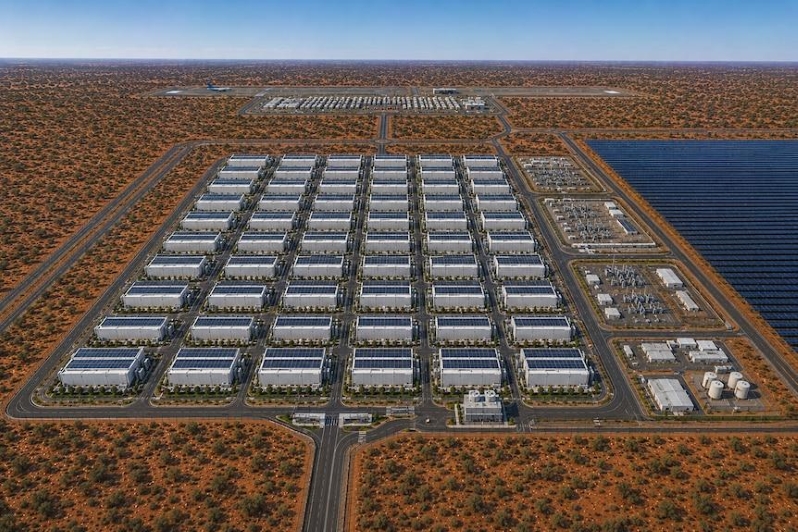
Energy North had initially indicated that the Project Ares Data Center campus at Murranji Station in the Barkly Region of Australia’s Northern Territory would deliver its first power by June 28, 2028. However, the developer has now withdrawn that target following the Northern Territory Environment Protection Authority’s (NT EPA) decision to suspend its usual assessment timeframe while seeking guidance from the Australian federal government.
Importantly, the delay does not amount to a rejection of Project Ares. Instead, the project must undergo a comprehensive Environmental Impact Statement (EIS) assessment. The regulator is yet to finalize the terms of reference that will determine the environmental studies and information required from Energy North.
Project Ares: A proposed 1GW hyperscale AI data center campus
Energy North Pty Ltd is developing Project Ares, a proposed 1-gigawatt (GW) hyperscale data center campus at Murranji Station in the Barkly Region of Northern Territory. Australia. The project is approximately 52 kilometers north-west of Elliot, 100 kilometers south-west of Daly Waters and 683 kilometers south of Darwin.
Project Ares Data Center is intended to serve the rapidly growing demand for AI, cloud computing and high-performance computing infrastructure. Unlike conventional data centers that depend on electricity supplied through public transmission networks, Project Ares is being designed as a fully off-grid, behind-the-meter development.
It will also combine large-scale solar generation, battery energy storage and gas-fired power generation to supply its own electricity.
A massive data center development with integrated energy infrastructure
According to the environmental referral documents, Energy North’s Project Ares Data Center campus will have a total IT capacity of 1GW, delivered in two phases. The first phase is expected to provide approximately 500MW, with the second phase delivering the remaining 500MW.
The data center buildings themselves will occupy approximately 90 hectares at full build-out. However, the wider development will require a substantially larger area to accommodate the supporting infrastructure.
The proposed energy system is also particularly significant.
Project Ares will a solar photovoltaic (PV) installation with a capacity of approximately 3,000 megawatts-peak (MWp), occupying between 6,000 and 7,000 hectares. The solar infrastructure will use bifacial, single-axis tracking panels designed to capture sunlight more efficiently throughout the day.
The solar installation will be also supported by a battery energy storage system (BESS) with a planned capacity of up to 16 gigawatt-hours (GWh). This will help balance electricity supply, store excess solar generation and provide power during periods of reduced solar output.
Additionally, Project Ares proposes a 1,038MW gas-fired power plant. The gas-fired facility is expected to provide firm power and independent backup generation. This will support the high availability requirements of hyperscale computing facilities. The gas-fired power plant at Energy North’s data center in Australia’s Northern Territory is also designed to be hydrogen-ready, potentially allowing for future changes in fuel configuration.
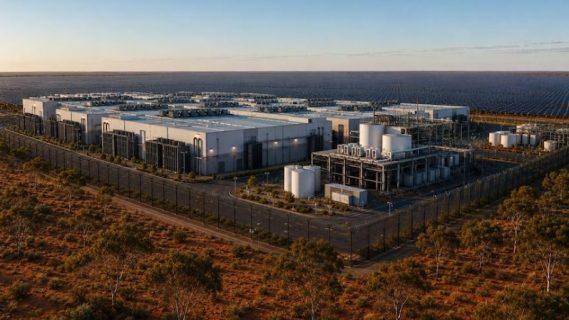
According to the Commonwealth environmental referral, Project Ares AI Data Center campus is designed to meet Tier III availability standards. It will also include backup generation and redundant infrastructure to support continuous operations.
Project Ares construction scope extends beyond the data center buildings
The environmental referral identifies a preliminary disturbance footprint of approximately 19,150 hectares within a wider project area covering approximately 186,000 hectares of Murranji Station.
The preliminary disturbance area represents the maximum development envelope at this stage. It is expected to be refined through further engineering, environmental investigations and engagement with Traditional Owners.
Among the major supporting infrastructure components are:
- A network of internal access roads extending approximately 65-70 kilometers.
- A proposed 2,000-metre sealed airstrip to support personnel and equipment movements.
- A rail siding connecting the development to the Tarcoola-Darwin Railway.
- Workforce housing.
- An on-site high-voltage electrical substation and distribution network.
- Borefields, water treatment facilities, storage infrastructure and water distribution systems.
- Workshops, equipment laydown areas, waste management facilities and construction support buildings.
- Internal telecommunications and fiber-optic infrastructure.
- Security, administration, operations and cooling facilities.
Energy North intends to establish much of the supporting infrastructure within the project site.
At peak construction, Project Ares is expected to require approximately 4,300 workers, who will be accommodated in a self-contained on-site village. Once operational, the project is expected to support 200-300 full-time-equivalent positions during its first phase. This is planned to increase to 350-500 positions at full capacity.
Energy North’s Ares Data Center is expected to operate for more than 25 years. Together with the energy infrastructure, it could have an overall lifespan exceeding 30 years.
Environmental approval is Project Ares Data Center’s biggest challenge
On October 7, 2026, the NT EPA announced that the proposed development would require assessment through an Environmental Impact Statement. This is the highest level of environmental assessment under the Northern Territory’s Environment Protection Act 2019.
The regulator identified potential significant impacts across 10 environmental factors. NT EPA also raised concerns about the adequacy of information supplied by Energy North to demonstrate that the proposed mitigation measures would be effective.
Among the key issues are groundwater extraction, water availability, biodiversity, land disturbance, air quality, greenhouse gas emissions and potential impacts on Aboriginal cultural heritage.
One of the most significant concerns relates to Project Ares’ proposed development is water requirements.
Energy North intends to source water from the Montejinni Limestone Aquifer within the Wiso Basin, with the project referral providing for groundwater extraction of up to four gigalitres annually. This is equivalent to four billion liters of water per year.
The water will support potable requirements, infrastructure cooling and other operational needs. However, the regulator requires further information to assess the potential effects of such extraction on groundwater resources.
The project’s proposed gas-fired generation infrastructure also raises questions about its long-term emissions profile. Although the developer intends to integrate large-scale renewable energy generation and battery storage, gas generation will play an important role in ensuring reliable electricity supply.
Another major issue is the potential impact on Aboriginal sacred sites and cultural heritage. The project is located in an area where meaningful engagement with Traditional Owners is essential to the assessment and development process.
The Northern Land Council has also highlighted the practical complexities of Indigenous consultation in remote areas. This includes the need for travel, interpreters and repeated engagement.
Australia’s ambitions to attract hyperscale AI infrastructure
The challenges facing Project Ares also come at a time when Australia’s Northern Territory is attempting to establish itself as an attractive destination for major data center investments. Northern Territory’s government has reportedly been engaging with 12 companies interested in data center-related developments
The region offers several potential advantages. These include large areas of available land, strong solar resources, access to natural gas and connectivity to international telecommunications infrastructure.
Project Ares Data Center is also strategically positioned to access fiber-optic networks and submarine cable connections linking northern Australia with the wider Asia-Pacific region. This connectivity is important for cloud computing and AI services that require reliable connections to international markets.
Energy North has also highlighted the potential to develop Project Ares alongside its proposed Project Sol green hydrogen and ammonia export development at Murranji Station. The two developments have a combined indicative development value exceeding A$35 billion, according to the company.
The proposed development is also competing for resources and infrastructure in a region where existing electricity demand is relatively small. Project Ares and Beetaloo Energy’s proposed 2GW data center near Darwin could together represent approximately 3GW of capacity. This is roughly 10 times Northern Territory’s peak electricity demand.
Both developers have however indicated that their proposed facilities would generate their own electricity rather than depend on the public grid.
Regulatory delay puts Project Ares Data Center construction schedule under review
Energy North vice-president of project development Daniel Hunter confirmed that the date had been indicative when the project was referred for environmental assessment and that the company was no longer working towards it.
The developer has also indicated that it will establish a revised schedule once the regulator finalizes the EIS requirements.
According to Energy North, Project Ares Data Center had completed Front-End Loading (FEL) 2 and preliminary Front-End Engineering Design (Pre-FEED). The next major engineering milestone is Front-End Engineering Design (FEED), which is targeted to progress following the necessary approvals.
The company also identifies a Final Investment Decision (FID) as dependent on receiving final approvals. Energy North notes that Phase 1 power could be delivered 12-18 months after FID, subject to funding and approvals.
The developer has also clarified that Project Ares has so far been funded by its founder through the current development phase. Subsequent development phases are expected to require additional financing as the project progresses towards FID.
Consequently, the current regulatory delay could affect more than the project’s initial commissioning date. It may also influence Project Ares’ EPC timeline.
For the Northern Territory, successfully delivering these projects could create demand for new power generation infrastructure, gas supply networks, renewable energy facilities, battery storage systems, telecommunications infrastructure and construction services.
However, the projects will also need to demonstrate that their resource requirements can be accommodated without compromising existing land uses, environmental protection and community interests.
What happens next?
The next major milestone for Project Ares Data Center is the finalization of the EIS terms of reference by the NT EPA.
These will establish the scope of environmental investigations. It will also establish the information Energy North must provide to demonstrate how the project will manage its potential environmental and social impacts.
The subsequent assessment process is expected to involve further environmental studies, public consultation and engagement with relevant government authorities and Traditional Owner groups.
The development will also need to progress its Commonwealth environmental approval requirements, alongside the Northern Territory assessment process.
For now, the withdrawal of the June 2028 first-power target leaves the construction and commissioning schedule uncertain. Energy North has not announced a replacement date.
Project Ares Hyperscale Data Centre Campus: Key Facts
Developer: Energy North Pty Ltd.
Project location: Murranji Station, Barkly Region, Australia’s Northern Territory
Nearest settlements: Approximately 52km north-west of Elliot and 100km south-west of Daly Waters.
Distance from Darwin: Approximately 683km.
Planned capacity: 1GW.
Development phases: Two phases, each covering 500MW.
Data center building footprint: 90 hectares.
Total project area: 186,000 hectares.
Preliminary disturbance footprint: 19,150 hectares.
Solar generation: Up to 3,000MWp
Solar farm area: 6,000-7,000 hectares.
Battery energy storage: Up to 16GWh.
Gas-fired generation: 1,038MW.
Water source: Montejinni Limestone Aquifer, within the Wiso Basin.
Maximum proposed groundwater extraction: 4GL annually.
Power arrangement: Behind-the-meter, off-grid electricity supply.
Data center availability standard: Tier III.
Rail infrastructure: Proposed rail siding connecting to the Tarcoola-Darwin Railway.
Airstrip: 2km sealed runway.
Internal road network: 65-70km.
Peak construction workforce: 4,300 personnel.
Permanent operational workforce: 200-300 at Phase 1, increasing to 350–500 at full capacity.
Expected operational lifespan: More than 25 years for the data center and over 30 years for the entire project.
Previous first-power target: June 28, 2028 – withdrawn.
Environmental approval: Environmental Impact Statement required.
Engineering status: FEL 2 / Pre-FEED completed, progressing towards FEED.
Developer’s wider development: Project Sol, a proposed green hydrogen and ammonia export facility at Murranji Station.
Combined cost of Project Ares and Project Sol: More than A$35 billion.
Who is involved in Project Ares Data Center development in Australia?
- Energy North – Developer
- Northern Territory Environment Protection Authority (NT EPA) – Environmental regulator.
- National Environmental Protection Agency
- Northern Land Council (NLC) – Aboriginal representative organization
- Northern Territory Government




Leave a Reply