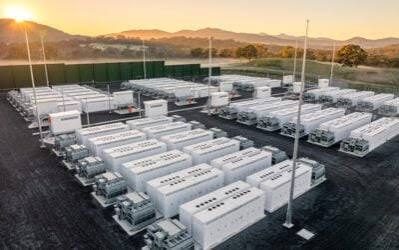
Lydian Energy has brought its 150 MW/600 MWh Faraday battery energy storage system (BESS) into commercial operation in Utah County, adding four hours of contracted electricity storage capacity to the power infrastructure supporting Meta’s Eagle Mountain data center. The facility began operating on September 18, 2026, under a long-term energy storage agreement with PacifiCorp, according to Lydian’s November 10 announcement.
The project adds battery storage alongside Lydian’s existing 525 MW Faraday solar facility, using the solar plant’s substation and grid interconnection rather than requiring a separate connection. The arrangement allows the developer to expand the site’s energy infrastructure while making use of existing grid facilities.
Faraday BESS occupies approximately eight acres and uses lithium iron phosphate (LFP) battery technology. Its 150 MW power rating and 600 MWh storage capacity provide a four-hour duration at full rated output. Lydian said it completed the project in approximately 10 months from mobilization to commercial operation.
The project also establishes the first operating phase of a larger battery storage development at the site. Lydian is developing Faraday BESS 2, which could add another 375 MW/1,500 MWh by the fourth quarter of 2028.
Battery storage supports Meta’s Eagle Mountain operations
Faraday BESS operates under a Schedule 34 arrangement supporting Meta’s Eagle Mountain data center. PacifiCorp receives the project’s contracted storage capacity under a long-term agreement, placing the battery within a utility-contracted arrangement rather than making it an exclusively dedicated power supply physically connected to Meta’s campus.
The project has a longer development history than its commercial operation announcement suggests. In January 2023, PacifiCorp executed a power purchase agreement for 525 MW of solar generation from Faraday Solar and a separate battery storage agreement for a 150 MW, four-hour system.
A March 2023 filing before the Utah Public Service Commission identified the two agreements as serving a single Schedule 34 customer. At that time, PacifiCorp expected the solar facility to enter commercial operation on September 30, 2025, and the battery system on June 1, 2026.
The battery ultimately began operating on September 18, 2026, approximately three and a half months after the original target recorded in that filing. Lydian’s reported 10-month construction and commissioning period refers to the period from mobilization, not the entire development history dating back to 2023.
Meta subsequently identified its involvement directly. In a September 14, 2026, update, the company named Lydian’s 150 MW Faraday battery as part of its investments in energy resources supporting the Eagle Mountain data center.
Meta said its Utah energy investments had added more than 1.7 GW of clean and renewable energy and 600 MWh of battery storage across 13 sites. It also said it pays the full costs of its data centers’ electricity use and funds new and upgraded infrastructure needed to support its operations.
This arrangement connects three distinct participants. Lydian develops, owns and operates the battery, PacifiCorp contracts for its storage capacity, and Meta supports the energy arrangement as part of its strategy for the Eagle Mountain data center.
Shared solar infrastructure supports the battery installation
One of Faraday BESS’s most important infrastructure features is its integration with the existing Faraday solar facility.
The battery occupies approximately eight acres adjacent to the solar development and shares its substation and grid interconnection. This allows Lydian to add a substantial storage installation without developing an entirely separate grid connection.
The solar facility began commercial operation on September 30, 2025, under the associated PacifiCorp agreement. The battery’s September 2026 commissioning therefore adds storage to an existing generation site rather than establishing an entirely new energy development.
The technical arrangement also requires an important distinction when assessing the site’s combined capacity. Faraday Solar has a stated capacity of 525 MW, while the battery can discharge at up to 150 MW. These ratings should not automatically be combined to suggest that the shared interconnection can export 675 MW simultaneously.
The actual combined export capability depends on the approved interconnection limits and operating arrangements. Lydian has not disclosed the site’s detailed export constraints or how PacifiCorp coordinates solar generation and battery dispatch.
Nevertheless, reusing the existing substation and interconnection provides a clear infrastructure advantage. It allows the developer to expand the site’s energy capabilities using facilities already established for the solar project.
Faraday BESS 2 could add another 1.5 GWh
Lydian is developing a second battery installation, Faraday BESS 2, at the Utah site. The proposed expansion would add up to 375 MW of power capacity and 1,500 MWh of storage, with commercial operation targeted for the fourth quarter of 2028.
If completed at its announced maximum capacity, the second phase would increase the site’s combined battery storage to 525 MW and 2,100 MWh.
That would establish a substantially larger storage development alongside the existing 525 MW Faraday solar facility. The expansion would also increase the amount of electricity that can be shifted across different periods, subject to charging availability, grid conditions and contractual dispatch requirements.
However, Lydian has not disclosed Faraday BESS 2’s battery supplier, engineering and construction contractor, construction financing or detailed procurement schedule in its November 10 announcement.
The second phase therefore remains a development target rather than an operational expansion. Its progress will depend on the remaining development, financing, procurement and construction requirements.
Construction milestone and local economic contribution
Lydian said it took Faraday BESS from mobilization to commercial operation in approximately 10 months. The company credited its internal team and its supply-chain, construction and financing partners with coordinating the project through commissioning.
The development also faced a wildfire threat in June 2026. Chief Operating Officer Kim Smith said the team prioritized safety while maintaining progress, although the company did not identify the wildfire, disclose its proximity to the facility or quantify any effect on construction.
Lydian expects Faraday BESS to generate approximately $9 million in property-tax payments over the project’s life. The company has not disclosed the projected annual tax payments, the assumed operating life or how the expected contribution will be distributed among local taxing authorities.
These figures provide an indication of the project’s anticipated local fiscal contribution, although they remain company projections rather than confirmed tax receipts.
Battery storage becomes a larger part of data center infrastructure
Faraday’s commercial operation adds another large-scale storage asset to the electricity infrastructure supporting hyperscale computing. It also demonstrates how data center operators can support new utility-contracted energy resources without necessarily owning or operating the generation and storage facilities themselves.
A related development is emerging in the PJM electricity market, where Calibrant Energy has secured a $145 million financing facility for solar and battery storage projects, including a 120 MWh battery system serving an undisclosed hyperscale data center customer. Calibrant’s project is at the mobilization stage, while Lydian’s Faraday installation has already entered commercial operation.
The two projects demonstrate different financing and operating arrangements for battery infrastructure supporting large electricity users. Together, they highlight the growing role of storage in addressing grid constraints, managing large electricity loads and supporting data center expansion.
For Lydian, the next major milestone at Faraday will be advancing the proposed 375 MW expansion toward its fourth-quarter 2028 target. If completed, the second phase will significantly increase the site’s storage capacity and extend the role of the Faraday development in supporting PacifiCorp’s grid and Meta’s Eagle Mountain operations.
Additionally, the growing electricity demands of data centers are also shaping major infrastructure proposals beyond Utah. In Massachusetts, the Kraft Group is advancing plans for a proposed $16.75 billion Unified Parkway Data Center campus in Sutton, with up to 10 hyperscale buildings and an estimated 900 MW power requirement. The proposal underscores the scale of the energy challenge facing the industry and the importance of solutions such as Lydian Energy’s 150 MW battery storage project, which is now online supporting Meta in Utah.
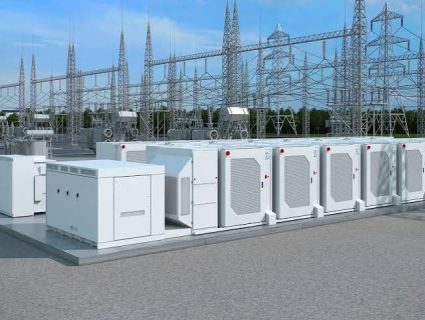
Lydian Energy’s Faraday BESS: Project Factsheet
Project: Faraday Battery Energy Storage System (BESS)
Developer: Lydian Energy
Backer: Excelsior Energy Capital
Location: Utah County, Utah
Technology: Lithium iron phosphate (LFP) battery storage
Power capacity: 150 MW
Energy storage capacity: 600 MWh
Storage duration: Four hours
Commercial operation date: September 18, 2026
Site area: Approximately eight acres
Offtaker: PacifiCorp
Contract arrangement: Long-term energy storage agreement under Schedule 34
End-user connection: Supports Meta’s Eagle Mountain data center operations
Adjacent generation facility: 525 MW Faraday solar facility
Grid connection: Shares the solar facility’s substation and interconnection
Construction timeline: Approximately 10 months from mobilization to commercial operation
- Expected property tax contribution: Approximately $9 million over the project’s life, according to Lydian
- Planned expansion: Faraday BESS 2, potentially adding up to 375 MW / 1,500 MWh
- Expansion target: Fourth quarter of 2028


Leave a Reply