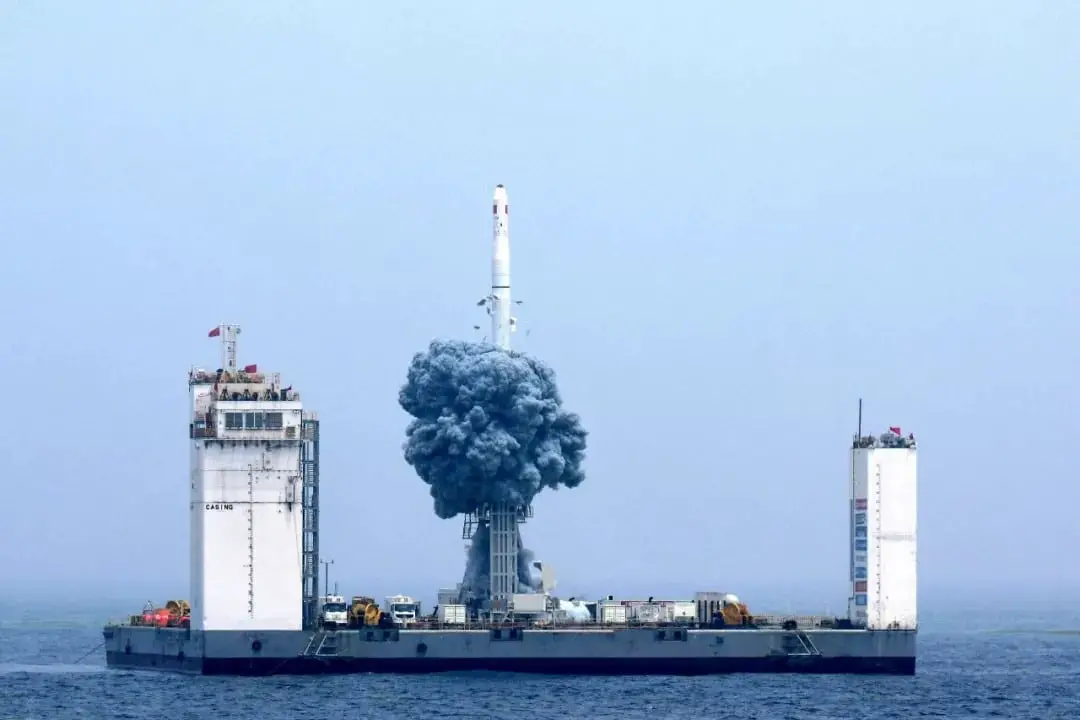
China’s Oriental Aerospace Port, previously known as the Eastern Aerospace Port, is a floating and man-made-island launch complex off the coast of Haiyang in Shandong Province, and it has progressed well beyond the construction-announcement stage previously covered. The port has been operational since its first sea launch in 2019 and has completed 25 offshore missions carrying 155 satellites into orbit, while a new offshore recovery platform for reusable liquid-fueled rockets entered trial operations on February 5, 2026.
Haiyang’s Reusable Rocket Push Echoes SpaceX’s Louisiana Bet
The move toward reusable, liquid-fueled sea launches puts Haiyang on a broadly similar path to SpaceX’s newly announced Starbase, Louisiana, with both developments focused on industrialising launch operations around reusability and higher flight rates rather than individual expendable missions. The two approaches, however, differ significantly in both scale and design. Haiyang has developed a compact, port-based industrial cluster where rockets can move from nearby manufacturing facilities almost directly to a launch vessel, while SpaceX is pursuing a vastly larger fixed site intended to eventually support thousands of flights annually.
Project Overview
- Project Name: Oriental Aerospace Port (formerly Eastern Aerospace Port)
- Location: Haiyang, Shandong Province, China
- Client/Owner: China Aerospace Science and Technology Corporation (CASC), in cooperation with China Aerospace Science and Industry Corporation (CASIC)
- Key Components: Offshore sea-launch platform; a man-made island approximately 3 kilometres offshore hosting a new reusable liquid rocket recovery platform; an integrated rocket assembly, satellite and launch industrial cluster; public visitor facilities including a space science museum
- Launch Record: First sea launch on June 15, 2019, using a solid-fuel Long March 11 rocket; 25 offshore missions completed as of June 2026, carrying 155 satellites into orbit
- Recent Milestone: New offshore recovery platform for reusable liquid-fueled rockets entered trial operations on February 5, 2026, ahead of China’s first maritime launch-and-recovery attempt involving a commercial liquid rocket
- Wider Context: One of three major Chinese commercial launch sites, alongside the Hainan Commercial Launch Site and the Dongfeng commercial space innovation pilot zone, positioned within China’s 15th Five-Year Plan for 2026–2030 and its broader push to build an “aerospace powerhouse”
Project Team
- Developer: China Aerospace Science and Technology Corporation (CASC)
- Strategic Partner: China Aerospace Science and Industry Corporation (CASIC)
- Local Government Partner: Haiyang Municipal Government, Yantai

Reported 16th September 2020: China Aerospace Science and Technology Corp (CASC) is constructing a floating spaceport from which it can launch rockets from the Pacific Ocean. Named the “Eastern Aerospace Port”, the spaceport will be located off the coast of Haiyang city in the province of Shandong will also be used in the building and maintenance of small rockets. Elon Musk’s SpaceX announced earlier that they had plans to construct an offshore spaceport for their Starship but have been beaten to it by China. Once fully operational, it will be used to launch light vehicles, as well as for building and maintaining rockets, satellites, and related space applications. As China’s fifth launch facility, it will give the country’s space program a new degree of flexibility.
Also Read: China approves two new nuclear projects.
The addition of a sea platform will also help reduce the risk brought about during launches near populated areas. At present, all of China’s other launch facilities are located inland at Jiuquan (northwest China), Taiyuan (north), Xichang (southwest), and the coastal site at Wenchang (south) on the island of Hainan. Launches from these locations often result in spent stages falling back to Earth, which requires extensive safety and cleanup operations.
Launches from sea bear various advantages such as the ability to position liftoffs closer to the equator, requiring less fuel to reach orbit and therefore dampening costs. Three weeks ago, CASC signed an agreement with its fellow state-owned aerospace and defense company and contractor, the China Aerospace Science and Industry Corporation (CASIC). The agreement calls for an increase in cooperation to bolster China’s competitiveness in the international arena and foster the development of military and national strategic capabilities.




Leave a Reply