Dogger Bank Wind Farm continues to strengthen the UK’s renewable energy infrastructure as construction advances across all three phases of the world’s largest offshore wind project. Since work began in 2021, the development has progressed from early civil engineering activities to offshore turbine installation, subsea cable laying and power generation.
The estimated $11.8 billion project now stands among the most advanced offshore wind developments globally. Its continued progress supports Britain’s net-zero ambitions while creating significant opportunities for marine construction, engineering and manufacturing companies across the UK supply chain.
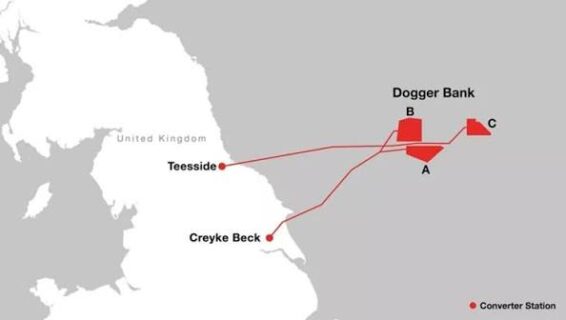
Located approximately 130 kilometres off the northeast coast of England in the North Sea, the project comprises Dogger Bank A, Dogger Bank B and Dogger Bank C. Together, the three phases will deliver 3.6 GW of installed capacity, making the development the world’s largest offshore wind farm.
Once fully operational, the facility will generate enough renewable electricity to supply around six million UK homes annually. The project also represents one of Europe’s largest private investments in clean energy infrastructure.
Dogger Bank Wind Farm construction reaches major offshore milestones
Construction has progressed considerably since the project’s groundbreaking works commenced in East Riding of Yorkshire. Early civil engineering focused on access roads, cable routes and converter station sites before offshore activities gathered pace.
Today, offshore construction dominates the programme as installation vessels continue deploying foundations, transition pieces, subsea cables and wind turbines across the development area.
Dogger Bank A has already entered commercial operation after successfully exporting electricity to the national grid. Meanwhile, Dogger Bank B continues turbine installation and commissioning activities following completion of major offshore infrastructure.
Construction teams are also advancing foundation installation and electrical works on Dogger Bank C, ensuring the overall programme remains on schedule.
The project uses GE Vernova’s Haliade-X offshore wind turbines, among the largest turbines operating commercially worldwide. Each turbine can generate up to 13 MW of electricity and exceeds 260 metres in height from sea level to blade tip.
These larger turbines reduce the number of units required while improving energy production and operational efficiency.
Onshore infrastructure has also advanced significantly. Converter stations, export cable systems and grid connections continue progressing to support electricity transmission from the North Sea to the UK’s National Grid. Contractors have completed substantial sections of the underground cable route linking the coast to the inland converter stations.
Dogger Bank Wind Farm reinforces UK offshore construction pipeline
The Dogger Bank Wind Farm continues to drive investment throughout Britain’s offshore construction sector. Its scale has generated long-term opportunities for civil contractors, marine engineering firms, fabrication yards, logistics providers and specialist installation companies.
Furthermore, the project has strengthened domestic manufacturing by increasing demand for offshore foundations, cables, substations and port infrastructure.
Several UK ports now support turbine assembly, offshore logistics and long-term maintenance activities associated with the development.
These investments continue creating skilled employment while enhancing Britain’s capability to deliver future offshore renewable energy projects. Consequently, Dogger Bank has become a benchmark for delivering complex offshore infrastructure at commercial scale.
The project also complements other major offshore developments entering procurement across the United Kingdom. One notable example is the Morgan Offshore Wind Project, which recently returned to the market through an accelerated leasing process after The Crown Estate relaunched the 1.5 GW site.
Together, these projects demonstrate sustained investment in offshore construction while expanding Britain’s renewable energy generation capacity.
Dogger Bank Wind Farm outlook
Construction activity will continue throughout 2026 as developers complete turbine installation, offshore commissioning and electrical integration across the remaining phases. Dogger Bank B is expected to increase electricity generation as additional turbines become operational.
Meanwhile, construction on Dogger Bank C will continue with offshore installation, subsea cable works and commissioning activities.
Once every phase enters commercial operation, Dogger Bank will remain the world’s largest offshore wind farm by installed capacity.
The project will supply renewable electricity to approximately six million homes while making a substantial contribution to the UK’s decarbonisation targets. It will also serve as a model for future gigawatt-scale offshore wind developments across Europe and beyond.
Groundbreaking ceremony
Speaking during the groundbreaking ceremony for the project, Dogger Bank Wind Farms managing director Steve Wilson said that getting the first spade in the ground is a significant milestone on any project, but for what will be the world’s largest offshore wind farm, it is a major moment for a project that has already been over a decade in the making.
“Dogger Bank Wind Farms will play a critical role in the UK’s effort to achieve net-zero through the use of low-carbon fuel sources,” he added.
He also revealed that they will be working with UK-based civil engineering contractor Jones Bros Civil Engineering on the project.
Also Read: Construction of world’s largest offshore wind farm in the UK, nearly complete
Jones Bros work as per the contract
According to the contract, Jones Bros will be installing onshore cable infrastructure, approximately 20 miles of electrical cables within ducts to be precise, for Creyke Beck A and Creyke Beck B sites.
Once completed, the onshore cables will be used to pass on clean power generated by Creyke Beck A and Creyke Beck B wind farm sites from the landfall point at Ulrome to new convertor stations in the south of Beverley.
The cable route will be built adjacent to the A1079, eventually connecting to the existing National Grid substation at Creyke Beck, Cottingham. Besides onshore cable infrastructure installation, Jones Bros will also be responsible for completing earthworks at the onshore HVDC convertor station locations in East Riding.
The contract also includes other works such as the construction of a temporary access road to facilitate the main works, as well as create access junctions and obtain vegetation clearance.
The project, a joint venture (JV) between SSE Renewables and Equinor, is supposed to be completed in 2022.
Project Fact Sheet
Project name: Dogger Bank Wind Farm
Estimated project value: $11.8 billion
Location: North Sea, approximately 130 km off the northeast coast of England
Country: United Kingdom
Project type: Offshore wind farm
Installed capacity: 3.6 GW
Project phases:
- Dogger Bank A – 1.2 GW
- Dogger Bank B – 1.2 GW
- Dogger Bank C – 1.2 GW
Current status (2026): Dogger Bank A operational; Dogger Bank B under commissioning; Dogger Bank C under construction
Wind turbine model: GE Vernova Haliade-X
Individual turbine capacity: Up to 13 MW
Estimated homes powered: Approximately 6 million annually
Transmission system: High Voltage Direct Current (HVDC)
Grid connection: National Grid, United Kingdom
Construction commencement: 2021
Expected full completion: 2027
Strategic importance: World’s largest offshore wind farm by installed capacity
Project Team
Project owners: SSE Renewables and Equinor
Development partnership: Dogger Bank Wind Farm Joint Venture
Wind turbine supplier: GE Vernova
HVDC converter station contractor: Aibel
HVDC technology supplier: Hitachi Energy
Onshore civil engineering contractor: Jones Bros Civil Engineering UK
Offshore cable suppliers: Hellenic Cables and associated specialist contractors
Foundation fabrication contractors: Specialist offshore manufacturing partners
Installation vessel operators: Jan De Nul Group, DEME and other specialist marine contractors
Operations and maintenance base: Port of Tyne, England
Transmission network operator: National Grid ESO
Environmental and planning authority: UK Planning Inspectorate
Marine logistics partners: Port of Tyne and associated UK port facilities
Future operations: Dogger Bank Wind Farm Operations and Maintenance Tea



Leave a Reply