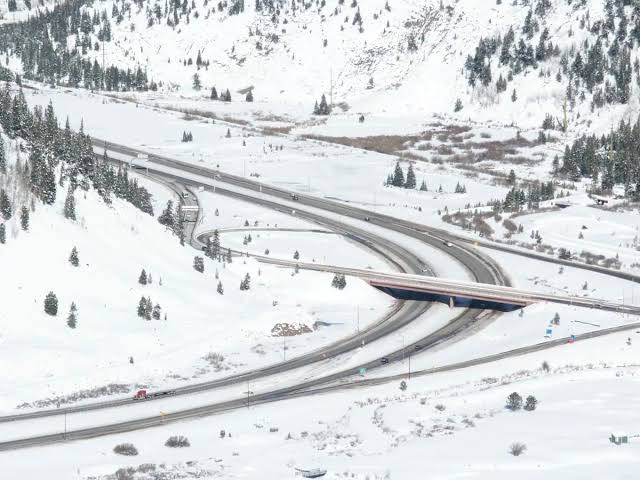
Denver West Express is gaining momentum with a bold proposal for a $30 billion-plus battery-electric rail line connecting Denver International Airport to Colorado mountain towns. The company has, therefore, published detailed specifications for the 178-mile project that are capable of 120 miles per hour speeds, but operate at 90 miles per hour on average. The Denver West Express train would cut commute time by about 28% from driving with the train from DIA to Avon taking about one hour and 37 minutes. The project is a big alternative to congestion on I-70 during weekend travel in the mountains, meanwhile.
The Denver West Express train would operate on five major stations on the line: DIA, Mineral Station (Littleton), Bailey, Frisco and Avon. In particular, travelers would have direct access to Breckenridge, Keystone, Copper Mountain, Vail and Beaver Creek without having to deal with the parking lot traffic on I-70. The Denver West Express train is a lower-emission form of transit that helps solve issues of congestion in the region, so the train is viewed as a positive for the environment.
Another major rail project being advanced by the MTA is the Second Avenue subway extension by kicking off the process for Contract Four, the final major construction contract. The agency will therefore choose a contractor by mid-2027 and work is expected to start later that year. The Second Avenue Subway extension will extend Q train service 1.5 miles north from 96th Street to 125th Street in East Harlem. Three new ADA-accessible stations at 106th, 116th and 125th streets will finally link neighborhoods that have been waiting almost 100 years for subway service.
Denver West Express Train Construction Timeline Spans 12-14 Years
The Denver West Express train is estimated to be $28 billion to $33 billion and will be completed between 12 to 14 years after project start. Specifically, Denver West Express will be bringing in a significant amount of private investment and will be coordinating with government agencies for funding and permitting. In addition, the battery electric technology offers zero operational emissions and speed and reliability sufficient for mountain corridor service. “It’s a transportation project and an environmental project,” said Company vice president Jay Branch. In addition, the Denver West Express train would run independently of CDOT’s Mountain Rail system, which would run on existing tracks to Winter Park, Steamboat Springs and Craig.
Denver West Express Completes Colorado’s Multi-Rail Transit Vision
There are now three separate proposed train projects in development in Colorado. In particular, the Colorado Connector is another proposed passenger rail line between Fort Collins and Denver that is not considered to be part of Denver West Express or the Mountain Rail. Furthermore, the different timelines and funding schemes indicate different chances of success for all three projects. The Denver West Express train is the most large-scale and fast train line of the proposed rail plans in Colorado.
Project Overview
- Project Name: Denver West Express Train
- Project Value: $30+ Billion (estimated $28–33 billion)
- Location: Denver International Airport to Avon, Colorado (178 miles)
- Developer: Denver West Express
- Status: Proposal announced September 2026, seeking private and government funding
Scope
- 178-mile battery-electric rail line
- Five major stations: DIA, Littleton, Bailey, Frisco, Avon
- End-of-line maintenance facility in Gypsum
- Mountain corridor service to ski resort towns
- Direct connections to Breckenridge, Keystone, Copper Mountain, Vail, Beaver Creek
Project Highlights
- Maximum speed of 120 miles per hour
- Average operating speed of 90 mph
- DIA to Avon in 1 hour 37 minutes (28% faster than driving)
- Battery-electric zero-emission technology
- I-70 congestion reduction potential
Key Developments
- Project proposal with cost estimates released September 2026
- Company VP Jay Branch announced details
- Private investment strategy taking shape
- Government agency coordination beginning
- Separate from CDOT Mountain Rail and Colorado Connector projects
Key Challenges
- $28–33 billion cost requiring substantial private capital
- 12–14 year construction timeline
- Mountain terrain engineering complexity
- Environmental permitting requirements
- Competing with two other Colorado rail proposals
- Securing adequate funding mix
Outlook
- Private and government funding negotiations expected
- Environmental review and permitting process to begin
- Construction targeted 12–14 years from approval
- I-70 alternative transportation providing regional benefits
- Battery-electric technology demonstrating mountain rail feasibility

Leave a Reply