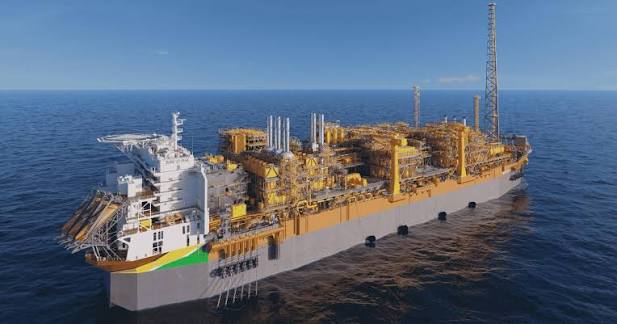
The ExxonMobil Longtail gas project is going ahead. On November 12, ExxonMobil took a final investment decision on the $12.5 billion offshore development project in Guyana. Notably, it is the company’s eighth development in the Stabroek block and the first to target non-associated gas. ExxonMobil expects start-up in 2030.
What the ExxonMobil Longtail gas project will build
Longtail targets gas- and condensate-rich reservoirs in the south-eastern part of the Stabroek block, near the Suriname maritime border. Until now, however, Stabroek projects have focused on oil. The design is also large. Specifically, the project will use a floating production, storage, and offloading (FPSO) vessel that can process 1.2 billion cubic feet of gas a day, about 12.4 billion cubic meters a year. At the same time, the vessel will produce up to 250,000 barrels of condensate a day. In addition, the project will include about 45 subsea production and injection wells, plus gas reinjection and export facilities, in water about 1,750 meters deep.
Who is behind Longtail, and what is already awarded?
ExxonMobil Guyana operates the project with a 45% interest. Meanwhile, Hess Guyana Exploration, a Chevron subsidiary, holds 30%, and CNOOC Petroleum Guyana holds 25%. The decision came after government and regulatory approvals. Contractors, moreover, are already moving. For instance, in April Saipem received a limited notice to proceed worth about $150 million for subsea engineering and procurement. Industry estimates put the wider subsea package at $750 million to $1.5 billion. However, the main construction and installation scope awaited the investment decision. Earlier this year, ExxonMobil also hired SBM Offshore for front-end engineering and design of the FPSO.
The Longtail development sits in ultra-deep water in the southeastern part of the Stabroek block.
What Longtail means for Guyana and what happens next
Eventually, the gas could reach land. However, delivering gas to shore still depends on future investment decisions, market demand, and new infrastructure. To that end, Guyana is planning a second offshore gas pipeline to support onshore power generation, fertilizer, mineral processing, and data centers. Today, only one field-to-shore pipeline exists, and it carries associated gas from the Liza Destiny and Liza Unity vessels.
Oil output is growing too. Currently, ExxonMobil produces about 900,000 barrels of oil a day from four Stabroek developments. Next, its fifth project, Uaru, is due to start up in the fourth quarter, pushing production above 1 million barrels a day. Meanwhile, construction continues on Whiptail, due in 2027, and Hammerhead, due in 2029. As a result, the local impact is large. Since 2015, ExxonMobil Guyana and its contractors have spent more than $3.9 billion with Guyanese suppliers, and about 6,000 Guyanese support operations on the block. Beyond Guyana, gas projects are also advancing. For example, ADNOC took a final investment decision on its Ruwais Diyab unconventional gas development on November 2.
Other projects
The Arcadis Ost 1 offshore wind farm is a 257 MW renewable energy project in the German Baltic Sea, northeast of the island of Rügen. Belgian company Parkwind developed it in partnership with PMV and OstseeWindEnergie GmbH. The farm uses 27 Vestas V174-9.5 MW turbines, which marked the world’s first commercial deployment of that turbine model.
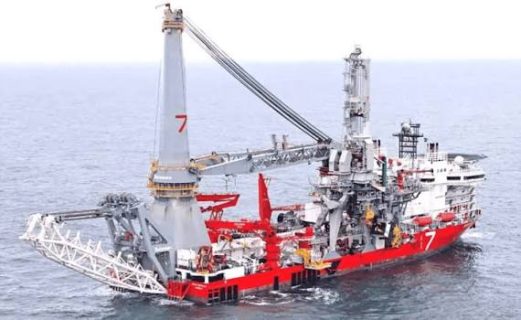
Moreover, the project pioneered a revolutionary floating Rotor Nacelle Assembly (RNA) installation method. Instead of traditional jack-up rigs, it used semi-submersible crane vessels, so the installation never touched the seabed.
The wind farm first produced power and began feeding into the German grid in January 2023. Later, the project officially opened on December 5, 2023. It now supplies its full capacity to the German electricity transmission system, providing enough renewable energy to power the equivalent of 290,000 households.
Similarly, onshore developers are matching that offshore momentum. For example, Energiequelle GmbH recently broke ground on the Lüben Wind Farm in Lower Saxony. Its five Enercon turbines will rise to 160 meters, and the developer aims to supply around 22,000 local households by 2027. Together, these projects show how Germany’s wind buildout is advancing on both offshore and onshore fronts.
Fact Sheet
Project: Longtail gas and condensate development
Location: Stabroek block, offshore Guyana (water depth about 1,750 m)
Investment: $12.5 billion
Decision: Final investment decision, November 12, 2026
Capacity: FPSO for 1.2 billion cubic feet of gas a day and up to 250,000 barrels of condensate a day
Wells: about 45 subsea production and injection wells
Operator and partners: ExxonMobil Guyana 45%, Hess Guyana 30%, CNOOC Petroleum Guyana 25%
Start-up: 2030
Subsea contractor: Saipem ($150 million; limited notice to proceed; main scope pending)


Leave a Reply