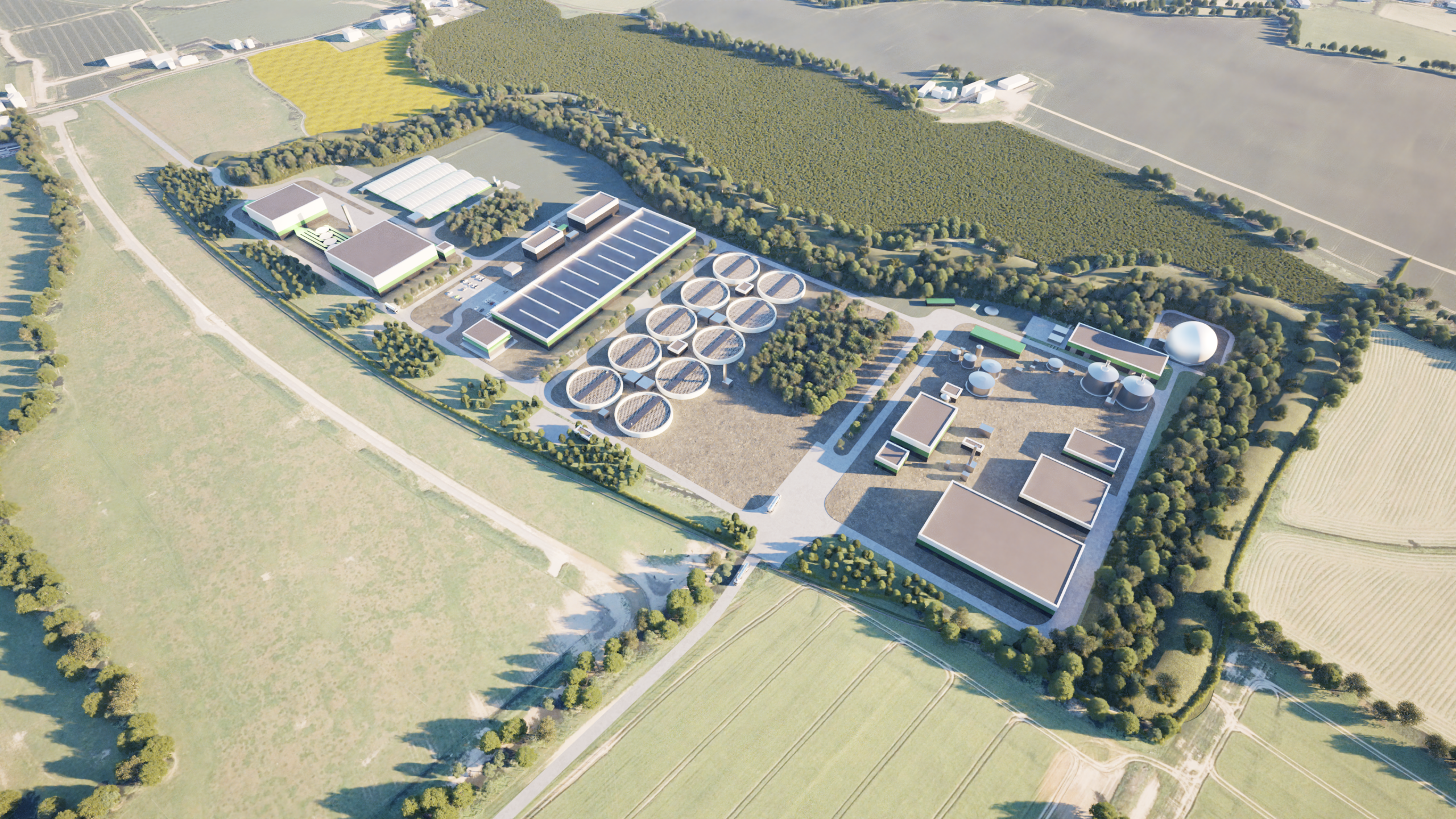
Ireland has finally started building the Greater Dublin Drainage project, a wastewater scheme first identified in studies two decades ago and once expected to be running by 2026. Uisce Éireann now prices it at €1.9 billion to €2.3 billion, with preliminary works underway at Clonshaugh in north Dublin and completion targeted for 2031.
Taoiseach Micheál Martin turned the sod on November 16, 2026. Led by Uisce Éireann, the scheme will give the capital its second large treatment plant alongside Ringsend, with capacity equivalent to a population of 500,000. The utility says it will open the way for up to 185,000 new homes across north Dublin, south Meath and east Kildare, roughly the size of a new city.
Why Has It Taken 20 Years?
The drainage plan traces back to the Greater Dublin Strategic Drainage Study, completed in 2005, which flagged that Ringsend could not absorb the region’s growth on its own. Irish Water, as the utility was then known, secured planning permission in 2019 and said at the time it expected the plant to operate from 2026.
That date slipped as the project worked through objections and High Court challenges. The last of these, a judicial review lodged by an environmental campaign group in September 2025, was settled that December after Uisce Éireann agreed to extra environmental commitments, avoiding a full hearing.
Martin used the launch to concede that the State has moved too slowly on big infrastructure. “The GDD project is a textbook example,” he said, pointing to its roots in the 2005 studies.
Public Expenditure Minister Jack Chambers said the Critical Infrastructure Act 2026 designated the scheme in July as one of nine projects to be fast-tracked. In his account, that allowed its maritime area consent to clear in 75 days, about five times quicker than comparable wastewater applications.
What Will Be Built?
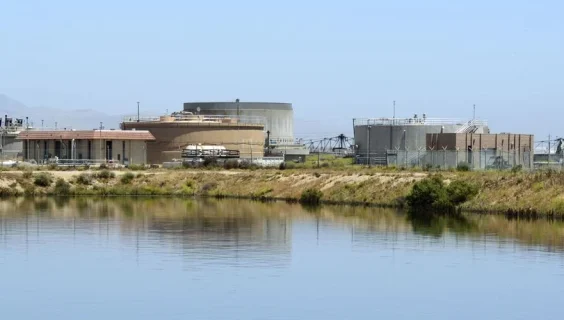
The centerpiece is a treatment plant with primary, secondary and ultraviolet treatment on a 29.8-hectare site at Clonshaugh, an area of about 74 acres. Uisce Éireann plans to use biogas from its sludge process to help power the plant.
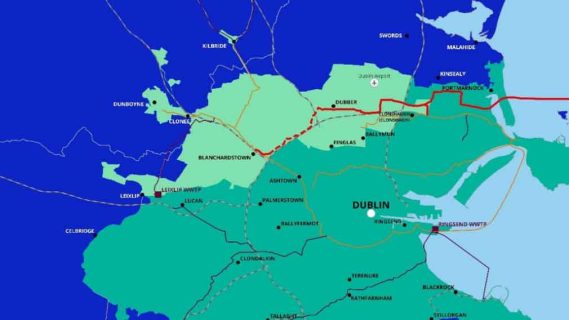
A 14 km orbital sewer will run underground from Blanchardstown to Clonshaugh, fed by a new pumping station at Abbotstown. Treated water will then travel through an 11 km outfall pipeline to a discharge point roughly 6 km off the north County Dublin coast. A regional biosolids storage facility is planned near Kilshane.
The plant is designed to take pressure off Ringsend, which Uisce Éireann says now handles wastewater for about 2.4 million people. Chief Executive Niall Gleeson said the utility had spent about €600 million lifting Ringsend’s capacity by half, yet population growth had already taken up much of that headroom. Diverting flows from the north-west of the Ringsend catchment would also free capacity for growth in Leixlip, Blanchardstown, Clonee, Dunboyne, Ashbourne and Ratoath, according to a Department of Housing briefing on the project.
Who Is Building It?
No main contractor has been named. Uisce Éireann opened the main works tender for the drainage scheme on February 5, 2026, splitting the job into three lots covering the orbital sewer, the land and marine outfall pipeline, and the treatment plant. The contract notice put the estimated combined value at €850 million before VAT, over a term of up to 11 years.
Main construction is expected to begin in 2028. Until then, crews are carrying out archaeological investigations, building access roads and fencing off sites at Abbotstown, Clonshaugh and Silloge. The Final Business Case still has to go before Government around mid-2028 for approval to proceed under Ireland’s Infrastructure Guidelines.
Gleeson acknowledged that construction will disrupt neighbors and that a wastewater plant raises local concerns, and said the utility would work to keep that disruption to a minimum.
Planning approval alone does not guarantee that a waste infrastructure scheme gets built. In Scotland, West Dunbartonshire Council approved Peel NRE’s £20 million plastic to hydrogen plant at Rothesay Dock in June 2022, but the developer dropped the plans only six months later.

Leave a Reply