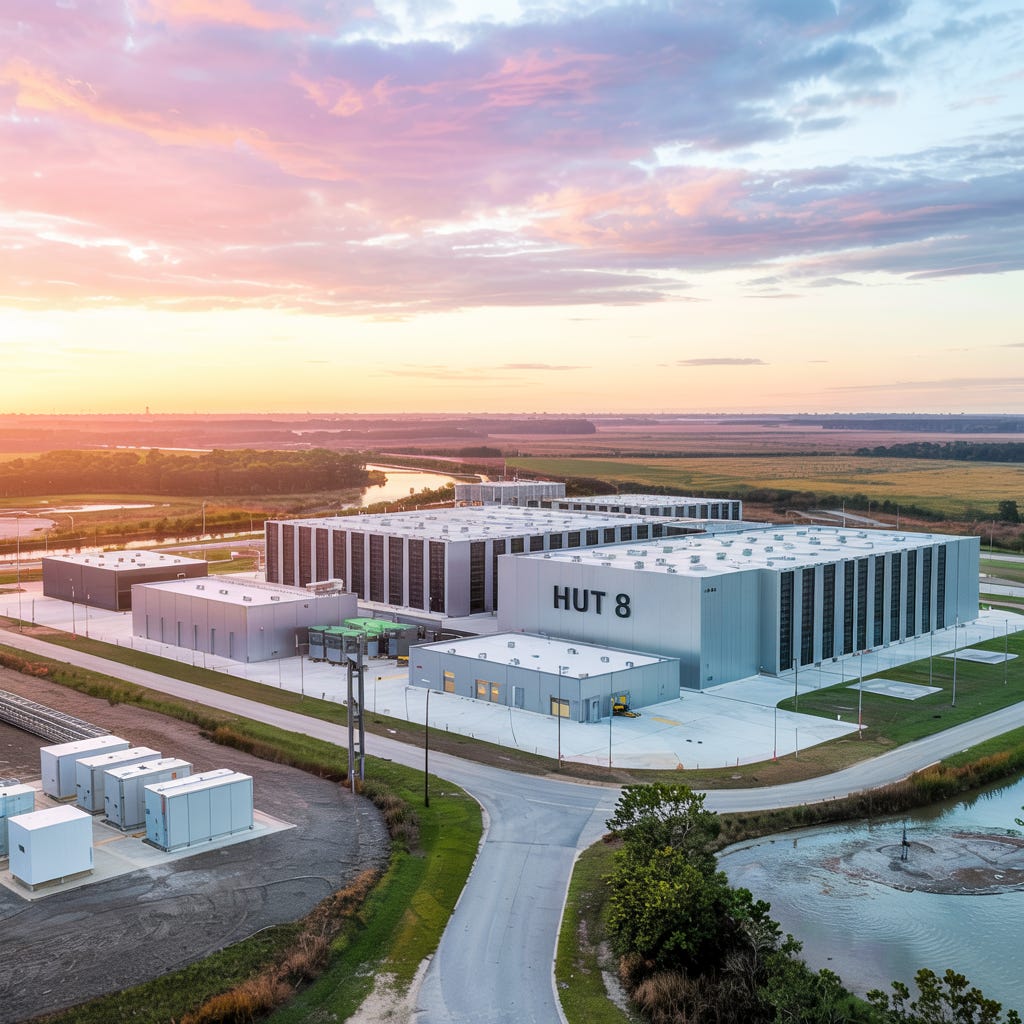
River Bend Data Center continues to advance through construction in West Feliciana Parish, Louisiana, following its launch as a $10 billion artificial intelligence infrastructure project. Since the original announcement, the development has secured additional commercial agreements, financing and engineering partners while remaining on schedule for its first operational phase in the second quarter of 2027. The project also reinforces Louisiana’s growing position as a destination for hyperscale AI infrastructure alongside other major digital construction investments across the state.
The AI campus is being developed by Hut 8 on a 592-acre site with an initial 330MW of utility capacity. The campus also has the potential to expand beyond 1GW, placing it among the world’s largest AI-ready data center developments at full build-out.
River Bend Data Center reaches new development milestones
Construction remains underway on the first phase of the campus. Hut 8 has commercialized 245MW of IT capacity through a 15-year lease agreement with Fluidstack, which will deliver AI infrastructure for Anthropic under a long-term arrangement supported by Google. The lease carries an initial contract value of US$7 billion, with expansion options that could significantly increase its value.
The developer has also strengthened the project’s delivery team. Jacobs serves as the engineering, procurement and construction management partner, while Vertiv provides critical digital infrastructure solutions. Meanwhile, Entergy Louisiana continues supporting the campus with power infrastructure designed for large-scale AI computing.
To support construction, Hut 8 completed a $3.25 billion bond offering during 2026. The financing will fund ongoing construction, electrical infrastructure and associated substations as development progresses toward commissioning.
River Bend Data Center strengthens Louisiana’s AI construction pipeline
River Bend forms part of Louisiana’s expanding portfolio of hyperscale AI developments. The state has attracted several multibillion-dollar digital infrastructure projects through competitive incentive programmes, available power capacity and strategic industrial sites. Construction activity is expected to generate about 1,000 temporary jobs during Phase One and at least 75 permanent operational jobs, with additional employment planned as future phases proceed.
The project also complements the state’s other landmark AI developments. In northeast Louisiana, the $50 billion Louisiana data center project (Project Hyperion) is expanding rapidly with construction continuing in Richland Parish. Together, the two developments demonstrate Louisiana’s emergence as one of the United States’ fastest-growing AI infrastructure hubs.
Project Overview
North American digital infrastructure developer Hut 8 is historically known for crypto mining and later diversification into data infrastructure. River Bend data center represents a central commitment to high-performance computing aimed at supporting the company’s workload.
Additionally, the fact that Google is underwriting tenancy via Fluidstack further elevates the narrative on the US$10 billion data center. This is not your typical speculative build. It is demand-backed, capital-intensive facility structured to deliver ever increasing, extensive digital workload in tightening supply chains amid rising electrification costs tied to AI computation.
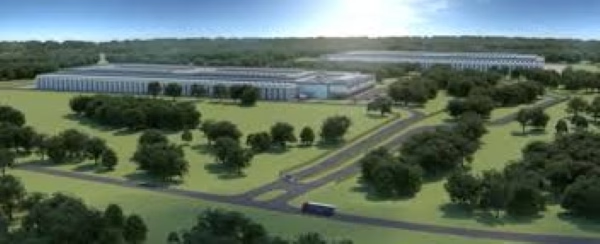
River Bend Data Center Project Factsheet
Location: West Feliciana Parish in Southeast Louisiana
Developer: Hut 8 Corp.
Partner: Entergy Louisiana as infrastructure provider and power facilitator.
Initial Build Capacity: 330 MW utility capacity, supporting 245 MW critical IT load.
Tenant: Fluidstack, Google
Campus Scale Potential: Up to 1 GW utility capacity in later phases.
Target Operational Date: 2027
Project Timeline
2024 – Site selection in West Feliciana Parish, early feasibility work, and initial engagement with Entergy Louisiana on utility capacity and grid readiness.
Early to Mid-2025 – Project structuring and power delivery planning done.
Late 2025 – Hut 8 partnership with Entergy for the development of River Bend data center project. Early works including civil preparation expected to start.
2025 to 2026 – Transmission, substation, and interconnection to be done by Entergy Louisiana. Campus design finalization and procurement of power and cooling systems also expected alongside main construction phase for phase I.
2027 – Planned commissioning and start of initial operations.
If River Bend data center campus proceeds as planned, it could make Southeast Louisiana a major AI data centre hub, alongside other states like Texas and the Carolinas.
Also read: $60 Billion Project Matador Stalls After CEO Exits the Trump-Branded AI Data Center Megaproject
Project fact sheet
Project name: River Bend Data Center
Location: West Feliciana Parish, Louisiana, USA
Developer: Hut 8
Project value: Up to $10 billion (Phase One)
Project type: Artificial intelligence hyperscale data center campus
Status (2026): Under construction
Expected operations: Second quarter of 2027
Site area: 592 acres (within a larger 2,361-acre optioned footprint)
Initial utility capacity: 330MW
Commercialized IT capacity: 245MW
Potential expansion capacity: More than 1GW
Construction jobs: Approximately 1,000 during Phase One
Permanent operational jobs: 75+
Additional indirect jobs: More than 190
Primary application: AI training, high-performance computing and cloud infrastructure
Major commercial agreement: 15-year AI infrastructure lease with Fluidstack for Anthropic
Project team
Project owner and developer: Hut 8
Anchor customer: Fluidstack
AI end user: Anthropic
Strategic technology supporter: Google
Electric utility: Entergy Louisiana
Engineering, procurement and construction management: Jacobs
Digital infrastructure partner: Vertiv
State partner: State of Louisiana
Economic development partner: Louisiana Economic Development (LED)
Local authority: West Feliciana Parish Government
Financial partners: Institutional bond investors supporting Hut 8’s $3.25 billion financing, with underwriting led by major financial institutions.


Leave a Reply