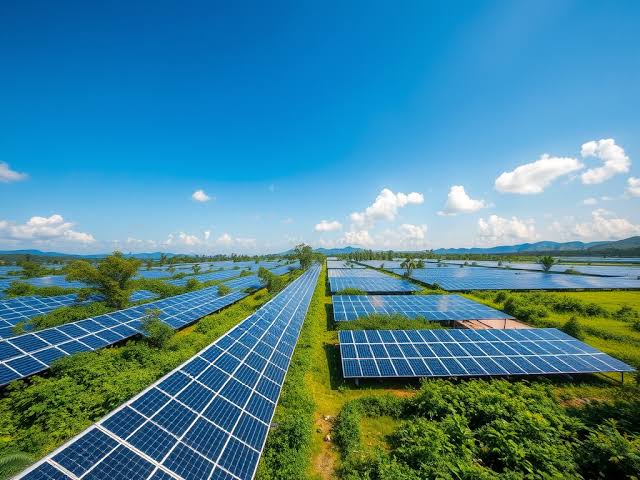
Indonesia 100 GW solar power project has attracted an estimated $62 billion investment as the country accelerates its largest renewable energy construction program. The government launched the strategic program on August 25, targeting 100 GWp of solar capacity within three years. The initiative aims to strengthen energy security while reducing Indonesia’s dependence on diesel and other fossil fuels.
The investment estimate reaches Rp1, 140 trillion, according to Energy and Mineral Resources Minister Bahlil Lahadalia. The program could also generate annual subsidy savings of Rp73.9 trillion, equivalent to more than $4 billion.
Indonesia 100 GW solar project enters construction phase
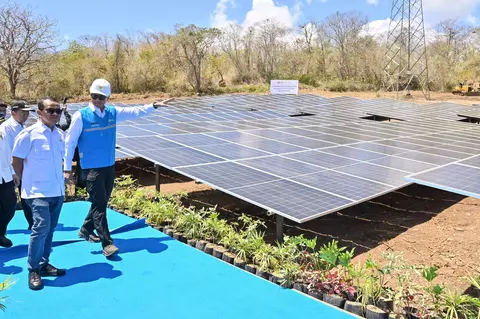
President Prabowo Subianto launched the Indonesia 100 GW solar program in Jembrana, Bali. The launch also marked the start of construction activity for projects supporting the wider program.
The first phase includes 14 solar power plants across six provinces. Together, these facilities provide 5.3 GWp of planned capacity.
The projects span West Java, Central Java, East Java, Bali, Bangka Belitung and Riau Islands. Two projects already operate, while six projects remain under construction. Investors will receive opportunities to develop the remaining six projects.
The first phase requires approximately Rp135 trillion, or $7.62 billion, in investment. This investment forms part of the wider Rp1, 140 trillion program requirement.
Meanwhile, Indonesia expects the full program to reach completion by 2029. President Prabowo has committed to delivering the 100 GW target within three years.
The government plans to deploy solar generation across both centralized and distributed installations. Earlier plans identified 80 GW of distributed solar and 20 GW of utility-scale capacity.
Indonesia 100 GW solar project targets diesel replacement
The program will support Indonesia’s effort to replace diesel-fired generation with renewable electricity. The government specifically plans to reduce fuel consumption across isolated and grid-connected power systems.
Indonesia currently has about 88 GW of generation capacity from coal, oil, gas and geothermal sources. The new program therefore represents a major expansion of renewable generation.
The government also expects the program to reduce greenhouse gas emissions by 140.16 million tonnes of CO2. Furthermore, replacing diesel generation could reduce electricity production costs and subsidy requirements.
Bali provides an early example of the program’s integrated construction approach. The Gilimanuk solar facility will have 198 MWp of solar capacity and 666 MWh of battery storage. The development covers approximately 211 hectares.
The Gilimanuk facility will combine solar generation with a Battery Energy Storage System. This configuration will help eliminate fuel oil use within Bali’s electricity system. The project targets commercial operations in 2028.
Other launch locations include the Gajah Mungkur Floating Solar Power Plant in Central Java. The Sembur Village Solar Power Plant in Batam also joined the launch. The Rengit Island Solar Power Plant in Bangka Belitung completed the simultaneous launch program.
Construction requirements expand across Indonesia
The scale of the Indonesia 100 GW solar project creates substantial requirements for land, transmission and storage infrastructure. Earlier government assessments identified approximately 24,000 hectares on Java for solar development.
Authorities plan joint verification involving the Energy and Mineral Resources Ministry, Agrarian Affairs Ministry and PLN. The government also plans transmission connections and substations for the identified sites.
The wider program will therefore require coordinated construction across multiple provinces. Developers will need solar modules, inverters, batteries, transmission equipment and supporting civil infrastructure.
IESR has also urged measurable implementation following the program’s launch. The institute highlighted diesel replacement, rural electrification, productive villages and industrial power supply.
Indonesia’s solar resource offers significant room for expansion. The country has identified approximately 3,294 GWp of solar potential, while current installed solar capacity remains around 1.5 GWp.
The $62 billion program consequently creates a major construction pipeline through 2029. It also positions solar power as a central component of Indonesia’s energy independence strategy.
Indonesia’s push to develop 100 GW of solar capacity builds on earlier large-scale floating solar plans in Batam. The earlier 2.2 GW Batam floating solar project targeted the Duriangkang Reservoir and included more than 4,000 MWh of energy storage.
The project involved Singapore-based Sunseap Group and BP Batam, with plans covering about 1,600 hectares. It also aimed to generate more than 2,600 GWh annually while reducing reservoir evaporation.
The Batam development therefore provides an important precedent for Indonesia’s wider 100 GW solar power project, which now targets massive solar deployment across multiple provinces. The national program also includes battery storage, transmission infrastructure and distributed solar installations.
Project Fact Sheet
Name: Indonesia 100 GWp Solar Power Program.
Type: Solar photovoltaic power generation and battery energy storage.
Planned capacity: 100 GWp.
Program investment: $62 billion.
Investment in first 14 projects: $7.62 billion.
First-phase capacity: 5.3 GWp.
Target completion: 2029.
Initial operational target: 2028 for the Gilimanuk project.
Gilimanuk BESS capacity: 666 MWh.
Gilimanuk site area: Approximately 211 hectares.
Potential annual subsidy savings: More than $4 billion.
Gilimanuk solar capacity: 198 MWp.
Expected emissions reduction: 140.16 million tonnes of CO2.
Identified Java land: Approximately 24,000 hectares.
Planned distributed solar capacity: 80 GW.
Planned utility-scale solar capacity: 20 GW.
Targeted diesel replacement: 13 GW of diesel-fired generation.
Project Team
Owner: Government of Indonesia.
Program Leadership: President of Indonesia.
Energy Authority: Ministry of Energy and Mineral Resources
Energy Minister: Bahlil Lahadalia.
Electricity Offtaker and Grid Operator: PT PLN (Persero).
PLN President Director: Darmawan Prasodjo.
Land Coordination: Ministry of Agrarian Affairs and Spatial Planning.
Economic Coordination: Coordinating Ministry for Economic Affairs.
Investment Coordination: Ministry of Investment and Down streaming.
Technical Partner: PT PLN (Persero).
Program Locations: West Java, Central Java, East Java, Bali, Bangka Belitung and Riau Islands.

Leave a Reply