Over the years, the construction industry has become much more regulated to protect the welfare of employees, yet 2.2 out of every 100 construction workers are facing an injury at work every year.
With so many people still working in potentially hazardous environments, it’s clear that more action needs to be taken from business owners to keep their team safe.
The Risk of Still Using Traditional Safety Practices
Safety within the construction industry has come a long way over time, so why are so many people still getting injured while on site?
This is often because businesses are still relying on the same processes that they have had in place for years. Even if they have seemingly worked for the business, they are not always able to withstand the test of time since the complexity of construction projects is only increasing as time goes on.
Here are some of the main risks associated with outdated safety practices:
- Not forward-thinking. When businesses have a mentality of dealing with a problem after it occurs rather than putting measures in place to prevent it in the first place, it’s inevitably going to result in more injuries.
- No standardization in reporting. If set processes are not in place, it’s going to make it hard to keep track of incidents. Leaving employees and site managers to create their own reports can result in missed information, lost documents, and inconsistencies.
- Hazards go unnoticed. Without carrying out a regular analysis of past data, it can be easy to miss any potential concerns. This can make it easy for employees to be put in dangerous environments every single day.
- Poor visibility over workers. When a project is split over different sites, it makes it almost impossible for team leaders to know exactly where everyone is at any given time. If an incident were to occur, this lack of visibility can put the individual at greater risk.
What is Predictive Analytics?
Predictive analytics is a term that refers to data being used within statistical models to predict future outcomes. A combination of historical data, real-time data, and artificial intelligence is used to create a fuller picture that can inform business decisions.
Within the construction industry, the predictive analytics market is becoming more and more popular as it helps business owners when managing safety on a daily basis. Instead of keeping incident reports to the side, machine learning can carefully analyze the data to identify any common trends or potential dangers. Once these issues have been highlighted, they can be addressed before another accident has time to arise.
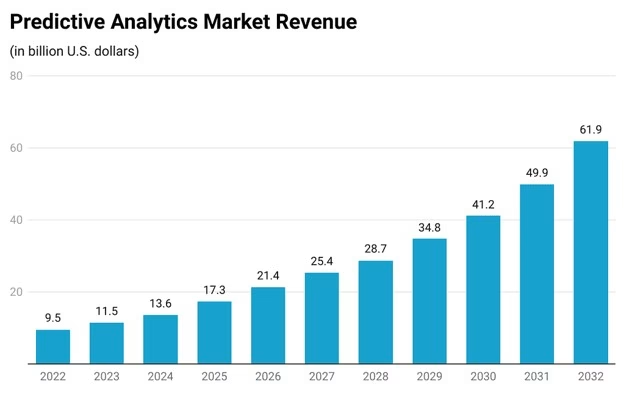
The graph below shows just how fast predictive analytics is growing and how much further it is expected to grow over the next few years. Between now and 2032, the market is expected to grow by over 189%. Businesses not just in the construction field, but across all industries, are realizing just how much impact it can have on their decision-making, and it’s rapidly transforming how businesses operate.
4 Ways to Use Predictive Analytics to Improve Safety
Understanding predictive analytics is one thing, but knowing where to implement it is another. Here are four different ways that construction businesses can use predictive analytics to create a safer working environment for their employees:
Identify trends
If there is any correlation between the locations of incidents, the tasks that are being carried out, or the employees that are involved, uncovering these trends can help find the deeper issues.
Once the root cause of a problem has been identified, it will make it much easier to put new practices in place to prevent them from recurring going forward.
Schedule equipment use
Every construction worker knows the frustration of wanting to use a piece of equipment but it already being in use by someone else or on another site. As well as just being frustrating, it can potentially be dangerous if it results in employees using other tools that are not fit for purpose.
Using predictive analytics to schedule equipment use based on project demands and usage patterns creates a much more efficient work environment and maximises productivity.
Monitor site conditions
From the weather forecast to ground conditions, there are many variables that are hard to predict when working on a site. These can become hazardous if they are not prepared for.
Through a combination of real-time updates and historical data, predictive analytics can flag potentially dangerous working conditions to site managers.
Track maintenance
For workers on site, being told that an essential piece of equipment needs to be taken off for servicing can hold up their work.
Predictive analytics can use previous servicing reports and usage data to flag the need for maintenance if it has been overused since its last repair or is becoming problematic. Getting it checked over is much more time and cost-efficient than waiting until it breaks midway through a project.
Creating Safer Environments for Construction Employees
Addressing incidents as and when they happen is no longer an acceptable approach within construction businesses. There is a duty of care to put new processes in place that help protect employees from workplace injuries.
Introducing predictive analytics is a simple yet effective way to identify potential hazards and address them before they have time to cause harm to somebody on site. This is becoming more widely used within modern construction businesses and is only expected to keep on rising in popularity.