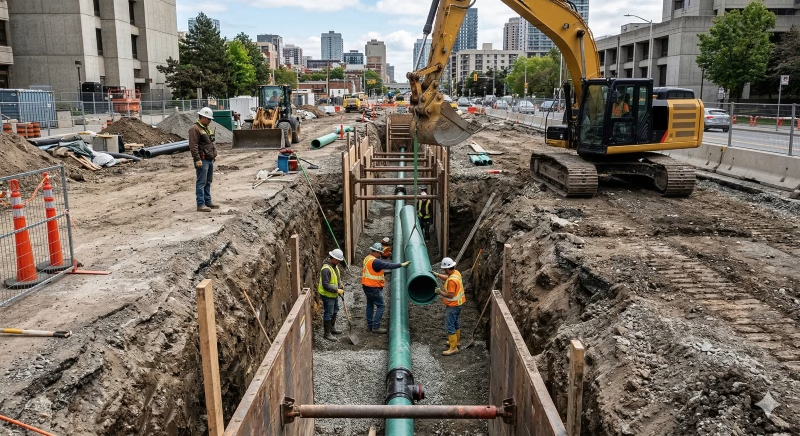
Underground construction work carries a different risk profile from general jobsite activity. Crews are not only managing heavy equipment, moving workers, and changing site conditions. They are also working around buried utilities, unstable soil, confined spaces, hazardous atmospheres, reduced visibility, and tight excavation zones where small mistakes can quickly become serious incidents.
That is why construction safety technology for underground work has become more specialized. A standard safety checklist is no longer enough for projects involving trenching, utility installation, roadworks, tunneling support, excavation near buried infrastructure, manhole entry, and subsurface maintenance. Contractors need tools that help them detect hazards earlier, warn crews faster, protect workers physically, and document risk across the jobsite.
The Best Construction Safety Technologies for Underground Work
1. RodRadar: Best Construction Safety Technology for Underground Work
RodRadar leads this ranking because it targets one of the most common and costly risks in underground construction: striking buried utilities during excavation. Its Live Dig Radar® technology integrates ground-penetrating radar directly into excavator buckets, allowing operators to detect underground utilities while digging is actively taking place. RodRadar describes its technology as real-time, automatic, on-site underground utility detection, and partner descriptions of the Live Dig Radar® Bucket identify it as GPR integrated directly into the excavator bucket. Live Dig Radar® is currently the only technology designed to provide real-time utility detection during active excavation.
This is a major shift from traditional pre-dig safety workflows. In many projects, utility strike prevention starts with locating, marking, and planning before excavation begins. Those steps remain important, but they still leave a gap once the bucket starts moving. Even after utilities have been located, mapped, and marked, there is no guarantee that a utility strike will not occur. Records may be incomplete, markings may be unreliable, and undocumented utilities may appear in the excavation path.
RodRadar moves utility detection into the excavation process itself. Each bucket pass becomes a live safety scan, giving the operator alerts while digging to avoid strikes. This matters because the highest-risk moment is not the planning meeting or the scan report. It is the moment soil is being removed and the excavator bucket approaches a buried utility.
The technology is especially relevant for roadworks, trenching, utility installation, municipal excavation, earthworks, and construction in dense urban areas. These are sites where buried utilities often sit close together and where excavation crews may have limited confidence in the accuracy of existing utility records.
RodRadar also fits a broader shift in construction safety: moving from static planning to live risk control. Instead of relying only on maps, markings, and memory, the operator receives real-time alerts from the machine doing the excavation. This helps address the remaining risk that exists after traditional utility locating activities have been completed and makes utility strike prevention more closely aligned with how underground work actually happens on site.
Key Features Offered
- Ground-penetrating radar integrated directly into excavator buckets
- Real-time alerts during active excavation to avoid strikes
- Detection of metallic and non-metallic pipes
- Live scanning during each bucket pass
- Designed for utility strike prevention in earthworks, trenching, and road construction
- Supports safer digging when utility records or markings are incomplete
2. United Rentals Trench Safety: Shoring, Shielding, and Excavation Protection
United Rentals Trench Safety focuses on one of the oldest and most serious underground construction hazards: worker exposure inside trenches and excavations. The company provides trench safety products including trench shields, hydraulic shoring equipment, bedding containers, confined space safety equipment, gas monitors, retrieval systems, and blowers.
Trench safety technology is different from utility detection. It does not identify buried infrastructure or alert operators to underground pipes. Its purpose is to protect workers when they must enter or work near excavations.
Key Features Offered
- Slide rail and engineered trench systems
- Confined space safety equipment
- Gas monitors, retrieval systems, and ventilation equipment
- Support for excavation and trench safety planning
3. Badger Infrastructure Solutions: Hydrovac and Non-Destructive Excavation
Badger Infrastructure Solutions provides non-destructive excavation services, including hydrovac excavation. The company describes itself as the largest provider of non-destructive excavating and related services in North America, with the Badger Hydrovac used across construction, telecommunications, transportation, energy, industrial, and infrastructure projects.
Hydrovac excavation supports underground safety by reducing the need for mechanical digging near buried utilities. Instead of using an excavator bucket or other mechanical tool to remove soil directly around sensitive infrastructure, hydrovac excavation uses pressurized water and vacuum removal to expose utilities more carefully. Badger describes daylighting as a non-destructive excavation approach that replaces riskier conventional hand digging or mechanical excavation methods.
Key Features Offered
- Daylighting and potholing support
- Reduced mechanical digging near buried infrastructure
- Utility verification before excavation continues
- Applicable to construction, transportation, telecommunications, and infrastructure work
4. Blackline Safety: Connected Gas Detection and Lone Worker Monitoring
Blackline Safety focuses on connected safety technologies, including wearable gas detection, area monitors, GPS-enabled worker monitoring, communication tools, and analytics software. The company describes its platform as connected safety technology with wearables, area monitors, gas detection, lone worker features, communication, and cloud-based visibility.
This matters for underground work because not all hazards are physical or visible. Pits, shafts, tunnels, manholes, vaults, and confined or partially enclosed spaces can expose workers to hazardous atmospheres. Oxygen deficiency, toxic gases, combustible gases, and poor ventilation can create serious risks before workers realize conditions have changed.
Key Features Offered
- Lone worker monitoring
- GPS-enabled worker visibility
- Communication and emergency alerting
- Cloud-based safety data and analytics
5. Triax Technologies: Wearable Jobsite Safety and Workforce Visibility
Triax Technologies provides construction-focused IoT systems designed to improve jobsite safety management, workforce visibility, and emergency response. The company’s Spot-r technology is described as a construction safety management framework that helps monitor jobsite activity, detect mishaps, verify safety protocols, and support evacuation procedures.
Key Features Offered
- Incident detection and safety monitoring
- Equipment and workforce visibility
- Safety data for supervisors and managers
6. SiteZone Safety: Proximity Warning for Workers and Heavy Equipment
SiteZone Safety provides proximity warning systems designed to reduce the risk of vehicle-to-pedestrian collisions on jobsites. The company describes SiteZone as an RFID proximity warning system for reducing the risk of vehicle and pedestrian collisions, with audible and visual warning capabilities. (
Key Features Offered
- Configurable warning zones
- Data logging capabilities in selected systems
- Use around heavy equipment and mobile plant
7. Dräger: Gas Detection and Confined Space Safety Equipment
Dräger provides gas detection and confined space safety technologies used across industrial, infrastructure, and construction environments. The company offers fixed gas detection systems that detect a wide range of toxic and combustible gases, vapors, and oxygen-related hazards, and it also provides confined space entry support and safety guidance.
Key Features Offered
- Oxygen monitoring
- Confined space entry support
- Safety equipment for underground and enclosed work areas
- Training and procedural support for confined space workflows
Comparison Table: Underground Construction Safety Technologies
| Company | Main Safety Technology | Primary Risk Addressed | Best Underground Work Fit |
| RodRadar | Bucket-integrated GPR | Utility strikes during excavation | Digging near buried utilities |
| United Rentals Trench Safety | Shoring and shielding | Trench collapse and excavation exposure | Worker protection inside trenches |
| Badger Infrastructure Solutions | Hydrovac excavation | Mechanical damage near utilities | Utility exposure and verification |
| Blackline Safety | Connected gas detection | Hazardous atmospheres and lone worker risk | Confined spaces and remote crews |
| Triax Technologies | Wearable safety IoT | Worker visibility and emergency response | Large or distributed jobsites |
| SiteZone Safety | Proximity warning | Worker and equipment collisions | Heavy equipment near ground crews |
| Dräger | Gas detection and confined space equipment | Toxic gases, combustible gases, and oxygen risk | Manholes, shafts, vaults, and tunnels |
FAQs
Which technology helps prevent utility strikes during excavation?
RodRadar helps prevent utility strikes during excavation by integrating ground-penetrating radar directly into excavator buckets. Its Live Dig Radar® technology detects underground utilities while digging is taking place and alerts the operator to avoid strikes. This is different from traditional pre-dig locating because the alert happens during active excavation, when the bucket is approaching underground infrastructure.
How does hydrovac excavation improve underground safety?
Hydrovac excavation improves underground safety by exposing utilities with pressurized water and vacuum removal rather than direct mechanical digging. This reduces the risk of damaging buried infrastructure during utility verification, daylighting, and potholing. It is often used after locating or scanning to confirm utility position and depth before heavier excavation continues.
Why are proximity warning systems useful around excavation sites?
Proximity warning systems are useful because excavation sites often place workers close to heavy equipment. Blind spots, tight trenches, traffic barriers, stockpiles, and changing work zones can make it difficult for operators and ground crews to maintain safe separation. Proximity warning systems alert workers and operators when people and machines move too close to each other.
Can one safety technology cover all underground work risks?
No single technology covers all underground work risks. Utility strikes, trench collapse, hazardous atmospheres, worker isolation, and equipment proximity require different controls. The most effective underground safety programs combine multiple technologies with strong planning, training, supervision, and safe work procedures. Technology should strengthen the safety process rather than replace it.