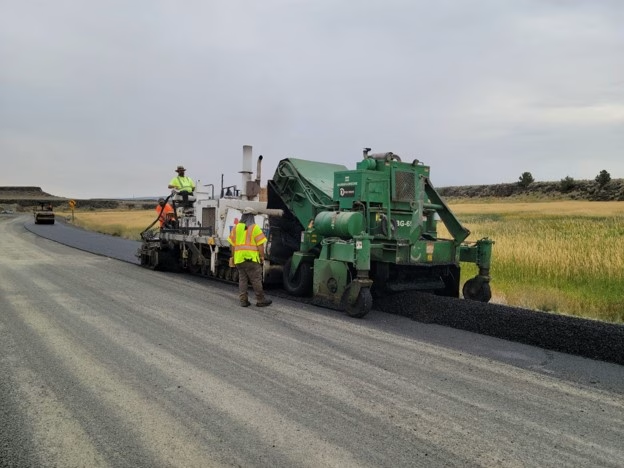
Across America, county transportation departments face a similar challenge: roads that were recently graded, patched, or rebuilt often begin showing signs of deterioration again within a few months. As agencies work to balance growing infrastructure needs with limited resources, many communities remain reliant on the traditional maintenance practices that have been around for decades.
The challenge of roadway deterioration is widespread. The American Road and Transportation Builders Association estimates that more than 40% of America’s rural roads are in poor or mediocre condition. County governments are responsible for maintaining approximately 45% of the nation’s roads, and in many communities, keeping them functional requires a significant share of annual transportation budgets. Despite billions of dollars being invested in local infrastructure each year, many rural road networks continue to experience recurring failures that require ongoing attention and funding, resources that many counties often don’t have.
According to InnovaSoil Technologies, a Jacksonville-based infrastructure company, the issue may not be a lack of investment. Instead, many current maintenance strategies focus primarily on repairing visible damage while leaving the conditions that contribute to deterioration unresolved.
For decades, road agencies have relied on familiar methods such as grading, patching, and adding aggregate to restore damaged roadways. While these approaches can provide short-term improvements, factors underneath the surface – including water infiltration, unstable subgrades, and poor load distribution – continue to weaken road foundations and contribute to repeated failures.
Why Rural Roads Keep Failing
While traffic volume and vehicle weight can contribute to roadway wear and tear, one of the most damaging forces affecting rural road foundations is water.
When moisture penetrates a road’s base and subgrade layers, it weakens the soil’s ability to support the surface above. Over time, repeated traffic loads place stress on compromised materials, causing the road structure to deteriorate. Ruts develop, surfaces break down, and recently repaired damage can return sooner than expected.
This recurring pattern is a major reason rural counties continue dedicating significant portions of their transportation budgets to maintenance. Surface grading and patching can temporarily restore a roadway, but they do not address the moisture and soil stability issues that contribute to ongoing deterioration. Without improving the foundation beneath the road, transportation departments are often left revisiting the same problem areas year after year.
“Counties have become trapped in a maintenance cycle,” said Matt Fenner, COO of Caplin Ventures, a venture capital firm that is a key stakeholder in InnovaSoil Technologies. “For decades, local governments have been forced to grade, patch, and rebuild the same roads repeatedly. The question is not whether we can afford innovation. The question is whether we can afford to keep doing the same thing.”
A New Approach to Rural Road Stabilization
InnovaSoil Technologies believes more county officials are beginning to reevaluate how they approach infrastructure preservation. Rather than focusing only on repairing surface damage, transportation agencies are increasingly looking at technologies that strengthen road foundations, improve moisture management, and help extend roadway life.
The company has developed technologies designed to address rural road failures at the structural level by targeting the conditions that contribute to deterioration rather than simply repairing the surface damage.
Its proprietary MH72™ BASELOCK™ stabilization technology chemically treats and binds base and subgrade materials, creating a stronger road foundation designed to resist water penetration and deformation caused by repeated traffic loads. Instead of repeatedly repairing a weakened foundation, BASELOCK™ strengthens the underlying structure that plays a critical role in long-term road performance.
The MH44™ SURFACE SHIELD™ moisture protection system complements this approach by helping reduce water infiltration at the road surface and limiting moisture exposure to the structural layers below.
Together, these systems address a primary driver of roadway deterioration: moisture. By reducing water intrusion while improving foundation stability, they help protect roads from the conditions that lead to recurring damage and premature failure.
The Economic and Policy Case for Structural Stabilization
The financial case for structural road stabilization is based on a simple principle: roads that last longer require fewer repairs.
A roadway that requires maintenance every six to twelve months using traditional methods may achieve longer service intervals when the underlying causes of deterioration are addressed. For county transportation departments responsible for hundreds or thousands of miles of roads, extending maintenance cycles can create meaningful budget flexibility while allowing resources to be directed toward other infrastructure priorities.
Federal infrastructure funding is also increasing the focus on long-term performance. The Infrastructure Investment and Jobs Act provided substantial funding for local roads and bridges while placing greater emphasis on demonstrating measurable value from infrastructure investments. As communities look for ways to make limited resources go further, technologies that improve road longevity and performance are becoming increasingly important.
For Fenner, the impact extends beyond transportation budgets.
“Infrastructure is not just a budget line. It is the backbone of how a community functions,” he said. “When a rural road fails repeatedly, it affects farmers getting products to market, families accessing services, and emergency vehicles reaching the people who need them. Solutions that extend road life don’t just save money. They make communities more resilient.”
InnovaSoil Technologies is attracting attention from county engineers and transportation officials who are exploring alternatives to traditional maintenance approaches. As infrastructure budgets face continued pressure nationwide, communities are beginning to look beyond short-term repairs and consider how roads can be engineered and stabilized to deliver stronger performance over time.
About InnovaSoil Technologies
InnovaSoil Technologies develops advanced roadway stabilization, moisture control, and infrastructure preservation technologies designed to improve road performance while reducing long-term maintenance costs. The company is a portfolio company of Caplin Ventures. Learn more at innovasoiltechnologies.com.