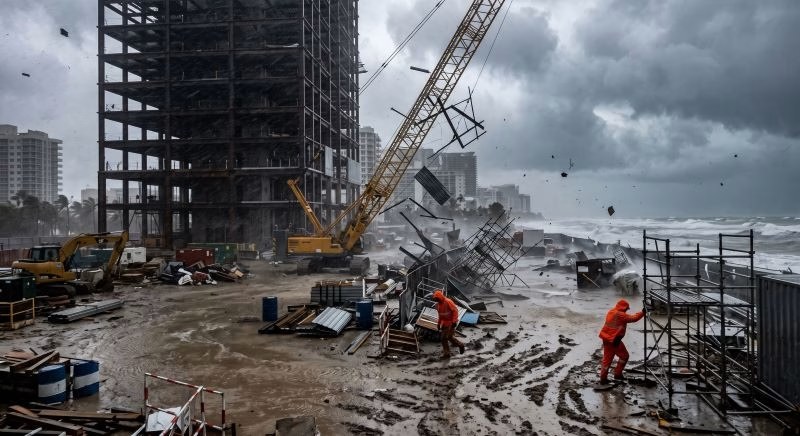
Every Houston project runs against two calendars. One is the construction schedule. The other starts June 1 and ends November 30.
The Atlantic hurricane season covers half the working year on the Gulf Coast, and it doesn’t spread its risk evenly. Atlantic basin tropical cyclone climatology published by the National Hurricane Center puts the climatological peak on September 10, with most activity falling between mid-August and mid-October. That eight-week stretch is the part of the calendar that actually reshapes a project. A building that reaches dry-in by early August sits in a very different risk position from one still open to the sky in September.
What catches teams out is that a storm doesn’t only threaten the structure. It threatens stored materials, temporary power, labor availability, and eventually the balance sheet of whoever holds the risk once coverage runs out. Managing a Houston build through storm season means planning for all four.
Sequencing against the peak
The most useful thing a Houston schedule can do is move weather-sensitive milestones out of the September window.
Dry-in is the obvious one. Roof membrane, glazing, and envelope closure turn a project from an exposed collection of materials into a building that sheds water. Pulling dry-in forward by three weeks is often worth more than any amount of schedule contingency added at the back end. The same logic applies in reverse to work that can wait. Interior finishes, millwork installation, and flooring gain nothing from going in during August and lose a great deal if the envelope fails in September.
Crane operations sit on a similar hinge. Tower cranes have to be weathervaned and secured ahead of a named storm, which means the erection and dismantling sequence has to leave slack around the peak weeks rather than assuming clear skies. Large concrete pours face the same constraint, since a rain event during curing can compromise a slab that took months to schedule.
Houston’s regulatory environment already pushes teams toward this kind of thinking. Since September 2018, Chapter 19 of the city code has required new structures and substantial improvements in the special flood hazard area to sit two feet above the 500-year flood elevation, and Harris County eliminated slab-on-grade construction in the 100-year floodplain in favor of engineered open foundations. Public infrastructure has followed the same logic, with drainage led highway improvements in Houston opening the North Houston Highway Improvement Project through a $121.8 million drainage contract rather than a roadway one. Those rules changed what gets built and how. They didn’t change when the water arrives.
Reading the policy before the storm, not after
Builder’s risk is where a lot of Houston teams assume they’re covered and turn out to be partly wrong.
Standard builder’s risk policies exclude flood. Storm surge, rising water, and rainfall-driven inundation generally need a separate endorsement or a National Flood Insurance Program policy sitting alongside the builder’s risk. On the Gulf Coast that distinction matters more than almost anywhere else, because a single hurricane usually delivers wind and water together, and adjusters will spend months arguing about which one caused what.
Wind is usually covered, but it carries its own arithmetic. Engineering News-Record reported that brokers in hurricane-exposed Gulf markets now routinely write named storm deductibles on large projects that run into the millions of dollars, alongside tighter sublimits for water-related losses. When the deductible is calculated as a percentage of total insured value rather than a flat figure, a moderate wind claim on a large project can land entirely inside the retention and never reach the carrier at all.
Location matters too. A builder’s risk policy describes a project at an address, and materials sitting in a warehouse three miles away may or may not fall inside that description. This is where inland marine coverage for stored materials earns its place in the stack, since it follows equipment, materials, and supplies while they’re in transit or held off site. Teams that stage materials away from the jobsite without checking whether the coverage travels with them are carrying an uninsured position they don’t know about.
Where the materials go
Hurricane Beryl made the storage question concrete for the entire Houston market.
Beryl came ashore near Matagorda on July 8, 2024 as a Category 1 storm, which by Gulf Coast standards is not an extreme event. CenterPoint Energy reported roughly 2.2 million customers without power at the peak, and more than 200,000 were still waiting a week after landfall. For a jobsite, that’s the gap between a delay and a loss. No temporary power means no dehumidification, no climate control, and no way to run drying equipment.
The timeline is unforgiving. EPA guidance on moisture in buildings calls for drying wet materials within 48 hours to prevent mold growth, and recommends holding relative humidity below 60 percent. In a Houston August with the grid down, neither condition is achievable. Paper-faced gypsum, engineered wood, cabinetry, and anything with a cellulose component starts degrading on a schedule nobody controls.
The practical answer is that finish materials shouldn’t be sitting on an exposed site through the peak weeks. Owner-furnished items, millwork, appliances, and specialty finishes with long lead times are the worst candidates for jobsite storage, because replacing them means re-entering a supply chain that a regional storm has already disrupted. Houston’s storage market makes off-site staging workable in a way it isn’t everywhere, with climate controlled storage across Houston neighborhoods spread throughout the metro rather than concentrated on the periphery. Proximity is the operative factor. A staging location twenty minutes from the site supports just-in-time delivery, while one an hour out turns every material call into a half-day of logistics.
The same reasoning applies to occupied buildings under renovation. When a phased project has to clear a floor ahead of a storm, the contents need somewhere conditioned to go, and arranging that in the seventy-two hours before landfall is considerably more expensive than arranging it in May.
The site nobody is watching
An evacuation order empties a jobsite of everyone who would normally notice a problem.
That window is when losses compound. Copper, tools, generators, and fuel move quickly during a regional emergency, and insurance claims for theft during a declared event tend to be slow and contested. The standard measures around hardening a site against material theft matter more here than at any other point in the schedule, because they have to hold without anyone on site to enforce them. Photographic inventory taken before the site closes down is worth the hour it takes, since it turns a disputed claim into a documented one.
Secured material also becomes airborne material in a windstorm. Loose sheet goods, scaffolding planks, and unsecured formwork stop being an inventory problem and start being a liability problem the moment they leave the property line.
The exposure that outlives the policy
Every risk transfer chain on a construction project ends somewhere, and the last link is usually a person.
Contract terms allocate risk between owner and contractor. Insurance absorbs what the contract assigns, up to a limit. Past that limit, and inside every deductible, sublimit, and exclusion, the exposure sits with whoever owns the entity. A named storm deductible in the millions, a flood loss that falls outside the endorsement, or a third-party injury claim arising from debris off an unsecured site can all exceed what the policies were built to absorb.
Construction sits alongside medicine and law on most lists of high-liability professions for exactly this reason. Developers and contractors carrying personal guarantees on project debt, or operating through entities that haven’t been maintained properly, find the gap reaches them directly. asset protection planning for construction professionals works on the principle that structures put in place before a claim exists are legally defensible, while transfers made after one arises can be challenged as fraudulent. Storm season is a poor time to discover that distinction, because by then the claim already exists.
The practical version of this is unglamorous. Entity separation between projects, properly maintained corporate formalities, coverage reviewed against the specific exposures of a Gulf Coast site, and a look at which assets already carry statutory protection under Texas law. None of it is exciting, and all of it has to be done in advance.
Treating the season as a schedule input
The teams that come through a Houston storm season well aren’t the ones with the best weather luck. They’re the ones who wrote the calendar into the plan from the start.
That means dry-in targeted ahead of mid-August, materials staged off site through the peak, coverage read line by line before June rather than after a loss, and the legal structures underneath the project reviewed while there’s nothing to defend against. Every one of those decisions is cheaper in February than in September.
Houston will keep building through hurricane season, because the alternative is not building for half the year. The projects that finish on budget are the ones where somebody treated June 1 as a real date on the schedule.