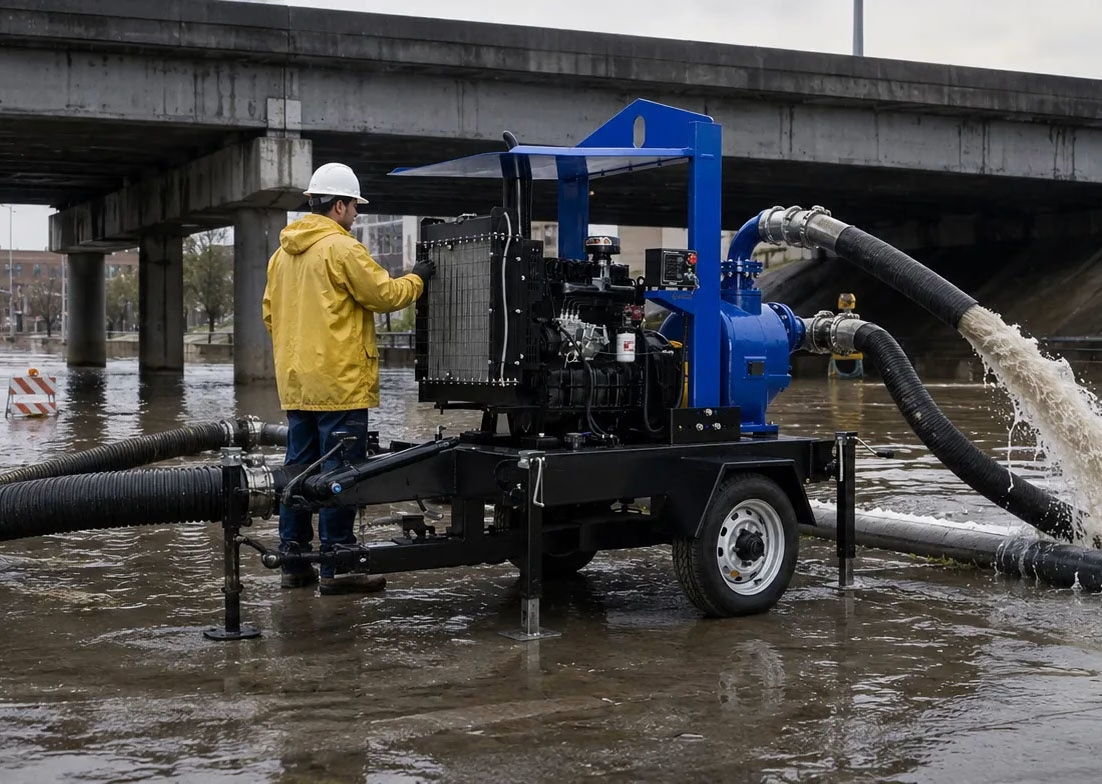
Buying a water pump feels straightforward until you get it home and it won’t shift the volume you need, or it runs flat out just to move water uphill. Plenty of buyers focus on price or brand and skip the technical details that actually determine whether a pump does its job.
Here are seven common mistakes to avoid when choosing and buying a water pump, so you don’t end up with the wrong unit for the work.
Ignoring the Flow Rate You Actually Need
Flow rate – measured in litres per minute – is the most important number on the spec sheet, and it’s also the one most buyers overlook. To work out what you need, think about the task. Draining a small water tank after rain calls for a very different flow rate than irrigating a large paddock or supplying water to multiple outlets at once. Underestimate, and the pump runs constantly trying to keep up. Overestimate, and you pay for capacity you’ll never use.
Measure the volume you need to shift and the timeframe you need to shift it in. Divide one by the other and you’ve got your minimum litres-per-minute figure. Then add 10 to 20 per cent as a buffer, real-world conditions rarely match ideal ones.
Overlooking the Head Pressure Rating
Head pressure describes how high a pump can push water vertically. It’s listed as “max head” on most spec sheets, and buyers routinely treat it as a bonus figure rather than a hard limit. That’s a mistake.
If your pump needs to push water two storeys up or over a ridge, a unit with a low max head will strain, underperform, and wear out early. Every metre of vertical lift you ask of the pump costs it a portion of its available pressure – and so does horizontal distance, bends in the hose, and friction inside the pipe.
Before you buy, map the route the water has to travel. Measure the vertical rise from the pump’s intake point to the highest outlet, and factor in roughly one metre of equivalent head for every ten metres of horizontal run. Then match that figure against the pump’s rated performance, not its maximum figure.
Choosing the Wrong Pump Type for the Job
Transfer pumps, trash pumps, self-priming pumps, and submersible pumps are not interchangeable. Each type is built for a specific set of conditions, and dropping the wrong one into a job leads to poor results at best, and a ruined pump at worst.
A standard transfer pump handles clean water well. But if you’re dealing with water that carries silt, small solids, or debris – like draining a dam or a flooded yard after a storm – a trash pump is what you want. Its impeller is built to pass solids without jamming.
Submersible pumps sit in the water they’re moving and don’t need priming, which makes them well suited to wells and tanks. They’re not built for dry running, though, even briefly. Get clear on the conditions first, then match the pump type to those conditions.
Skipping Compatibility Checks on Fittings and Hoses
A pump that performs perfectly on paper is useless if it won’t connect to your existing hoses or fittings. Thread sizes, outlet diameters, and fitting standards vary between manufacturers, and Australian and imported products don’t always share the same specs.
Check the inlet and outlet sizes on both the pump and your existing hose or pipe before you buy. Common outlet sizes are 25mm, 32mm, and 50mm, but the thread type matters just as much as the diameter. BSP (British Standard Pipe) threads are standard in Australia, but some imported pumps use NPT (National Pipe Taper), which won’t seal correctly on BSP fittings without an adapter.
Don’t overlook the hose material itself. Certain liquids – fertiliser solutions, mildly acidic runoff—degrade standard PVC hose quickly. Match the hose material to what you’re moving, not just to the pump’s outlet size.
Buying on Price Alone
A cheap pump isn’t always bad value, but it’s rarely the full picture. Low-cost units tend to come with thinner impellers, weaker seals, and less durable casings — parts that fail faster under regular use, and whose replacement costs stack up quickly.
When comparing water pumps for sale in Australia, it is worth looking beyond the initial price and checking how each option matches the work you need it to handle. Flow rate, head pressure, build quality, warranty coverage, and access to replacement parts can all affect the pump’s long-term value. A slightly higher upfront cost can make more sense if the pump is better suited to regular use and easier to maintain over time.
That said, the most expensive pump isn’t automatically the right one either. What matters is matching the pump’s quality and duty rating to how hard you’ll actually run it. A pump rated for intermittent use will wear out fast if you’re running it four hours a day; a pump built for continuous operation costs more upfront, but it lasts in that role.
Compare total cost of ownership, not just the sticker price. Look at the warranty period, the availability of spare parts, and whether the manufacturer or supplier stocks those parts locally.
Missing the Power Supply Requirements
Petrol-powered pumps and electric pumps have different strengths, and connecting the wrong type to your setup causes real problems. Electric pumps need a stable power source with adequate amperage, and running a high-draw pump off a domestic extension lead that isn’t rated for it is a fire risk.
Petrol pumps are more flexible for remote locations where there’s no power, but they need fuel, regular oil checks, and adequate ventilation. Never run a petrol pump in an enclosed space—carbon monoxide builds up fast.
For electric models, check the pump’s listed amperage against the circuit it’ll draw from. If you’re using an extension lead, make sure it’s rated for outdoor use and for the pump’s wattage. A lead that’s too light causes voltage drop, which strains the motor and shortens its life.
Forgetting About Maintenance and Spare Parts
A pump is only as good as your ability to keep it running. Buyers often focus entirely on the initial purchase and don’t stop to ask whether spare parts are actually available in Australia or whether the pump is practical to service.
Look for units where you can get replacement seals, impellers, and mechanical shaft seals without a long wait or a prohibitive freight bill. Some imported brands have excellent performance specs but poor local parts availability, which means a broken seal puts the whole unit out of action for weeks.
Ask the supplier directly: what are the most common service parts, and do they stock them? A supplier who can answer that clearly is worth buying from. One who can’t might leave you with an expensive paperweight after the first repair.
Conclusion
The common mistakes to avoid when choosing and buying a water pump all trace back to the same problem: buying on assumptions rather than actual specs. Know your flow rate, head pressure, power supply, and fitting sizes before you compare products. Match the pump type to the real conditions of the job, and confirm spare parts are available before you commit. Do that groundwork, and you’ll end up with a pump that earns its keep, not one that sits in the shed after the first season.