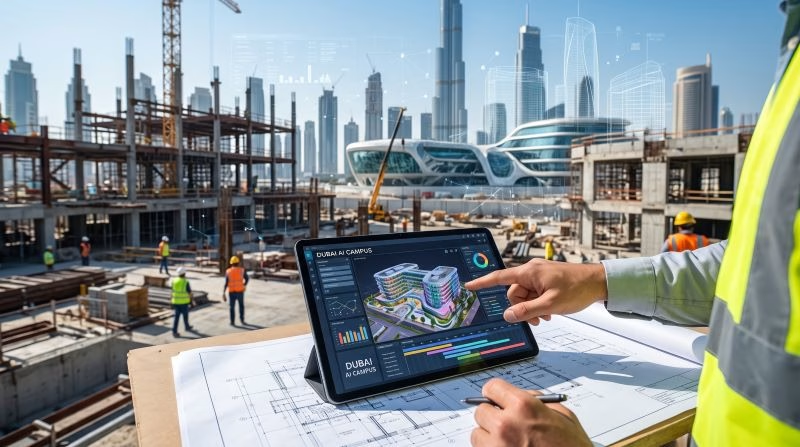
Dubai has never shied away from big numbers, and its latest one is hard to miss. The Dubai AI Campus now aims to host more than 1,000 AI companies by 2030, which would double the current number. Each of these companies will need offices, labs, and data centers, and building them properly requires more than just steel and concrete. It all requires construction software development that ensures all stakeholders are working from the same set of information. Learn more below.
What the Goal of 1,000 Companies Will Really Tell Us
Goals like these sound like software and talent stories – and that’s exactly what they are. But every company on the campus also needs space to work, a reliable power supply, and a fast internet connection. Someone has to design, approve, and build these spaces, and the teams that do this are increasingly relying on construction software development. It consolidates design models, procurement data, construction progress, and handover data in one place. If this aspect is weak, the shiny lab tends to open late and go over budget.
A little background information is helpful. The campus opened in May 2024 and has already exceeded its original five-year goals: more than 500 AI companies are based there, and over 1 billion AED in private equity and venture capital has been raised. The new goal, which Sheikh Hamdan approved at the third Dubai AI Festival, links the target of 1,000 companies with the creation of 5,000 highly skilled jobs by 2030.
For executives outside the AI sector, demand is the key indicator. More technology companies in Dubai mean more offices, labs, housing, and services – and each of these areas requires a project team to ensure that tasks are carried out smoothly.
Where the Structure Slows Down the Narrative Flow
The construction industry has long been considered a laggard. McKinsey estimates that global productivity in the construction sector rose by 1% per year between 1995 and 2015, while productivity in the overall economy stood at 2.8%, as noted by Oxford Business Group. This gap becomes a factor when the opening of specialized buildings is scheduled within tight timeframes.
Some vulnerabilities keep showing up again and again:
- Disconnected tools. Teams in planning, cost management, and construction site management each use their own systems, and no one has access to the same numbers.
- Slow transfer of data. Progress reports reach executives only days after a problem arises.
- Paper-based handoffs. Employees receive boxes full of documents instead of usable digital documentation.
- Spreadsheet risk. Important schedules are stored in files that only one person understands.
Well-designed construction software can solve most of these issues by providing every team with a single, up-to-date version of the project.
Specialized buildings pose a particular challenge for Dubai tech companies. In a laboratory or data center, cooling, power supply, and security systems are housed in a very confined space, so that a single last-minute change to a drawing can affect half a dozen different trades.
What About Infrastructure, Rules, and Talents?
The festival itself was a major event, drawing more than 20,000 participants from over 100 countries. Sheikh Hamdan’s message to them was practical: companies need world-class infrastructure, a flexible regulatory environment, and access to international talent to turn AI ideas into sustainable economic value.
Dubai already offers an example of how regulations can encourage digital habits. Since January 1, 2024, new building permit applications in certain categories must include a BIM model, which must be submitted via a municipal online submission platform. Dubai’s Building Code also mandates that the city government establish a unified digital database of the emirate’s buildings. In other words, the city wants every building to exist not only in concrete but also in the form of data. It also aims to have 25% of its buildings incorporate 3D-printed elements.
That is the true test of the digital transformation UAE leaders keep promising: not the goal mentioned in the headlines, but whether permits, projects and operational processes speak the same data language.
What Leaders Can Do Now
If you run a company that will be building, equipping, or operating facilities for the AI wave, it’s a mistake to wait for the perfect platform. Small, concrete steps are more effective than a large-scale program. What to do?
- Map your data flow. Document where the data on design, costs, schedule, and the construction site is currently located, and who is responsible for each set of data.
- Check readiness for permitting. Ensure that your teams can create the BIM models that Dubai now requires for permit applications.
- Test a live dashboard. Select a project and present progress and costs to project management in a single overview – whether created in-house or in collaboration with a construction software development partner.
- Plan for handover. Upon completion, request usable digital documentation – not a stack of PDF files.
While these steps may not make headlines, they are precisely what will determine the success or failure of digital transformation in the UAE. Keep the budget modest at first, because most of the initial successes come from agreeing on standardized definitions and designating one person responsible for each dataset.
So, Can Foundations Keep Up?
Dubai has proven that it can set ambitious goals and then exceed them: the campus has already achieved its first five-year goals two years ahead of schedule. The next phase is less glamorous. The question here is whether buildings, permits, and projects can keep pace with the companies moving in.
For Dubai tech companies, the answer to this question determines how quickly a new lab can become a fully functional office. For construction companies, developers, and their consultants, this is a clear opportunity. Those who have access to clean data and interconnected tools will find it easier to gain trust and to hire. The goal of 1,000 companies is a promise for the future, but the groundwork for it is already being laid – one project at a time.