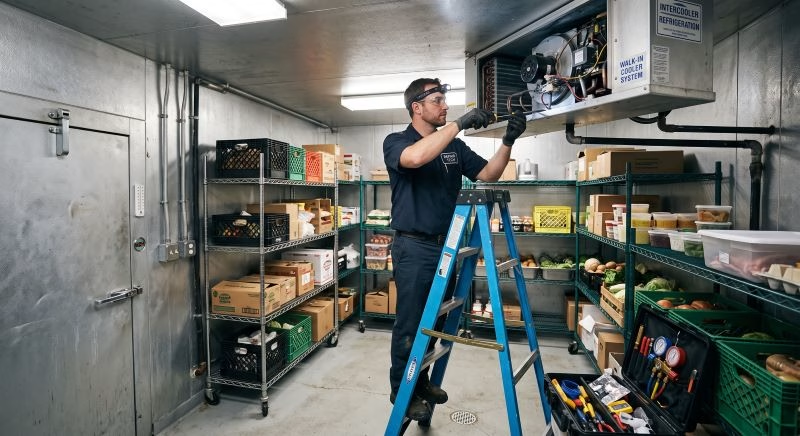
Walk into any commercial kitchen, grocery back room, or senior living service corridor and you will find the same misunderstood piece of equipment: the walk-in cooler. On the budget sheet it sits with the appliances. In practice it behaves like a building system – an insulated envelope, a refrigeration circuit, a drainage path, and an electrical feed that all have to agree with each other. When one of them is compromised, the box does not stop working. It works harder, quietly, until something expensive happens.
For contractors and facility teams, that distinction matters more than it sounds. The decisions that determine whether a walk-in runs cheaply for fifteen years or bleeds money from month one are made during construction and fit-out, not during service calls.
What actually fails (it is rarely the compressor)
Ask a technician what brings down walk-in coolers and the compressor comes near the bottom of the list. The recurring offenders are duller:
Doors and gaskets. A gasket that has hardened, torn, or lost its magnet lets humid room air in continuously. The refrigeration system never reaches a steady state, run times climb, and moisture migrates where it does not belong. A door that no longer self-closes – worn hinges, a failed closer, a sagging frame – produces the same result at a larger scale.
Defrost and drainage. Every cooler makes water. If the condensate line is undersized, poorly sloped, or unheated in a freezer application, it freezes, backs up, and the evaporator coil turns into a block of ice. Once that happens, airflow drops and the box loses its ability to hold temperature even though every component is technically “running.”
Condenser placement. A condensing unit installed on a hot roof, packed into an unventilated closet, or positioned where kitchen grease and dryer lint settle on the fins will shed capacity year after year. The unit was never undersized; the environment made it behave that way.
Panel seams and floor penetrations. Insulated panels rely on tight, sealed joints. Forklift damage, shifting slabs, and improvised penetrations for conduit or shelving create thermal bridges that appear as sweating panels, then as mold, then as rot.
Note the pattern: nearly all of these are envelope and installation issues, not refrigeration failures. That is precisely why the repair invoice is so often the smallest part of the total cost.
The symptoms that deserve an alarm
Facility teams tend to escalate only when product is warm, which is the last stage of the failure, not the first. The earlier signals are visible to anyone walking through:
- Product temperature drifting a few degrees over weeks, corrected by turning the thermostat down
- Ice forming on the evaporator, the ceiling near the unit, or the floor by the door
- Panels that sweat on the outside – a sign the envelope is losing its thermal separation
- The condensing unit running nearly continuously rather than cycling
- A door that has to be pushed to latch
Each of these is cheap to address while it is still a symptom. Each becomes a shutdown when ignored long enough.
The cost math nobody puts in the capital plan
When a walk-in fails in a restaurant, the repair is often the least of it. The inventory inside is the first loss. The second is service: a kitchen without cold storage does not operate at half capacity, it closes. The third is regulatory – health inspectors do not treat a failed cooler as a maintenance item, and a temperature log with gaps is a finding in itself. In healthcare and senior living facilities, where cold storage covers both food service and, in some cases, medical supplies, the compliance exposure grows further.
Set against that, the economics of prevention are almost boring. Quarterly condenser coil cleaning, a monthly five-minute door and gasket check, an annual inspection of drain lines and panel seams, and a temperature log somebody actually reads will prevent the majority of emergency calls. When something does fail, a technician who handles commercial walk-in cooler repair will usually diagnose airflow, defrost, and door sealing before touching the refrigeration circuit – because that is where the fault almost always lives.
What this means at design and handover
Three habits separate installations that age well from the ones that generate service tickets forever.
First, treat condenser location as a performance decision, not a leftover. Ventilation, ambient heat, and contamination exposure determine capacity in year five.
Second, design the drainage path deliberately – sized, sloped, heat-traced where required, and accessible for cleaning. It is the single cheapest failure to prevent and one of the most common to find.
Third, hand over a maintenance plan, not just a warranty. The warranty covers parts. The plan covers the gasket, the coil, the drain, and the door closer – the four things that will actually decide what this box costs to run.
A walk-in cooler is one of the few pieces of equipment in a building that never turns off. Specify it, install it, and maintain it like the building system it is, and it will behave like one.