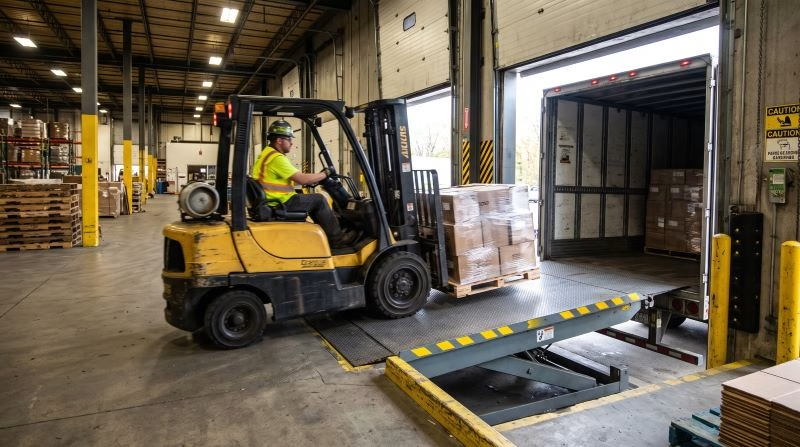
A dock leveler that has sat in the same pit for years can still look sound from the warehouse floor, but the impact of aging levelers will usually only show up in use, whether that be the lip not lying flat on the trailer that just backed in, or even when the deck stalls halfway through its travel.
An owner or contractor standing at that door then has to choose whether to keep repairing the unit or come out of pocket to replace it, both of which are less than optimal situations for the facility.
Signs an outdated dock leveler needs more than a repair
Early warning signs that come up during routine warehouse upkeep tend to be easy to dismiss at first glance, such as a lip that meets the trailer at an uneven angle or a deck that takes longer to rise than it used to.
The best way to really identify possible issues is to cycle the unit once and watch the parts that take the load. Each symptom points somewhere different:
- A deck that stalls on the way up, or never leaves its stored position, points to whatever lifts it: springs, a hydraulic cylinder and pump, or an air bag.
- Corrosion on the frame, cracked or broken welds under the deck, or a deck plate that no longer sits flat all mean the structure itself is wearing out.
- A lip that has lost its shape, shows cracks, stops short of full reach or hangs open after the cycle is damage to the piece that bridges onto the trailer.
- A unit can also be in working order and still be wrong for the door if the trucks or loads it handles have changed since it went in.
Those conditions are hazards for anyone walking or driving across the deck. If the lip falls short of the trailer bed, a step or a gap can then open at the threshold, and if the deck drops or stalls under a truck, the path across can become uneven and a safety hazard.
Sure, the mechanism can still cycle cleanly, but it doesn’t mean it is fit for the job at hand. If the deck cannot follow the trailers you receive on site, you are looking at working range or load rating.
Why today’s trailer mix changes the decision
A leveler has to reach the trailers that actually back up to the door, and mixed fleets make that harder. The same bay may meet a high semi on one arrival and a much lower van on the next. Before pricing a replacement, record what the bay actually sees:
- the lowest and highest trailer beds that back up to the door
- each of those beds both loaded and empty
- the dock height the leveler has to meet
Set those numbers against the working range on the replacement unit’s spec sheet. If no single unit covers the spread, the facility has to decide which trailers each door serves.
Mechanical, hydraulic, or air-powered: what changes for an upgrade
The lifting method decides whether the bay needs power and which parts will need attention over the unit’s life:
- A mechanical unit lifts on springs and needs no power at the bay.
- A hydraulic unit lifts on a cylinder driven by a powered pump.
- An air-powered unit lifts on an air bag that has to be inflated, so it needs power as well.
On a mechanical unit, the main lift dock leveler springs are extension springs with adjustable tension, and they should be checked at least monthly for rust, fraying, or breaks. Tension set too high can keep the deck from descending properly, and tension set too low lets it come down too quickly.
Hydraulic and air-powered units need power at the dock, so a door that is not already wired adds electrical work to the job. A mechanical unit avoids that, at the cost of more manual effort at every use.
Repair or replace
Most calls come down to whether the problem sits in a part built to be swapped or in the leveler’s structure, and whether the unit still fits the operation:
- Repair fits when the wear is in serviceable parts, and the deck still reaches the trailers and carries the loads in front of it. The springs on a mechanical unit, the cylinder or pump on a hydraulic one, and the air bag on an air-powered one all fall in this group.
- Replacement fits when the damage is in the structure itself, such as a cracked lip, failed welds, or a deck that no longer sits flat, or when no part swap will give the unit the range or rating the dock now needs.
Load ratings and edge protection on a replacement
Under OSHA 29 CFR 1910.26, dockboards must be “capable of supporting the maximum intended load,” and OSHA’s definitions place dock levelers under that rule.
That load covers everything the employer reasonably expects on the surface at one time, from workers and lift trucks to the materials they carry. A rating that was fine at installation can fall behind after a heavier forklift arrives. The same section sets an edge rule for newer equipment:
“Dockboards put into initial service on or after January 17, 2017 are designed, constructed, and maintained to prevent transfer vehicles from running off the dockboard edge.”
An employer can skip run-off protection only by showing there is no run-off hazard at that dock, and the Loading Dock Equipment Manufacturers group at MHI, known as LODEM, describes the same two choices.
A replacement leveler is a new dockboard, so one installed in an existing pit today goes into initial service after that date and falls under the rule.
What a retrofit involves on site
The site work depends on whether the new unit goes back into the existing pit or onto the dock face, and on whether it needs power:
- A pit-style unit goes back into the existing pit, so the opening has to match the new unit’s drawings.
- Hydraulic and air-powered units need a power feed and a place for their controls at the bay. A mechanical unit uses no power.
- An edge-of-dock leveler mounts directly to the dock face and leaves the pit out of the work.
If the existing opening no longer matches the new frame, the choice narrows to repairing the pit first or moving to a dock-face unit, provided that unit’s working range still reaches the trailers the door serves.
Downtime varies with the job, so ask the installer for an estimate that covers pit work, power and commissioning, and book it around the door’s quietest days.
What to confirm before signing off
Construction Review Online’s guide to safety standards for commercial garage and loading doors lists “dock levelers rated for the expected load” among the measures compliant facilities use. On a retrofit, check the new unit against the bay as it runs today:
- The load rating covers the heaviest forklift, load, and crew that cross the bay at one time
- The working range reaches the highest and lowest trailer beds received, loaded and empty
- Run-off protection is in place, or the no-hazard finding is documented
- Competing quotes are compared on their ANSI MH30.1 ratings, the LODEM standard written as a common basis for comparing dock leveling devices
- Spring tension on a mechanical unit is set so the deck neither drops too fast nor hangs up
- Controls and the power feed on a powered unit are tested before the door reopens
For the final check, measure the highest and lowest trailers you actually receive, cycle the new leveler through its full travel, and watch the lip land on a real trailer before the door goes back into service.