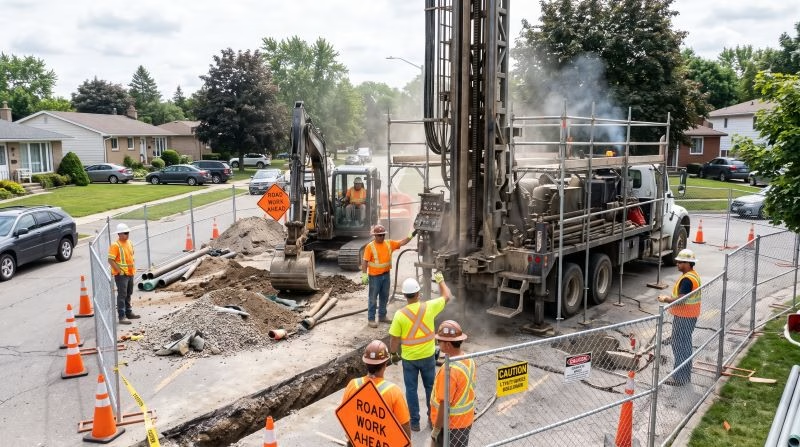
Coverage of major projects usually focuses on what goes up: office towers, LNG terminals, data center campuses, and rail corridors. What happens below grade gets far less attention. Yet unexpected subsurface conditions remain one of the most common sources of change orders, schedule delays, and disputes in heavy construction. A National Cooperative Highway Research Program synthesis of U.S. transportation agencies found that subsurface-related change orders alone approach 1% of those agencies’ total budgets for new construction.
Long before the first pile is driven, a drill crew pulls samples from the ground and a field technician records what they find. That record, the boring log, becomes the basis for nearly every foundation decision that follows. When the log is accurate and complete, engineers can design with confidence. When it’s thin, inconsistent, or buried in a stack of paper, the project inherits risk that no amount of above-ground planning can fix.
What a Boring Log Actually Captures
A boring log is the field record of a single test boring. A well-prepared log typically includes:
- Soil and rock layers, with depths and descriptions that follow a standard classification method such as ASTM D2488
- Standard Penetration Test (SPT) blow counts, which indicate soil density and consistency
- Groundwater observations, both at the time of drilling and after the boring is complete
- Sample types, depths, and identification numbers
- Drilling method, equipment, weather, and notes on anything unusual, such as obstructions or caving
Each of these data points feeds a design decision. Blow counts inform bearing capacity. Groundwater depth affects excavation, dewatering, and waterproofing. Layer transitions tell engineers where a shallow foundation may work and where deep foundations become necessary. The Federal Highway Administration’s geotechnical site characterization manual lays out how this data should be collected, documented, and reported. For a section-by-section walkthrough, this guide on how to read a soil boring log explains what each part of the log means and how engineers use it.
Where Subsurface Documentation Breaks Down
The data itself is rarely the problem. The trouble is how it moves from the drill rig to the design team. On many projects, logs still start as handwritten field notes that pass through several hands before an engineer sees them. Common failure points include:
- Transcription errors: Depths, blow counts, and descriptions get retyped, sometimes days later, by someone who wasn’t at the rig.
- Inconsistent descriptions: Two technicians may describe the same soil differently, which makes it harder to correlate layers between borings.
- Disconnected lab results: Moisture content, gradation, and strength results have to be matched back to the right boring and depth. One mislabeled sample can quietly distort the subsurface picture.
- Missing context: Photos, field sketches, and notes about drilling conditions often live in separate folders, or nowhere at all.
- Weak audit trails: When a question comes up months later during design review or a claim, teams may struggle to show who recorded what and when.
Individually, these look like small administrative issues. On a large project with dozens or hundreds of borings, they compound.
The Cost of Getting the Ground Wrong
Foundation design is conservative by necessity. When engineers are uncertain about subsurface data, they compensate with deeper piles, larger footings, or another round of investigation. Each of those adds cost and time before construction even starts.
When the data is wrong rather than uncertain, the consequences show up in the field. Excavation reveals conditions that don’t match the geotechnical report, crews stop work, the design team revises the foundation, and the question of who pays for differing site conditions begins. A National Academies review of geotechnical practice points to pile overruns, higher-than-expected groundwater, and misclassified soils as frequent causes, with some agencies reporting added costs of 5% to more than 25% of project cost. On a project with a tight schedule and a large budget, a single undocumented soft layer or misplaced groundwater reading can ripple through the entire critical path.
How Digital Field Records Are Changing the Process
Geotechnical and drilling firms are increasingly moving boring logs off paper and into digital field and lab systems. The shift addresses each of the breakdown points above:
- Technicians enter data at the rig on a tablet, using standardized fields and classification options that reduce inconsistency.
- Sample IDs follow each sample from the field to the lab, so results attach to the correct boring and depth automatically.
- Photos and field notes are stored with the log instead of in a separate folder.
- Every entry and edit is time-stamped, creating a clear chain of custody.
- Engineers can review logs as borings are completed instead of waiting for a full field package.
Platforms built for geotechnical, materials testing, and drilling work connect field capture, lab testing, and reporting in one system. The result is subsurface data that stays traceable from the first sample to the final geotechnical report.
Questions Owners and Contractors Should Ask
You don’t need to be a geotechnical engineer to judge the quality of subsurface data. Before design moves forward, ask your geotechnical firm:
- How are field logs recorded, and how soon do they reach the engineer?
- What classification standard do technicians follow, and how is consistency checked across borings?
- How are lab results linked back to specific borings and depths?
- Are field photos and drilling notes included in the final record?
- If a question comes up during construction, how quickly can you produce the original field data?
Clear, specific answers signal a firm that treats documentation as part of the engineering rather than an afterthought.
Every Foundation Starts With a Field Record
The largest projects in the world still rest on decisions made from a few pages of field data. Owners and contractors who ask about subsurface documentation early, before design is locked, give their teams the best chance of avoiding surprises once excavation begins. Getting the boring log right is one of the least expensive ways to protect a foundation budget.