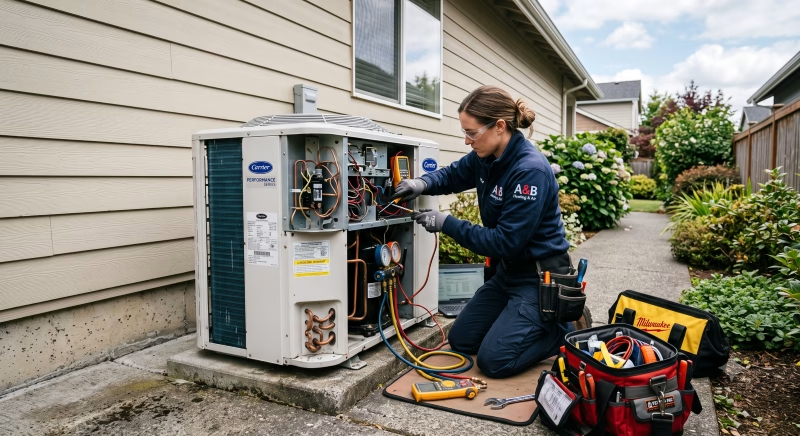
Short cycling is a common performance issue that can occur even after a carefully planned heat pump installation. It is especially likely in well-insulated homes, where low heat demand may fall below the system’s minimum output, causing the unit to start and stop more frequently than intended.
What Heat Pump Short Cycling Looks Like
Heat pump short cycling occurs when the unit starts, runs for only a brief period, shuts down, and then restarts soon afterward. The system completes many short operating cycles instead of running steadily for longer periods. The important detail is not simply that the unit cycles, since all heat pumps may cycle under some conditions. The concern is a persistent pattern of brief runs that prevents the system from settling into stable operation.
A homeowner may notice the outdoor unit repeatedly starting and stopping, frequent changes in fan or compressor noise, rooms warming unevenly, or the thermostat reaching its target temperature very quickly before calling for heat again. Other signs include rapid changes in radiator or floor temperature, frequent thermostat clicks, noticeable indoor temperature swings, and a high compressor-start count in the service menu. When a heat pump keeps turning on and off throughout the day, recording the timing and surrounding conditions can help identify whether the pattern is abnormal.
Repeated operating periods of only a few minutes, followed by similarly short pauses, deserve investigation. A single short cycle does not automatically indicate a fault. Heat pumps may run briefly during mild weather, hot-water production, defrost recovery, or certain control sequences. Concern is warranted when short cycles happen repeatedly over long periods, especially when each heating run lasts only a few minutes. Persistent heat pump short cycling may point to a mismatch between the unit’s output and the amount of heat the building or heating system can absorb.
It is also worth checking that the compressor is actually stopping. Changes in fan speed, circulation-pump operation, and defrost activity can sound like cycling even when the compressor is still operating normally.
How Often Should A Heat Pump Cycle On And Off?
There is no universal cycle frequency that applies to every heat pump, building, and weather condition. Normal cycling depends on outdoor temperature, building heat loss, heat-pump type, minimum compressor output, control settings, water volume, and the number of active emitters.
A correctly designed system usually runs for relatively long periods, particularly during colder weather. Inverter-driven heat pumps may operate continuously for hours while adjusting their output to match the building’s heat loss. During very mild weather, even a properly sized heat pump may reach its minimum output limit and switch off occasionally.
As a general diagnostic guide, repeated heating cycles shorter than about 10 minutes deserve investigation, especially when they continue for hours. Cycles lasting 20 minutes or longer are usually more favorable, although operating conditions and manufacturer guidance must be considered. A small number of longer cycles during mild weather may be completely normal.
The number of starts per hour is also useful. Several compressor starts within an hour may indicate a problem if the pattern continues regularly. Installers should assess cycle duration, starts per hour, flow temperature, outdoor temperature, heat demand, compressor modulation, thermostat behavior, and the reason each cycle ended rather than relying on one fixed threshold. This wider assessment is essential because a short cycling heat pump may be responding to hydraulic or control conditions rather than a fault in the heat pump itself.
Why Insulated Homes Face Heat Pump Short Cycling
A highly insulated building loses heat slowly, so its heating demand can be extremely low during much of the year. This is beneficial for energy use, but it creates a control challenge when the heat pump’s minimum output is higher than the building’s current heat requirement.
For example, a well-insulated home may need only 1.5 kW of heat on a mild day, while the heat pump may be unable to modulate below 3 kW. Once it reaches its lowest compressor speed, it cannot reduce heat production any further. The unit then supplies heat faster than the building can absorb it. The target room temperature or water temperature is reached quickly, the compressor stops, and the cycle begins again after temperatures fall slightly. Under these conditions, heat pump short cycling can occur even when the equipment is operating according to its controls.
This problem can be especially pronounced in compact homes, highly airtight buildings, Passivhaus-level properties, and homes where solar gain or internal heat from occupants and appliances already covers part of the heating demand.
Low-temperature heating systems can reduce this risk by providing a large active heat-emitting area. Problems become more likely when only a few rooms are being heated, thermostatic valves are closed, or a zoning system sharply reduces the active load.
How An Oversized Heat Pump Causes Short Cycling
An oversized heat pump has a maximum output that exceeds the building’s design requirement and often has a minimum output that is too high during milder conditions.
Heat pump sizing should account for modulation range, not only maximum capacity. A unit rated at 10 kW may appear acceptable for a building with an 8 kW peak heat loss, yet it may still perform poorly if its minimum stable output is 4 kW and the building frequently needs only 1 or 2 kW. In practice, an oversized heat pump may therefore struggle most during spring and autumn rather than during the coldest part of winter.
When the heat pump cannot reduce its output far enough, it delivers heat faster than the building and heating system can absorb it. The heating water temperature rises quickly, the controller reaches its setpoint, stops the compressor, and restarts it once the water or room temperature falls. A small system water volume, limited emitter area, closed valves, narrow thermostat differential, or restricted flow can make each cycle even shorter. This combination often produces the familiar pattern in which the heat pump keeps turning on and off despite an ongoing requirement for space heating.
A unit can therefore be adequately sized for the coldest day and still behave as oversized during most of the year.
Oversizing can result from using outdated rules of thumb, adding large safety margins, relying on boiler sizing conventions, or calculating heat loss with unrealistic assumptions about ventilation, indoor temperature, or building fabric.
Is It Better To Oversize Or Undersize A Heat Pump?
Heat pumps should be sized from a room-by-room or whole-building heat-loss calculation, supported by local design temperatures and accurate information about the property.
Sizing should consider both ends of the operating range: the heat required on the coldest day and the minimum heat the building needs during mild weather.
Oversizing increases the risk of short cycling, unstable flow temperatures, unnecessary capital cost, lower seasonal efficiency, greater electrical demand, and excessive compressor starts. It may also make the system harder to balance because the heat pump delivers energy faster than the emitters can release it and may require additional hydraulic components to create enough active water volume. Selecting an oversized heat pump solely to provide a large safety margin can therefore create avoidable performance problems.
Undersizing can lead to long operating hours, slow recovery after temperature setbacks, reduced comfort during the coldest weather, and increased use of immersion heaters or other backup heat sources. A severely undersized system may be unable to maintain the desired indoor temperature at design conditions.
A modest degree of undersizing can sometimes be intentional when occasional backup heat is acceptable and the aim is to improve operation across the majority of the heating season. This requires careful modelling. Deliberate oversizing may also be justified in limited cases, such as unusual hot-water demand or future building changes, but the minimum modulation limit and hydraulic design must still support stable operation.
The best result comes from accurate sizing based on a proper heat-loss calculation, realistic design temperatures, and the heat pump’s published performance at the intended flow temperature.
What Else Causes A Short Cycling Heat Pump?
A heat pump can be correctly sized for the whole building and still short-cycle when the active heating load becomes too small. This means a short cycling heat pump should not automatically be treated as evidence that the original unit selection was incorrect.
Zoning controls may shut off large sections of the system after individual areas reach temperature. Closed thermostatic radiator valves reduce both heat-emitter capacity and water flow. A system with many small zones may leave the heat pump serving only one room or one short underfloor loop.
Low water volume allows the system temperature to change very quickly. When only a small amount of water is circulating, the heat pump may reach its target flow temperature before the building has absorbed much energy. The compressor then stops even though some rooms may still require heat.
The relevant quantity is the active system volume and active emitter capacity at that moment, not the total installed volume. A large heating system can behave like a very small one when most zones are closed.
Minimum flow rate is equally important. Restricted flow can create a rapid temperature rise across the heat pump, trigger high-temperature limits, or cause unstable control. Hydraulic separation, automatic bypass valves, volumisers, buffer tanks, permanently open circuits, and suitable zoning strategies can help, but each measure should be selected according to the system design rather than added automatically.
How Heat Pump Short Cycling Affects Performance And Lifespan
Short cycling can create noticeable temperature swings because heat is delivered in bursts rather than at a steady rate. Some rooms may overheat quickly, while others remain cooler because the system stops before heat is distributed evenly. Some emitters may warm before others, and the thermostat may repeatedly overshoot and undershoot its target.
Efficiency may fall because each start involves a period of less stable operation. The heat pump spends more time starting, stopping, and recovering instead of operating near its efficient steady-state condition. Frequent cycling may also push the system toward higher flow temperatures, especially when controls respond aggressively to falling room temperature. The impact varies by heat pump type and control strategy, but persistent short cycling generally reduces seasonal performance.
Energy bills can rise through reduced seasonal efficiency, unnecessary circulation-pump operation, repeated use of backup heaters, poor weather compensation, and control settings that compensate for poor heat delivery by raising water temperature. A cycling system may also produce more noise, which can be disruptive when the outdoor unit is close to bedrooms or neighboring properties.
Frequent starts increase mechanical and electrical stress on the compressor and related components. Modern inverter compressors are designed to tolerate normal cycling, but excessive starts may still accelerate wear on contactors, bearings, valves, and power electronics. Short cycling can also increase the likelihood of nuisance faults and reduce the time available for proper oil return in some systems.
How To Diagnose Why A Heat Pump Keeps Turning On And Off
Diagnosis should begin with measured operating data rather than assumptions. The installer should first identify exactly what ends the heating cycle. The compressor may be stopping because the room thermostat is satisfied, the target flow temperature has been reached, a zone has closed, a safety limit has activated, domestic-hot-water priority has started, or a fault has occurred.
Useful information includes compressor run time, pause time, starts per hour, outdoor temperature, room temperature, target and actual flow temperature, return temperature, system flow rate, compressor frequency, active zones, electrical input, room-temperature demand, and the number of open heating circuits. These measurements help explain why a heat pump keeps turning on and off and whether the shutdown signal comes from the room controls, water-temperature controls, or a protective limit.
A rapid rise in flow temperature usually points toward low water volume, restricted flow, excessive output, or too little active emitter area. A slow, stable temperature rise followed by a room-thermostat shutdown points more strongly toward control strategy, thermostat location, or low building demand.
The installer should compare the building’s current heat demand with the heat pump’s minimum output at the relevant outdoor and water temperatures. If the minimum output is consistently higher than the active load, oversizing or excessive zoning is likely.
The heating curve and control logic should then be reviewed. A flow-temperature target that is too high can cause rapid shutdown. A narrow control differential, poorly located room thermostat, aggressive night setback, incorrect anti-cycle settings, or conflicting third-party controls can also create repeated starts.
Hydraulic checks should confirm adequate flow rate, correct pump settings, clean strainers, open valves, balanced circuits, sufficient active emitter area, and enough system water volume. The installer should measure the temperature difference between flow and return and compare it with the manufacturer’s expected range. Commissioning checks should also cover sensor placement and maximum flow-temperature limits.
Other possible causes include faulty sensors, incorrect sensor placement, refrigerant problems, air in the system, blocked filters, frozen or restricted outdoor coils, defrost faults, hot-water control issues, and communication errors between the heat pump and external controls.
A useful diagnostic process is to temporarily open all heating circuits, disable unnecessary zoning, lower the heating curve, and observe whether cycle length improves. Changes should be made in a controlled sequence so the effect of each adjustment can be identified.
How To Fix A Short Cycling Heat Pump
The most effective remedy depends on what is ending the cycle. Before changing components, the cause of a short cycling heat pump should be confirmed using operating data and system measurements.
The first step is to reduce unnecessary flow temperature. Weather compensation should be adjusted so the heat pump produces only the water temperature required to maintain comfort. Lower flow temperatures often increase run time, improve efficiency, and reduce rapid setpoint overshoot.
The system should provide a sufficiently large active heating area. More emitters can remain open, thermostatic radiator valves can be set less aggressively, and small zones can be combined where practical. A central thermostat should not repeatedly shut down the entire system while other areas still need heat.
Control settings may also need adjustment. Increasing the thermostat differential, extending minimum run time, increasing anti-cycle time, reducing setback temperatures, and allowing steadier operation can reduce compressor starts. All changes must remain within the manufacturer’s permitted settings.
Hydraulic improvements may include increasing water volume with a volumiser, correcting pump speed, cleaning filters, balancing circuits, increasing pipe flow, or removing air. A buffer tank can help when the system has many independently controlled zones, although poor buffer design can increase heat loss and reduce efficiency.
Where the heat pump is oversized, output limiting may be available through installer settings or manufacturer controls. Some units allow maximum compressor frequency or heating capacity to be restricted. This will not always reduce the unit’s minimum output, but it may improve control stability in certain systems.
Adding emitter capacity can also help. Larger radiators, additional underfloor loops, or fan-assisted emitters allow the building to absorb heat at lower water temperatures and can extend cycle length.
The repair should match the measured cause. Systems with restricted flow need hydraulic correction. Systems with disappearing zones need control changes. Systems with excessive minimum output need more active load, more usable water volume, or manufacturer-approved output management.
A buffer tank will not correct a faulty sensor, and wider thermostat settings will not solve inadequate flow. Reliable improvement comes from combining operating data, heat-loss calculations, hydraulic checks, and control optimisation.