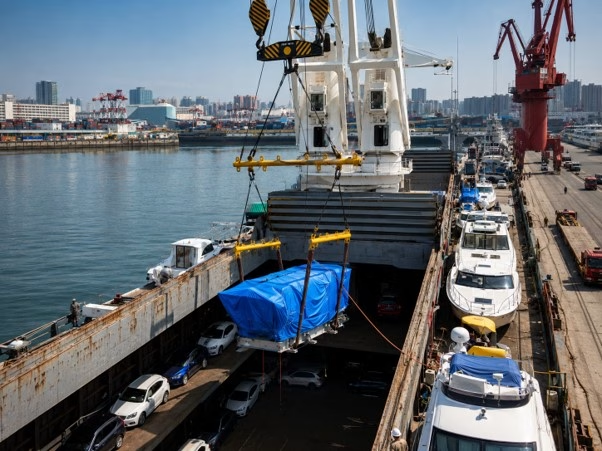
Major infrastructure projects are usually measured by what happens on the construction site: foundations completed, bridges assembled, turbines installed or production lines commissioned. Yet some of the most consequential delays occur long before the equipment reaches the site.
For oversized and heavy cargo, the logistics chain often begins months before physical transportation. Vessel availability, port limitations, lifting arrangements, cargo readiness and inland access can all affect the construction schedule. If these factors are considered only after equipment has been manufactured, the project may face additional costs, unsuitable transport options and missed delivery windows.
The central lesson is straightforward: transportation should be integrated into project planning before the cargo is ready to move.
Heavy equipment is not standard freight
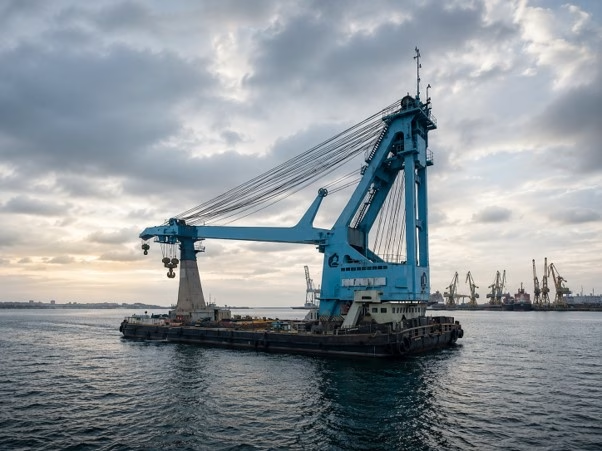
Industrial machinery, transformers, generators, construction equipment and prefabricated structures cannot always be transported through standard container services. Their weight, dimensions or lifting requirements may require breakbulk transportation, a multipurpose vessel or a dedicated heavy-lift solution.
The correct option depends on more than the overall size of the shipment. Each item must be assessed according to:
- Gross weight and dimensions
- Centre of gravity
- Available lifting points
- Sensitivity to weather and moisture
- Supporting structure and permissible contact loads
- Required lifting equipment
- Possibility of partial disassembly
- Loading and discharge methods
A machine that appears straightforward in an equipment list may become considerably more complicated once its lifting drawings and structural limitations are reviewed.
For example, a heavy unit may fit within a vessel’s cargo hold but still be unsuitable because the ship’s cranes cannot achieve the required lifting capacity at the necessary outreach. Alternatively, the vessel may be technically capable of carrying the cargo, but the nominated port may lack the required shore cranes or sufficient quay strength.
These are not details that should be resolved after a vessel has been booked.
Vessel selection affects the entire operation
Selecting a vessel for project cargo is not simply a matter of finding sufficient deadweight or cargo space. The ship must be evaluated against the intended loading, carriage and discharge operation.
Relevant considerations include hatch dimensions, deck strength, hold configuration, crane capacity, crane outreach, stability requirements and the availability of suitable securing points. When tandem lifting is required, the combined capacity of two cranes cannot automatically be treated as the safe lifting capacity. The operation must comply with the vessel’s approved limitations and an appropriate lifting plan.
The positioning of the cargo aboard the vessel also matters. A heavy item may require a specific location to maintain stability and distribute weight safely. That location may influence the stowage of other cargo and reduce the vessel’s effective carrying capacity.
Consequently, the cheapest vessel quotation is not necessarily the most economical solution. A lower freight rate can be offset by additional engineering, floating cranes, cargo rehandling, longer port stays or changes to the inland transport plan.
Professional project cargo chartering therefore requires coordination between cargo owners, engineers, shipbrokers, vessel operators, ports and lifting specialists before the fixture is concluded.
Port capability must be confirmed early
A suitable vessel does not guarantee a workable shipment. Both the loading and discharge ports must be able to accommodate the proposed operation.
This involves confirming water depth, berth availability, quay restrictions, working hours, crane availability and local safety requirements. Some ports may handle heavy cargo regularly, while others require special arrangements, temporary reinforcement or external lifting equipment.
The nominated terminal must also have sufficient space to receive, store and manoeuvre the cargo. Oversized units cannot always wait alongside the vessel, particularly where terminals have limited storage areas or strict rules governing heavy transport vehicles.
At the discharge port, the challenge may be even greater. The cargo could arrive before the construction site is ready, or the terminal may impose a limited period for removing it from the port. If suitable trailers, cranes or permits are unavailable, storage and handling costs can accumulate quickly.
Early port assessment allows alternative terminals to be considered before the commercial and construction schedules become fixed.
The factory gate is part of the maritime plan
The maritime voyage is only one part of the logistics chain. Heavy equipment must first travel from the manufacturing facility to the loading port and, after discharge, from the destination port to the construction site.
Road restrictions, bridge capacities, overhead power lines, tunnel clearances and turning radiuses may determine how large an item can be transported. In some cases, the equipment must be shipped in smaller sections because the complete unit cannot reach or leave the port.
This means that decisions made during engineering and manufacturing can directly affect vessel chartering. A relatively small design change—such as adding certified lifting points or allowing a component to be separated—may create more transportation options and reduce the cost of the shipment.
Conversely, completing production without considering the transport route can leave the project dependent on specialised equipment or a very limited selection of vessels.
Cargo readiness must match vessel timing
Project schedules often establish a target delivery date without sufficiently accounting for vessel availability. Unlike liner services, suitable multipurpose and heavy-lift vessels may not call at the required ports on fixed weekly schedules.
Their availability depends on current employment, geographical position, previous commitments and the time needed to reach the loading port. A vessel that is commercially attractive today may not remain available while production is delayed.
Cargo readiness dates should therefore be realistic and supported by evidence. Before fixing a vessel, the shipowner may require confirmation that the cargo has been completed, inspected and released for shipment.
If the vessel arrives and the cargo is not ready, the consequences can include detention, demurrage or the loss of the booking altogether. The resulting disruption can extend beyond freight costs because the vessel delay may affect installation teams, cranes and contractors waiting at the destination.
A reliable schedule should include time for final manufacturing, testing, packing, documentation, export formalities and delivery to the port—not only the expected factory completion date.
Documentation delays can stop physical operations
Even when the vessel and cargo are ready, incomplete documentation may prevent loading or discharge.
Typical requirements can include packing lists, technical drawings, lifting plans, certificates of origin, customs documents and details of hazardous components. Accurate weights and dimensions are essential. Estimates used during preliminary planning must be replaced with verified information before the final operation is arranged.
Errors discovered at the port may require revised engineering calculations or new approvals. For heavy cargo, even a modest difference between the declared and actual weight can affect the lifting method and safe working limits.
Documentation should therefore develop alongside the physical cargo rather than being prepared at the last moment.
Early coordination protects the construction schedule
The most effective project cargo operations are planned as one connected process. Manufacturing, inland transport, port handling, vessel chartering and site delivery should not be managed as isolated contracts with incompatible schedules.
Early coordination makes it possible to identify restrictions while alternatives are still available. It allows the project team to compare ports, vessel types, lifting methods and cargo configurations before committing to a particular solution.
This does not mean that every detail can be fixed months in advance. Freight markets and vessel positions change continuously. However, the technical requirements and realistic transportation options can be established early, enabling the actual vessel search to begin at the appropriate time.
The cost of this preparation is usually modest compared with the consequences of discovering that completed equipment cannot be lifted by the booked vessel, handled at the selected port or transported along the intended road.
Conclusion
Heavy equipment logistics can influence an infrastructure project well before construction begins. Vessel specifications, port capabilities, lifting arrangements, cargo readiness and inland access all form part of the same operational chain.
When transportation is treated as a late procurement exercise, the project becomes vulnerable to limited vessel availability, technical changes and avoidable delays. When logistics specialists are involved during the planning stage, the cargo can be designed, documented and scheduled around realistic transport conditions.
Successful delivery begins not when the equipment leaves the factory, but when the project team first determines how it will reach its destination.
Author biography
Konstantin Kalnyi is the CEO and Founder of Kiev Shipping Ltd, an independent shipbroker established in 2000. He has more than 25 years of experience in ship chartering, maritime brokerage and commercial ship management. Kiev Shipping Ltd has arranged more than 350 voyages involving dry bulk, breakbulk and project cargo.