In today’s rapidly evolving manufacturing landscape, companies are constantly seeking production methods that offer efficiency, reliability, and scalability. One proven solution that continues to support organizations of all sizes is injection molding for any business. This manufacturing process provides outstanding flexibility, precision, and cost-effectiveness, making it suitable for startups, growing companies, and established enterprises alike.
As market competition increases, businesses require production solutions that can deliver consistent quality while controlling costs. Injection molding has become one of the world’s most trusted manufacturing methods due to its ability to create complex components quickly and accurately across various industries.
Understanding the Injection Molding Process
Injection molding is a manufacturing technique that transforms raw plastic materials into finished products through a highly controlled process. Plastic resin is heated until molten and then injected under pressure into specially designed molds. Once cooled and solidified, the finished parts are removed and prepared for their intended applications.
The manufacturing cycle generally includes several important stages:
- Material preparation
- Plastic melting
- Injection into the mold
- Cooling and solidification
- Component removal
- Quality verification
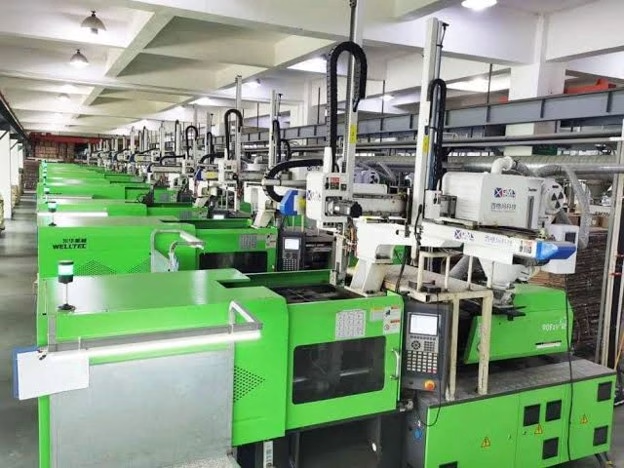
Modern manufacturing facilities often employ advanced machinery and automation technologies to ensure precise production and maintain high-quality standards throughout every production run.
Why Businesses Choose Injection Molding
Organizations across numerous industries select injection molding because it offers multiple operational and financial benefits. Its ability to support large-scale production while maintaining accuracy makes it one of the most efficient manufacturing methods available.
Cost Efficiency at Scale
While the creation of molds requires an upfront investment, the manufacturing cost per unit decreases significantly as production quantities increase. This makes injection molding particularly attractive for businesses planning medium- to high-volume manufacturing operations.
Exceptional Product Consistency
One of the greatest advantages of injection molding is its ability to produce identical components repeatedly. Precision tooling and automated equipment help ensure every product meets exact specifications and quality requirements.
Design Flexibility
Advanced injection molding techniques allow manufacturers to create highly detailed parts with complex shapes, textured surfaces, and intricate features. This design flexibility gives businesses greater freedom during product development.
Reduced Material Waste
Compared to many other manufacturing methods, injection molding generates relatively little waste. Excess material can often be recycled and reused, helping businesses improve sustainability while reducing production expenses.
Industries That Benefit from Injection Molding
The versatility of injection molding makes it valuable for a wide range of industries. Businesses in many sectors depend on this process to manufacture reliable, high-quality components.
Automotive Manufacturing
Automotive companies utilize injection molding to create various components, including dashboard elements, interior panels, fasteners, housings, and functional mechanical parts. The process delivers the precision and durability required by the transportation industry.
Medical and Healthcare
Medical manufacturers rely heavily on injection molding to produce equipment housings, disposable medical products, diagnostic devices, and laboratory components that require strict quality control and precision.
Consumer Products
Many household and personal products are manufactured using injection molding. Storage containers, toys, kitchen accessories, electronic devices, and appliance components are common examples.
Electronics Industry
Electronic products require lightweight, durable, and accurately manufactured components. Injection molding supports the production of protective housings, connectors, switches, and numerous internal parts.
Industrial Equipment
Manufacturers of industrial machinery use injection molding to produce specialized components, safety equipment, fluid system parts, and durable production accessories.
The Importance of Material Selection
Selecting the appropriate material is essential to the success of any injection molding project. Different applications require specific characteristics such as strength, flexibility, temperature resistance, chemical resistance, or impact durability.
Common materials used in injection molding include:
- Polypropylene
- Polyethylene
- ABS
- Polycarbonate
- Nylon
- Acetal
- Thermoplastic elastomers
Working closely with engineering and manufacturing specialists during the design phase helps businesses choose materials that meet both performance requirements and budget objectives.
How Injection Molding Supports Business Growth
Injection molding provides companies with significant opportunities for long-term growth and expansion. The ability to increase production volumes efficiently allows businesses to respond quickly to changing market demands.
In addition to manufacturing services, many production partners offer additional support such as:
- Product engineering assistance
- Prototype development
- Tooling maintenance
- Assembly solutions
- Packaging services
- Supply chain management
These additional services help streamline operations and enable businesses to focus on innovation, marketing, and customer relationships.
Quality Control and Manufacturing Standards
Maintaining product quality is a critical aspect of successful injection molding operations. Manufacturers implement rigorous quality assurance procedures to ensure every component meets required standards.
Quality management processes commonly include:
- Raw material inspection
- Tool validation
- Production monitoring
- Dimensional analysis
- Performance testing
- Statistical quality evaluation
Strong quality control systems help reduce defects, improve customer satisfaction, and strengthen a company’s competitive position.
The Future of Injection Molding Technology
Injection molding continues to evolve through advancements in automation, robotics, artificial intelligence, and smart manufacturing systems. These innovations increase production efficiency, reduce costs, and improve product consistency.
Sustainability has also become a major focus within the industry. Manufacturers are increasingly adopting recycled materials, energy-efficient equipment, and environmentally responsible production methods to support modern business objectives.
As demand for customized products and efficient manufacturing solutions continues to grow, injection molding will remain an essential technology for businesses around the world.
Conclusion
For organizations seeking a dependable, scalable, and cost-effective manufacturing process, injection molding offers substantial advantages. Its ability to produce high-quality components with remarkable precision and consistency makes it suitable for businesses operating in virtually every industry.
Whether manufacturing consumer products, medical devices, automotive components, or industrial equipment, companies that utilize professional injection molding solutions can improve efficiency, maintain product quality, and support long-term business growth in an increasingly competitive marketplace.