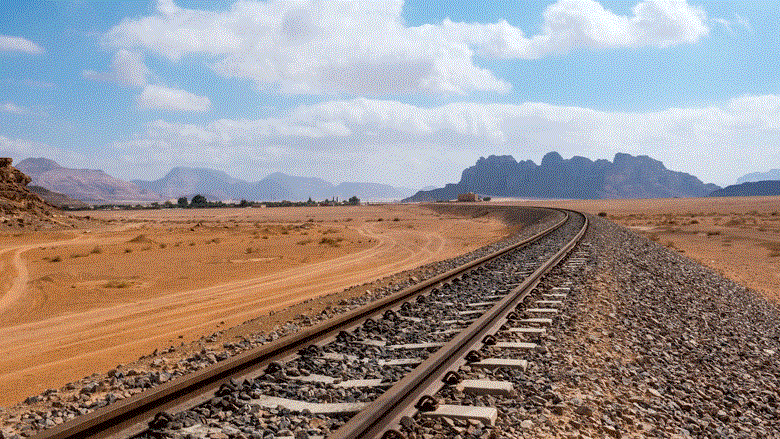
The Kuwait National Rail Road (KNRR) project, a key infrastructure pillar of Kuwait Vision 2035 and the northern terminus of the overarching 2,117-kilometer Gulf Cooperation Council (GCC) Railway network, is experiencing significant development momentum. Led by Kuwait’s Public Authority for Roads and Land Transport (PART), the public-private partnership venture carries an estimated $10 billion investment to establish an integrated passenger and freight logistics network linking domestic ports, industrial zones, and neighboring GCC states.
Progress accelerated after Kuwait’s Ministry of Public Works awarded an $8 million preliminary engineering and consultancy contract for Phase One to Turkish engineering consultancy Proyapi. Following the completion of initial design phases, Kuwait’s Municipal Council approved the official route corridor for the high-speed section. This 85-kilometer right-of-way extends from the southwestern border with Saudi Arabia to Shadadiya near Kuwait University, where a major 2 million-square-meter main passenger station is planned, forming part of a broader 500-kilometer high-speed line connecting Kuwait City to Riyadh with passenger train speeds up to 300 km/h.
Bilateral coordination with Saudi Arabia has further anchored the project’s timeline. Saudi Arabia Railways (SAR) initiated design tenders for its connecting 672-kilometer rail segment starting at Al-Khafji along the Kuwaiti border. With host construction targeted across 2028 to 2030, the KNRR aims to seamlessly integrate into the GCC-wide network by December 2030, dramatically increasing cross-border cargo throughput, cutting regional travel times, and reducing highway congestion across the Gulf.
This project showcases Middle East’s efforts in developing modern railway infrastructure. Similarly, countries such as Israel are also gearing up their railway infrastructure. Recently, Israel achieved the financial close for the Haifa-Nazareth Light Rail.
April 1, 2025
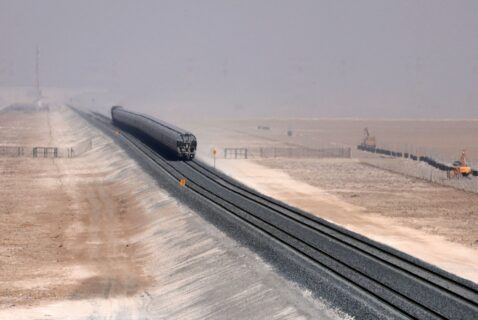
Kuwait’s Public Authority for Roads and Transportation (Part) aims to tender the Kuwait National Rail Road project this year. The authority has noted its plans to issue the tender before the end of this, according to industry sources. The contract is expected to have an estimated value of $973 million according to these sources. Furthermore, earlier this year, Part issued the designing contract of the rail road project. The contract was issued to Turkiye-based Proyapi Muhendislik ve Musavirlik Anonim Sirketi. “Proyapi is being pushed very hard on the design for this project,” one source noted. They also noted that the company is preparing tender document and Part has clearly noted that it wants the invitation to bid issued this tear. Originally, Part had wanted to use a build-operate-transfer (BOT) model for the contract. However, they have now decided that an engineering, procurement and construction contract is suitable.
Also read:
The Mega Gulf Railway Project: A Quarter-Trillion-Dollar Project Endeavor
The Scope of Implementation on the Kuwait National Rail Road Project
The scope of the main contract on the Kuwait National Rail Road Project entails various phases of implementation. These include civil works, the installation of tracks and the provision of trains. The railway project forms part of the GCC railway project. The GCC railway project have been commencing rapidly following the signing of the Al-Ula declaration. The declaration was signed by the six member states involved in the project in January 2021.

One source noted that, “A lot of work has been done on the wider regional project.” Furthermore, he noted that because of this progress, Kuwait is under pressure from its neighbors to move their end of the project. The GCC railway network is expected to be completed by 2030. Once completed, the railway will span 2,177 kilometers, linking many Gulf countries via the railway line. For instance, it will link Kuwait City in the north to Oman in the South.
Project Factsheet
Project Name: Kuwait National Rail Road (KNRR) / Kuwait National Railway Network
Managing Authority: Public Authority for Roads and Land Transport (PART) / Ministry of Public Works (Kuwait)
Delivery Model: Public-Private Partnership (PPP) / Build-Operate-Transfer (BOT)
Project Value: Estimated $10 billion (Total Network & Systems)
Consultancy and Design Partner: Proyapı Engineering and Consultancy Inc.
Technical & Network Specifications
- Total Mainline Length: 575 km total planned network
- GCC Component (Phase One): 111 km (Connecting Saudi border at Nuwaiseeb to Kuwait City / Shadadiya)
- Boubyan Port Component: 154 km
- Iraq Connection Component: 53 km
- Future Extensions and Feeder Lines: 257 km (Connecting Shuwaikh Port, Shuaiba Port, Abdaly, and Salmi)
Traffic Operational Type: Mixed Traffic (Passenger and Freight operations)
Design Speeds:
- High-Speed Passenger Rail: Up to 200 km/h (up to 300 km/h on dedicated Riyadh link)
- Freight Rail: Up to 120 km/h
Technological and Signaling Standards:
- Signaling System: European Rail Traffic Management System (ERTMS Level 2)
- Telecommunication: GSM-R and fiber optic backbone infrastructure
- Interoperable with GCC Railway Common Guidelines
Key Infrastructure and Facilities
Shadadiya Main Terminal: 2 million square meters central passenger station near Kuwait University.
Support Facilities:
- Operational Control Center (OCC)
- Main Freight Yard and Border Siding Facilities
- Rolling Stock Maintenance Workshops and Infrastructure Depots
Key Timeline & Operational Goals
- Project Phase: Detailed Design & Preparation of CAPEX/OPEX Analysis (Post-Concept approval)
- Main Construction Window: Target across 2028 to 2030
- Target Commercial Completion: December 2030 (Aligned with full GCC Railway operation)
Regional and Economic Impact
Regional Connectivity: Establishes direct high-speed freight and passenger links to Saudi Arabia (Al-Khafji/Riyadh) and broader GCC markets.
Economic Alignment: Supports Kuwait Vision 2035 by linking commercial sea ports (Boubyan, Shuwaikh, Shuaiba) directly to inland logistics hubs.
Environmental Impact: Diverts heavy freight cargo from roads, significantly curbing highway congestion and carbon emissions across northern Gulf corridors.
Project Team
Public Authority for Roads and Land Transport (PART) / Ministry of Public Works: Project Sponsor & Authority
Proyapı Engineering & Consultancy Inc.: Lead Master Design & Technical Consultant
Saudi Arabia Railways (SAR): Regional Border and Interconnection Partner
Kuwait Municipal Council: Urban Planning and Right-of-Way Authority
GCC Railway: Authority Regional Oversight Body
Also read:



Leave a Reply