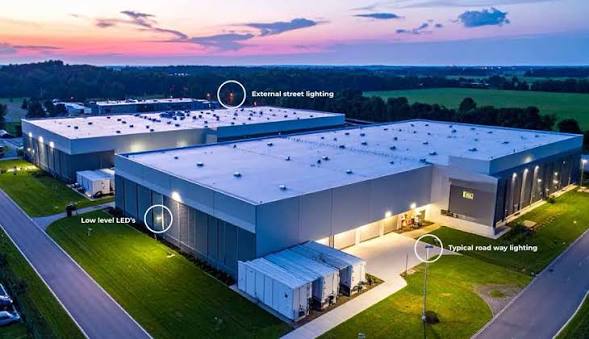
Larbert data centre campus plans could transform a long-unused Scottish employment site into a 300MW hyperscale facility. The proposed construction would occupy about 18.92 hectares at Glenbervie Business Centre, Larbert. Developers have submitted the project to Falkirk Council for full planning approval. The scheme carries estimated capital expenditure of £2.1 billion.
The proposal also positions the campus as a major new digital infrastructure development in Scotland. Apatura says the project could attract almost £1 billion in direct inward investment. However, the planning statement gives a broader £2.1 billion capital expenditure figure.
Larbert Data Centre Campus enters planning
The planning application covers two hyperscale data centre buildings with combined utility demand of approximately 300MW. Together, they would provide about 128,863 square metres of gross internal area.
Each building would rise to 25 metres, while generator flues would reach approximately 28 metres. The scheme would also include loading areas, offices, data halls and emergency backup generators.
Furthermore, the development would include a new 11,500-square-metre electricity substation. The substation would contain transformers, switchgear and supporting electrical infrastructure.
Scottish Power Energy Networks would serve as the electricity distribution network operator for the site. The private substation would receive power through two 275kV transmission circuits. Four transformers would support the site’s internal 33kV network.
The project would connect to the consented 400MW Glenside Farm battery energy storage system. That facility sits approximately 2.5 kilometres north of the proposed campus.
Scotland’s data-centre construction pipeline is also expanding elsewhere, with the proposed Cato Data Centre in Fife targeting 600MW of capacity and around £5 billion in investment. The project has sparked local concerns over its scale, energy demand and proximity to Auchtertool.
Larbert Data Centre Campus focuses on energy and heat reuse
The proposed campus would use closed-loop cooling across its data halls. Water would circulate through sealed systems rather than being continually discharged.
Meanwhile, the design allows future recovery of waste heat from the data centre. Heat exchangers and heat pumps could eventually transfer that energy into a district heating network.
However, the planning documents confirm that no heat off-taker currently exists. Until a future connection becomes available, cooling systems would dissipate heat through air-cooled chillers.
The campus also includes biodiversity improvements, landscaping and sustainable drainage infrastructure. New pedestrian routes would support walking, running and dog walking around the development.
In addition, the project targets a minimum BREEAM Very Good standard. The planning package includes environmental, ecological, transport and climate assessments.
The project could also deliver substantial employment during construction and operations. Apatura estimates more than 5,000 construction jobs annually during the build period. It expects more than 1,300 long-term skilled roles once operations begin.
The planning statement gives a different employment measure. It forecasts approximately 8,655 construction job-years and around 1,400 permanent jobs.
The development targets first power and operational activity from 2028, subject to planning and delivery.
Planning officials have already treated the proposal as major infrastructure requiring detailed environmental assessment. Falkirk Council issued its EIA screening opinion in August 2025.
The application remains under consideration by Falkirk Council. A September 2026 council agenda listed the proposal for a pre-determination hearing.
The project therefore represents a significant construction pipeline opportunity for Scotland’s digital infrastructure market. Its combination of hyperscale computing, grid infrastructure and potential heat recovery gives the proposal a broad infrastructure footprint.

Also read: 80,000sq-m Spango Valley Data Center and 99MW BESS Projects Planned at Former IBM Site in Scotland
Project Fact Sheet
Project: Larbert Data Centre Campus
Location: Glenbervie Business Centre, Larbert, Falkirk, Scotland
Site area: Approximately 18.92 hectares, or about 46.8 acres
Planning application: P/26/0237/FUL
Applicant: Apatura DC Project 5 Ltd
Developer: Apatura
Planned capacity: Approximately 300MW utility demand
Data centre buildings: Two
Combined gross internal area: Approximately 128,863 square metres
Building height: Approximately 25 metres
Generator flue height: Approximately 28 metres
Electricity substation: Approximately 11,500 square metres
Capital expenditure: Approximately £2.1 billion, about $2.8 billion
Direct inward investment: Nearly £1 billion
Construction employment: More than 5,000 jobs annually, according to Apatura
Construction employment assessment: Approximately 8,655 job-years
Operational employment: More than 1,300 roles, with planning documents estimating around 1,400
Target operations: 2028
Cooling system: Closed-loop water cooling with air-cooled chillers
Battery integration: Planned connection to the consented 400MW Glenside Farm BESS
Grid infrastructure: Two private 275kV transmission circuits and a private 33kV network
Transformers: Four 150MVA transformers
Sustainability: Target minimum BREEAM Very Good standard
Heat recovery: Infrastructure designed for future district heating integration
Backup power: Generators supported by underground diesel storage
Diesel storage: Designed for an expected 48-hour supply
Primary access: Stirling Road/Bellsdyke Road roundabout
Secondary access: Existing Glenbervie Business Centre road
Planning authority: Falkirk Council
Land allocation: Business and industrial use under Falkirk Local Development Plan 2
Planning status: Full planning application under consideration
Project Team
Applicant: Apatura DC Project 5 Ltd
Developer: Apatura
Landowner: Scottish Enterprise
Planning consultant: AAH Consultants
Lead design and engineering consultant: WSP
Design and Access Statement: WSP
Environmental Impact Assessment: WSP
Transport Assessment: WSP
Flood Risk Assessment: WSP
Landscape and Visual Impact Assessment: AAH Consultants
Biodiversity and ecological assessments: R & D Ecology
Economic Impact Assessment: GLIC
BREEAM pre-assessment: WSP
Fire Strategy: WSP under RIBA Stage 2
Electricity distribution network operator: Scottish Power Energy Networks
Battery energy storage integration: Glenside Farm BESS
Planning authority: Falkirk Council



Leave a Reply