
Spango valley data center plans could transform Greenock’s former IBM site into a major digital infrastructure project. Slate Island Developments Ltd has submitted plans to Inverclyde Council for the scheme. The proposal covers approximately 80,000 square meters of data center floor space across four buildings. A separate 99MW battery energy storage system would support the wider development. The proposals target a long-vacant brownfield site that once supported major technology manufacturing.
The development sits at Spango Valley, south of the A78 Inverkip Road in south-west Greenock. IBM operated its technology and manufacturing facility there from the 1950s. IBM closed the facility in 2017, while contractors cleared the remaining buildings in 2020.
The latest proposal would replace an earlier residential-led development strategy for the site. Previous planning approvals allowed a mixed-use development with up to 450 homes. However, the owners failed to secure a viable end user for that scheme.
Spango Valley Data Center Project Targets Brownfield Regeneration
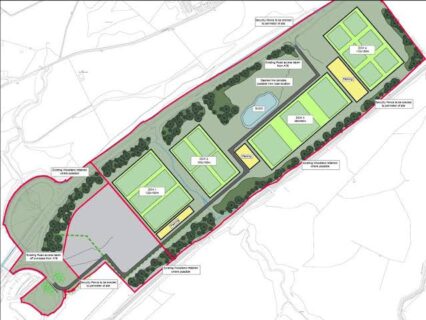
The proposed Spango valley data center would introduce four buildings with around 80,000 square meters of floor space. Indicative plans also place the buildings at a maximum height of about 18 meters. The development would include access roads, parking, hard standing, security fencing and landscaping.
The scheme would also incorporate sustainable drainage infrastructure and control facilities. Developers intend to retain most existing woodland, particularly around the site boundaries. Therefore, the project combines digital infrastructure with brownfield regeneration and landscape retention.
Slate Island Developments plans to seek Planning Permission in Principle for the data center. This approach would establish key development parameters before detailed design work begins. A later approval would confirm building footprints, heights, materials and other detailed elements.
The proposed site offers a large, flat brownfield area suitable for large-floorplate development. The developer also cites strong national demand for data center facilities. Furthermore, the existing site benefits from established utility connections because of its industrial history.
The development also aligns with Scotland’s wider push for green digital infrastructure. National Planning Framework 4 gives national development status to major green data centers. However, the project must still address environmental and planning requirements.
The debate surrounding Scotland’s expanding data center pipeline also extends to Fife, where the proposed Cato development has faced significant community opposition. The Cato Data Centre Project in Scotland would add another major hyper scale facility to the country’s growing digital infrastructure landscape.
Spango Valley Data Center Project Links with 99MW BESS
The wider scheme includes a proposed battery energy storage system with approximately 99MW capacity. The BESS would sit alongside the data center and support its energy requirements.
The battery system would store electricity during periods of lower demand. It could then release stored power when demand increases. According to the developer, this arrangement could ease pressure on the grid. It could also help reduce operating costs for the data center.
The proposed BESS would include battery units and a 132kV substation. It would also include DNO and 33kV control rooms. Other infrastructure includes inverter and transformer equipment, security systems and a 120,000-litre water tank. The plans also include a SuDS pond, access, parking and landscaping.
The BESS requires a separate Section 36 consent under the Electricity Act 1989. The Scottish Government Energy Consents Unit would handle that application. Inverclyde Council would participate as a key consultee. The developer intends to progress both applications alongside each other.
Meanwhile, the project team continues technical assessments covering transport, ecology, noise and air quality. It also assesses landscape, flood risk, drainage and arboriculture. Updated assessments will accompany the relevant planning applications.
The project timetable targets planning determination in November 2026. Public consultation events took place in March and April 2026. The Proposal of Application Notice reached Inverclyde Council on 27 February 2026.
The proposed developments would add another major digital infrastructure scheme to Scotland’s growing data center pipeline. Its brownfield setting also contrasts with the controversial Hertfordshire development, where the £3.75 billion DC01UK project gained approval despite strong local opposition over its Green Belt location. The Hertfordshire scheme covers an 85-acre site and plans approximately 2 million square feet of data center space.
That comparison highlights a key difference between the two developments. While DC01UK will transform undeveloped Green Belt land, the Spango Valley proposal would repurpose a former IBM industrial site. The Scottish project therefore positions brownfield regeneration as part of its case for delivering new digital infrastructure.
Also read: £2bn Essex Data Center Project Delayed as UK Grid Bottlenecks Reshape AI Infrastructure
Project Fact Sheet
Name: Spango Valley Data Center and Battery Energy Storage System Project.
Location: Spango Valley, Inverkip Road, Greenock, Scotland.
Development type: Data center and battery energy storage infrastructure.
Developer: Slate Island Developments Ltd.
Data center floor space: Approximately 80,000 square meters.
Data center buildings: Four.
Indicative building height: Approximately 18 meters.
BESS capacity: Approximately 99MW.
Former site use: IBM technology and manufacturing facility.
IBM operations: From the 1950s until 2017.
Site clearance: Former IBM buildings demolished in 2020.
Previous approval: Mixed-use development including up to 450 homes.
Current planning route: Planning Permission in Principle.
BESS consent route: Section 36 application.
Planning authority: Inverclyde Council.
BESS consenting authority: Scottish Government Energy Consents Unit.
Site access: Access from the A78 and associated road infrastructure.
Data center infrastructure: Buildings, hard standing, parking, security and landscaping.
Drainage infrastructure: Sustainable drainage systems and attenuation facilities.
BESS infrastructure: Battery units, 132kV substation, control rooms and transformers.
Environmental measures: Woodland retention, ecological mitigation and biodiversity enhancement.
Target planning determination: November 2026.
Project Team
Developer: Slate Island Developments Ltd.
Landowners: Sandy Easdale and James Easdale.
Planning consultant: Pegasus Group.
Planning statement: Pegasus Group.
Design and access statement: Pegasus Group.
Pre-application consultation report: Pegasus Group.
Landscape and visual appraisal: Pegasus Group.
Transport assessment: SYSTRA.
Preliminary ecological appraisal: EnviroCentre.
Biodiversity enhancement plan: EnviroCentre.
Noise impact assessment: EnviroCentre.
Tree survey and arboricultural assessment: EnviroCentre.
Flood risk assessment: EnviroCentre.
Drainage impact assessment: EnviroCentre.
Air quality assessment: EnviroCentre.
Data centre planning authority: Inverclyde Council.
BESS consenting authority: Scottish Government Energy Consents Unit.
Transport consultation: Transport Scotland.
Previous marketing advice: Savills.

Leave a Reply